









Mysuru: Preparations for the first-ever Mysuru Dasara Kambala are progressing at Sathagalli, with organisers planning a trial run involving five to six pairs of buffaloes on September 20 or 21. The trial will be used to assess the condition of the racing track, its surface and boundaries ahead of the main event scheduled for October 18 and 19.
The traditional buffalo race of coastal Karnataka is being introduced as part of the Mysuru Dasara celebrations this year. The event is being organised near the Visvesvaraya Technological University (VTU) Regional Centre along the Outer Ring Road at Sathagalli.
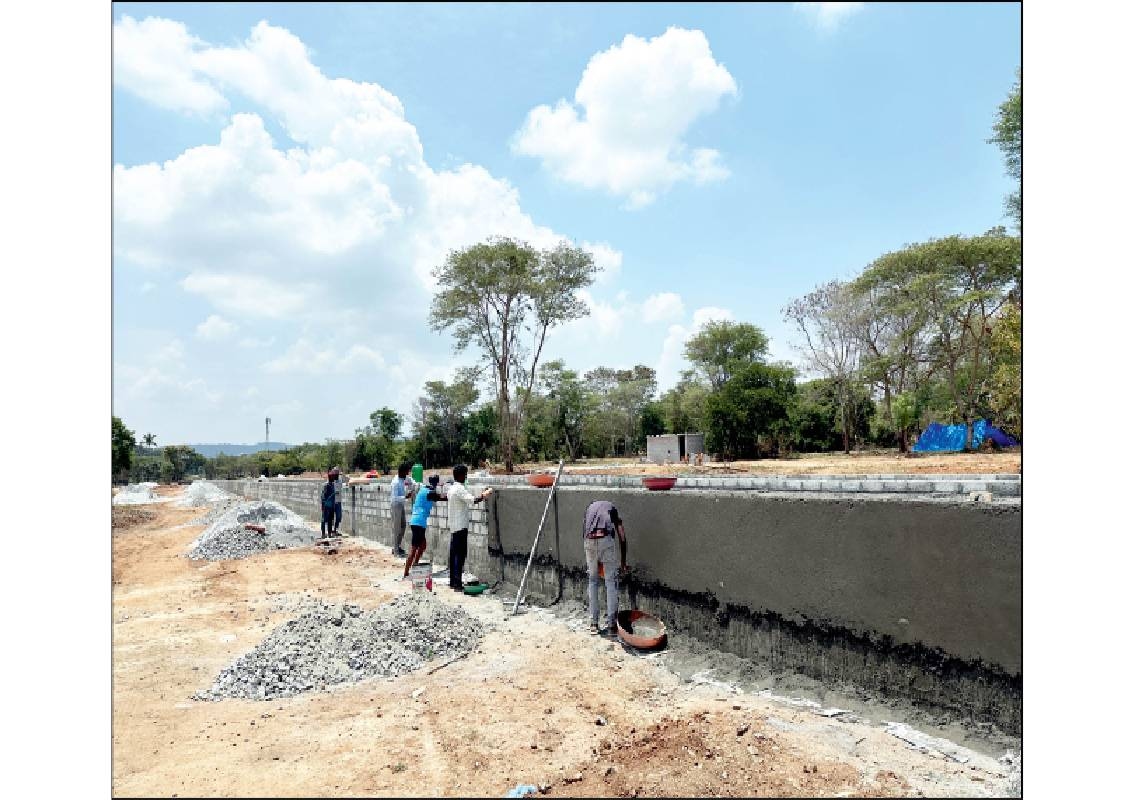
With infrastructure work progressing at the venue, workers are preparing the racing tracks, spectator facilities, food courts, sanitation arrangements and parking areas. The trial run is expected to provide organisers with an opportunity to identify and address any shortcomings before the two-day competition.
Trial run planned with five to six buffalo pairs
According to the latest preparations, a trial race involving around five to six pairs of buffaloes is proposed for September 20 or 21. The exercise will focus on the condition of the track and whether its surface and boundaries are suitable for the races.
The Kambala venue is spread across a portion of around 17 acres and 35 guntas of Mysuru Development Authority land. The land, covering Survey Nos. 85, 88, 106 and 107, has been handed over to the Department of Youth Empowerment and Sports for the event.
The ground is currently being cleared of shrubs and vegetation. Uneven portions, including fields and bunds, are also being levelled to prepare the venue.
Two parallel tracks being prepared
Two parallel tracks are being constructed for the buffalo races. The traditional Kambala track, known as the ‘kare’, requires a mixture of soil, sand and water to create the slush surface needed for the race.
Workers are taking care to remove stones and other hard materials from the track, as these could potentially cause injuries to the racing buffaloes.
Cement-brick barricades approximately three feet high are being constructed on either side and in the centre of the racing area. The barricades extend for nearly 150 metres, while the space between them, measuring about six metres, will serve as the slush racing track.
Workers with experience in preparing Kambala tracks have been brought from the coastal region to undertake the work.
Water arrangements made for the Kambala track
A substantial quantity of water will be required to prepare and maintain the slush track. To meet the requirement, borewells have been drilled at the venue and pipelines have been laid for irrigation.
A large water storage tank is also being constructed at the site. The water will be used to create the slush surface and maintain the tracks during the event.
Water arrangements are also being made specifically for the participating buffaloes. According to organisers, teams will bring drinking water from coastal Karnataka rather than depending on local sources.
The water is expected to be transported in 200-litre drums in the teams’ tempos. Organisers said the measure was being taken keeping the health of the animals in mind and to minimise the possibility of infections. Each buffalo is estimated to consume around 25 litres of water per feeding.
Around 130 pairs registered for the event
The response to the first Mysuru Dasara Kambala has been significant, with around 130 pairs of racing buffaloes registered for the two-day event.
The competition is planned to continue during both daytime and night-time. Areas from which the buffaloes will be released are being marked, while barricades are being erected along the racing tracks to regulate the event and improve safety arrangements for both animals and spectators.
The participation of teams from coastal Karnataka is expected to bring the traditional Kambala atmosphere to Mysuru during the Dasara season.
Main Kambala event on October 18 and 19
The first-ever Mysuru Dasara Kambala is scheduled for October 18 and 19 at the Sathagalli venue. The event forms part of the wider Mysuru Dasara celebrations.
The introduction of Kambala in Mysuru has also generated public debate. Farmers’ groups and environmental organisations have raised concerns about the use of water and expenditure associated with the event, particularly in the context of reported water shortages in parts of Karnataka.
Supporters, meanwhile, have described the event as an opportunity to bring the traditional coastal sport to a wider audience. The debate has therefore extended beyond the race itself to questions concerning culture, resources and the organisation of major public festivals.
Trial run to test preparations before Dasara
The proposed September 20 or 21 trial run will be an important stage in the preparations. It will allow organisers to examine the track after water and slush are added and assess the boundaries and other infrastructure under conditions closer to those expected during the actual competition.
With the main event less than a month away, work on the venue is being carried out on multiple fronts. The organisers will also need to ensure that spectator facilities, sanitation, parking and animal-related arrangements are ready before the competition begins.
The trial run is thus expected to provide a practical assessment of the venue before the October 18–19 Mysuru Dasara Kambala.