







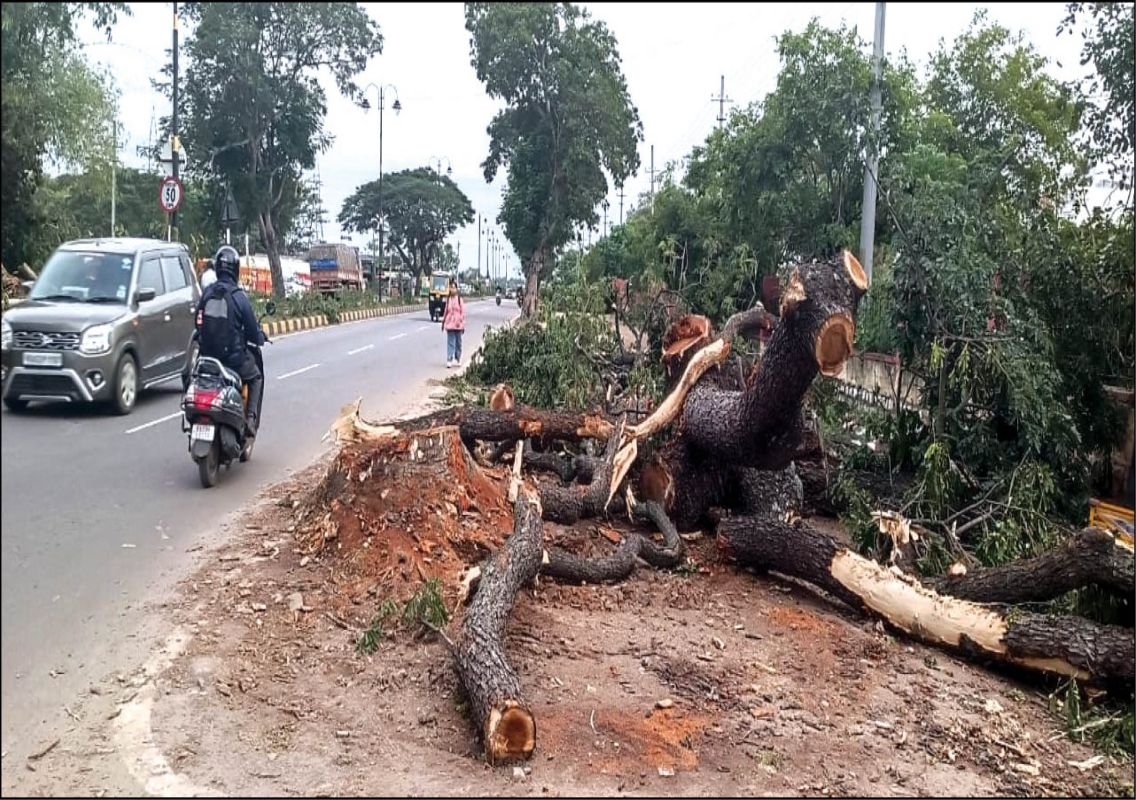


Mysuru: Seven more trees have been cut along the Mysuru-Bengaluru Highway as construction work on the flyover near Manipal Hospital junction, also known as Kempegowda Circle, progresses. The latest tree felling comes just days after 10 trees were cut at the same location on August 25, bringing the number of trees removed in the recent phase of the project to 17.
The flyover is being constructed at one of Mysuru’s important traffic junctions, where the Mysuru-Bengaluru Highway meets the city’s road network. The project is intended to improve traffic movement at Kempegowda Circle, but the removal of trees has continued to draw attention because of concerns over Mysuru’s green cover.
According to Star of Mysore, the seven trees were cut on both sides of the highway on Thursday. The Forest Department has approved the cutting of more than 65 trees required for constructing the flyover ramp at the Manipal Hospital junction. The work is being carried out by Maharashtra-based D.B. Ghorpade and Associates, which has been awarded the contract.
The contractor has also been assigned the responsibility of clearing the site and undertaking tree transplantation wherever possible.
Seven more trees removed after August 25 felling
The latest tree removal follows the cutting of 10 trees on August 25 for the same flyover project.
The earlier felling had already attracted opposition from environmentalists and green activists, who questioned whether all the trees identified for removal were essential for the infrastructure work.
The 10 trees cut earlier included species such as Hippe, also known as Indian Butter Tree, Akash Mallige or Indian Cork Tree, Beete or Indian Rosewood and Hebbevu. The Forest Department had earlier stated that efforts would be made to remove only trees considered unavoidable for the project.
The latest seven-tree removal indicates that the project has now entered another stage in which trees obstructing the construction of ramps and associated structures are being cleared.
Forest Department had approved cutting of over 65 trees
The Forest Department had initially been presented with a much larger list of trees potentially affected by the project.
A total of 347 trees belonging to 21 species had been marked for cutting across different locations connected with the city’s road infrastructure projects. These included 19 trees near Fountain Circle in Siddique Nagar, 256 trees in and around Bannimantap Park, 52 trees along Hunsur Road and 20 trees along Nanjangud Road.
Following scrutiny and discussions involving officials, engineers and environmentalists, the Forest Department decided that a significantly smaller number could be felled for the flyover project.
The department approved the cutting of more than 65 trees while plans were made to transplant a substantial number of others.
The decision was intended to balance the requirements of infrastructure development with the need to retain as much of the city’s existing green cover as possible.
Tree transplantation planned for several trees
While some trees have already been removed, efforts are also underway to transplant trees that can survive relocation.
Amit, Horticulture Manager of D.B. Ghorpade and Associates, told Star of Mysore that trees marked for shifting between Manipal Hospital junction and JSS Pharmacy College are being prepared for transplantation.
The roots of the trees are being covered with gunny bags and watered regularly to retain moisture until they are shifted.
According to the report, at least 30 trees are expected to be transplanted after pruning. Mysuru City Corporation has identified alternative locations where these trees can be relocated.
The success of such transplantation will depend on several factors, including the species, age, health and condition of each tree, as well as how carefully the root systems are handled during the process.
Earlier plans sought to save more trees
The latest developments come after efforts were made earlier to reduce the number of trees that would have to be removed.
In July, the National Highways Authority of India agreed to modify the flyover design at Kempegowda Circle to save an estimated 50 to 80 trees. The revised plan involved narrowing and slightly modifying the alignment of the flyover ramp from the Bannimantap side towards Bengaluru.
The supporting pillars were also proposed to be repositioned to protect a section of Bannimantap Park and its trees.
During a joint site inspection, officials from the Forest Department, NHAI and environmental groups examined alternatives to reduce tree loss.
The Forest Department had identified 278 trees for scientific transplantation instead of felling, while nine trees were proposed to be retained at their existing locations.
The project therefore became an example of the challenge faced by urban authorities when major infrastructure projects intersect with established green spaces.
₹63.67-crore flyover project
The flyover and underpass project at Kempegowda Circle is being implemented by the National Highways Authority of India.
Earlier reports put the project cost at ₹63.67 crore. The grade separator is intended to ease congestion at the busy junction where traffic from the Mysuru-Bengaluru Highway interacts with the Outer Ring Road and other major roads.
Kempegowda Circle, near Manipal Hospital, is an important entry and exit point for vehicles travelling between Bengaluru and Mysuru.
The project was formally moved forward after NHAI issued the work order in January 2026. Dhariwal Buildtech Limited was awarded the contract at that stage.
The infrastructure is expected to provide smoother movement for vehicles and reduce delays at the junction, particularly during peak traffic periods, weekends and holidays.
Green concerns remain a major issue
Although the flyover is intended to address traffic problems, the removal of mature trees has remained one of the biggest concerns surrounding the project.
Mysuru has long been known for its tree-lined roads and green spaces. Environmental groups have repeatedly argued that mature trees provide benefits that cannot be immediately replaced by planting new saplings.
Trees contribute to shade, temperature regulation, air quality, biodiversity and the overall character of an urban area.
The debate therefore centres not only on the number of trees being removed but also on whether alternative engineering solutions can reduce the environmental cost of infrastructure projects.
Environmentalists have previously said they are not opposed to development or improvements to traffic infrastructure. Their primary demand has been that authorities should first examine every possible option to retain trees before approving their removal.
Earlier list included 347 trees
The larger tree-felling proposal provides context to the current developments.
According to the latest report, 347 trees across 21 species had been marked for cutting in different locations. These included trees in Bannimantap, Siddique Nagar and along Hunsur and Nanjangud roads.
An earlier NHAI proposal had covered an even broader set of road infrastructure works and involved 561 trees across three stretches.
That proposal included 350 trees associated with the Kempegowda Circle flyover, along with trees identified for road widening on the Nanjangud and T. Narasipur roads.
The Forest Department had invited objections from the public before taking a final decision under the Karnataka Tree Preservation Act.
The process highlighted the growing public interest in the environmental impact of road and flyover projects in Mysuru.
Development versus conservation debate
The tree-felling issue has become part of a wider debate over how Mysuru should approach urban development.
The city needs improved road infrastructure as vehicle numbers increase and traffic volumes rise. Flyovers and grade separators can help remove bottlenecks and improve journey times.
At the same time, infrastructure projects that remove mature trees can have long-term environmental consequences.
The challenge for planners is therefore to ensure that traffic improvements do not come at an unnecessarily high ecological cost.
In the case of the Kempegowda Circle flyover, authorities have already explored modifications to save some trees and have proposed transplantation for others. However, the continued felling of trees shows that some removal remains unavoidable under the current design.
Contractor tasked with transplantation
An important aspect of the present work is that the same contractor undertaking the clearing has also been assigned the responsibility of tree transplantation.
According to the horticulture manager quoted by Star of Mysore, measures are being taken to preserve the root systems of trees identified for relocation. The roots are being protected with gunny bags and kept moist through regular watering before transplantation.
At least 30 trees are expected to be shifted to alternative sites identified by the Mysuru City Corporation.
The survival rate of transplanted trees will become an important measure of whether the conservation component of the project succeeds.
Planting new saplings is generally a longer-term process, while preserving mature trees through transplantation, where scientifically feasible, can retain some of the existing environmental benefits.
Traffic benefits remain the project’s main objective
The Kempegowda Circle flyover has been planned primarily to address traffic congestion.
The junction handles traffic moving between Mysuru city, the Bengaluru highway and other major roads. During busy periods, vehicles can face delays as traffic streams intersect at the junction.
The grade separator is expected to separate some of these movements and improve the flow of vehicles.
For motorists travelling towards Bengaluru and other destinations, a functioning flyover could reduce waiting time and improve connectivity.
The project’s supporters therefore view the infrastructure as an important improvement to Mysuru’s road network.
Environmental safeguards will be closely watched
With more trees now removed, attention is likely to remain focused on how many additional trees will be felled and how many can ultimately be transplanted.
The Forest Department’s earlier decision to limit felling and identify trees for transplantation was intended to reduce the project’s environmental impact.
The next stages will determine whether the planned transplantation is carried out successfully and whether further design changes can protect additional trees.
Environmental groups are also likely to continue monitoring the work, particularly around Bannimantap and the approaches to Kempegowda Circle.
For Mysuru residents, the issue represents a familiar challenge: improving infrastructure while protecting the green character that remains one of the city’s defining features.
Conclusion
Seven more trees have been cut along the Mysuru-Bengaluru Highway for the ongoing Kempegowda Circle flyover project, just days after 10 trees were removed on August 25. The Forest Department has approved the cutting of more than 65 trees for the flyover ramp.
At the same time, authorities and the contractor are preparing several trees for transplantation. At least 30 trees between Manipal Hospital junction and JSS Pharmacy College are expected to be pruned and shifted to alternative locations identified by the Mysuru City Corporation.
The ₹63.67-crore flyover project is aimed at easing traffic congestion at one of Mysuru’s busiest junctions. Earlier design changes were also explored to save an estimated 50 to 80 trees, highlighting efforts to balance infrastructure requirements with environmental protection.
However, the latest tree felling is likely to keep the development-versus-conservation debate alive. As construction progresses, the effectiveness of the planned transplantation and the authorities’ ability to minimise further tree loss will remain closely watched by residents and environmental groups.
For Mysuru, the challenge is not simply to build better roads but to ensure that the city’s green character is protected while its infrastructure expands.