







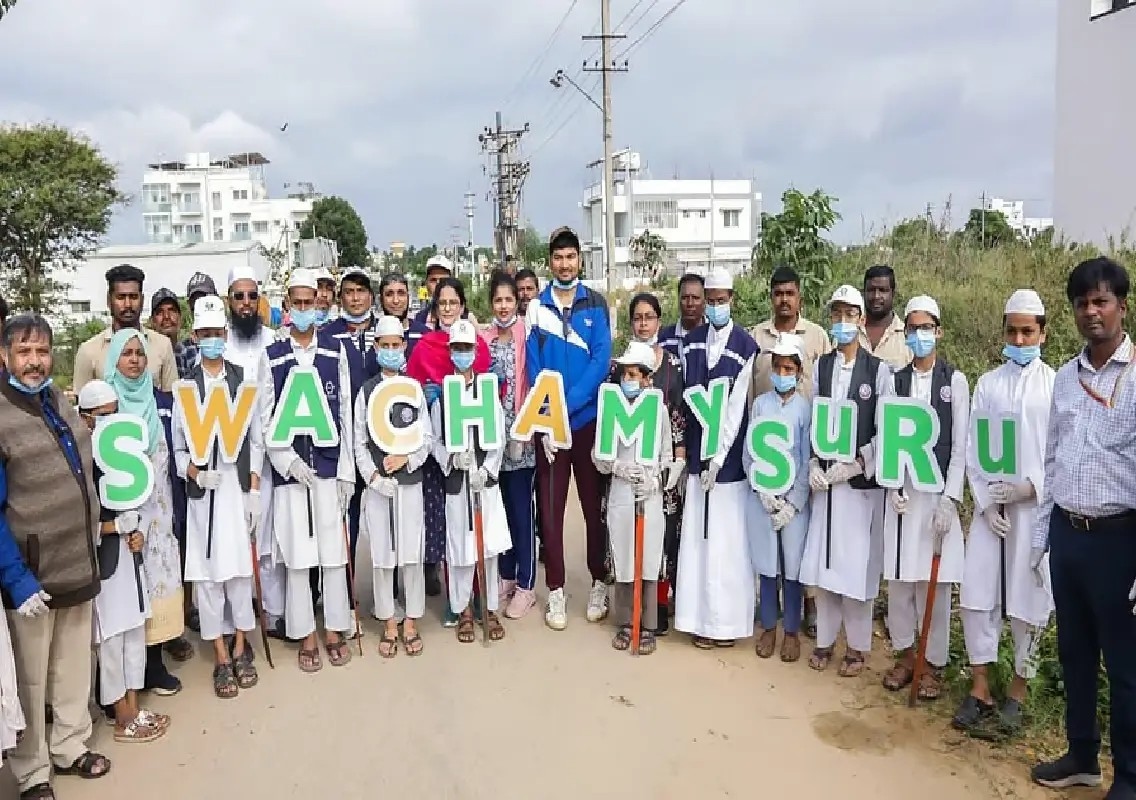


Mysuru: Mysuru City Corporation (MCC) has launched an ambitious Sustainable Waste Management System and a permanent Garbage Vulnerable Point (GVP) Management System to make the city cleaner and more sustainable.
As part of the initiative marking India’s 80th Independence Day, the civic body began a special cleanliness drive targeting 80 GVPs and aims to transform them into zero-litter zones. The initiative combines technology, staff accountability, citizen participation, source segregation and enforcement to tackle the problem of recurring waste dumping.
The MCC plans to eventually extend the system to all identified garbage vulnerable points and wards across Mysuru.
817 tonnes of waste cleared
The cleanliness drive has already produced significant results. According to the MCC, 817 tonnes of accumulated waste were cleared from 50 GVPs in around three weeks.
A total of 2,879 members of the public and representatives of various organisations joined MCC sanitation workers during the campaign. Together, they contributed around 190 hours of work between July 27 and August 14.
Several of the cleaned locations have also been beautified with attractive paintings, helping transform areas that had previously become recurring dumping spots.
The largest quantity of waste, 220 tonnes, was cleared from the Boothala ground on August 12. Another 149 tonnes was removed from the Gokulam crematorium point on August 11.
At Eden Garden in Rajiv Nagar Second Stage, 137.66 tonnes of waste was cleared on August 14, while 133 tonnes was removed from C.V. Road on August 5.
Five-pillar system for cleaner Mysuru
MCC Commissioner M.K. Savitha, who launched and is leading the initiative, said the corporation’s objective is not merely to remove accumulated waste but to establish a system that prevents garbage from returning to the same locations.
The system has been structured around five pillars, described as the five ‘Cs’:
- Clean: Remove existing accumulated waste from GVPs.
- Collect: Strengthen reliable door-to-door waste collection.
- Control: Establish a live sanitation intelligence network using technology and monitoring.
- Compel: Hold repeat and commercial offenders accountable for illegal dumping.
- Connect: Bring together citizens, resident welfare associations, businesses, NGOs and sanitation workers to focus on waste prevention.
The corporation believes the approach will shift its focus from simply clearing garbage to preventing waste from accumulating in the first place.
Live sanitation intelligence network
Technology forms a key part of the new system.
MCC plans to monitor sanitation staff attendance and vehicle movement through GPS tracking. QR codes have also been installed at GVPs to enable citizens to report complaints.
Ward-level dashboards are being developed to help officials monitor sanitation activities, while AI-powered cameras are being installed at selected vulnerable points.
The system is intended to allow officials to identify problems quickly and track whether corrective action has been taken.
The corporation is also maintaining digital profiles of individual GVPs. These profiles include the location of the point, type of waste commonly dumped there, peak dumping times, possible sources of waste and the staff responsible for collection.
GVPs classified according to severity
MCC has classified garbage vulnerable points into three categories based on the severity and frequency of littering.
Red points are chronic locations where heavy littering takes place. Orange points are areas where dumping occurs repeatedly, while Green points are locations that have come under control.
For every chronic GVP, MCC officials conduct waste-source mapping within a radius of around 100 to 200 metres.
The exercise is intended to identify where the waste is coming from and determine appropriate collection arrangements.
Once the source of the waste is identified, responsibility is assigned and collection arrangements are strengthened accordingly.
Weekly GVP scorecard introduced
The corporation has also introduced a weekly GVP scorecard to encourage continuous improvement.
Each garbage vulnerable point is assessed on several parameters, with a total score based on:
- Cleanliness – 30 marks
- Door-to-door collection – 20 marks
- No open dumping – 20 marks
- Waste segregation compliance – 10 marks
- Complaint resolution – 10 marks
The MCC plans to recognise the 10 best-performing GVPs every week.
The reward mechanism is intended to motivate sanitation staff and ward-level teams to maintain cleanliness rather than focus only on one-time clearance drives.
Rapid response team planned
The corporation also plans to establish a Garbage Hotspot Rapid Response Team.
The team will be deployed to chronic dumping locations, priority hotspots and areas where complaints require immediate attention.
The objective is to ensure that complaints are addressed quickly instead of waiting for regular sanitation vehicles or staff, which may otherwise take between two and four hours to respond.
The rapid response mechanism is expected to help prevent small dumping incidents from developing into large garbage accumulation points.
Mobile application for sanitation complaints
MCC is also planning a simple mobile application to strengthen reporting and monitoring.
Through the proposed application, supervisors will be able to report issues such as newly emerging dumping points, overflowing drains, construction debris, missed waste collection, commercial dumping, dead animals and waste burning.
Such reports can help the corporation identify sanitation problems at an early stage and assign responsibility for corrective action.
The application is expected to complement the QR-code complaint system and ward-level monitoring dashboards.
Door-to-door collection strengthened
The corporation is also focusing on improving source collection to prevent residents and businesses from resorting to open dumping.
A dashboard is being used to monitor staff attendance and the movement of collection vehicles.
GPS technology will help officers track vehicle routes and determine whether designated areas have been covered or missed.
Officials are also monitoring collection frequency, taking photographs before and after waste collection and recording action taken on complaints.
The ward officer in charge will monitor these activities and ensure that gaps in collection are addressed.
‘Adopt a GVP’ concept planned
MCC also plans to introduce an ‘Adopt a GVP’ initiative involving corporate organisations, educational institutions, resident welfare associations and NGOs.
Commissioner Savitha clarified that the initiative will not replace the statutory responsibilities of the civic body.
Instead, participating organisations can support awareness campaigns, cleanliness drives, beautification, wall art, tree plantation and citizen monitoring.
The concept is intended to encourage local communities and institutions to take ownership of the cleanliness of their surroundings while continuing to keep MCC responsible for core sanitation services.
Aim to top Swachh Survekshan
Commissioner Savitha has said the long-term objective is to maintain the GVPs and the wider city throughout the year rather than limit cleanliness efforts to special campaigns.
The initiative is also being positioned as part of Mysuru’s effort to reclaim its reputation as one of India’s cleanest cities.
The MCC hopes that sustained implementation of the new waste management system will strengthen Mysuru’s performance in the upcoming Swachh Survekshan.
The campaign’s early results, including the removal of 817 tonnes of waste and participation from nearly 2,900 volunteers, have provided momentum to the initiative.
However, the larger challenge will be preventing waste from returning to the same locations after the initial clean-up. The combination of regular door-to-door collection, technology-based monitoring, enforcement and citizen participation is therefore expected to determine whether the 80 GVPs remain permanently litter-free.
By expanding the programme from the initial 80 locations to all garbage vulnerable points and wards, MCC aims to turn the Independence Day cleanliness campaign into a permanent city-wide waste management model.