







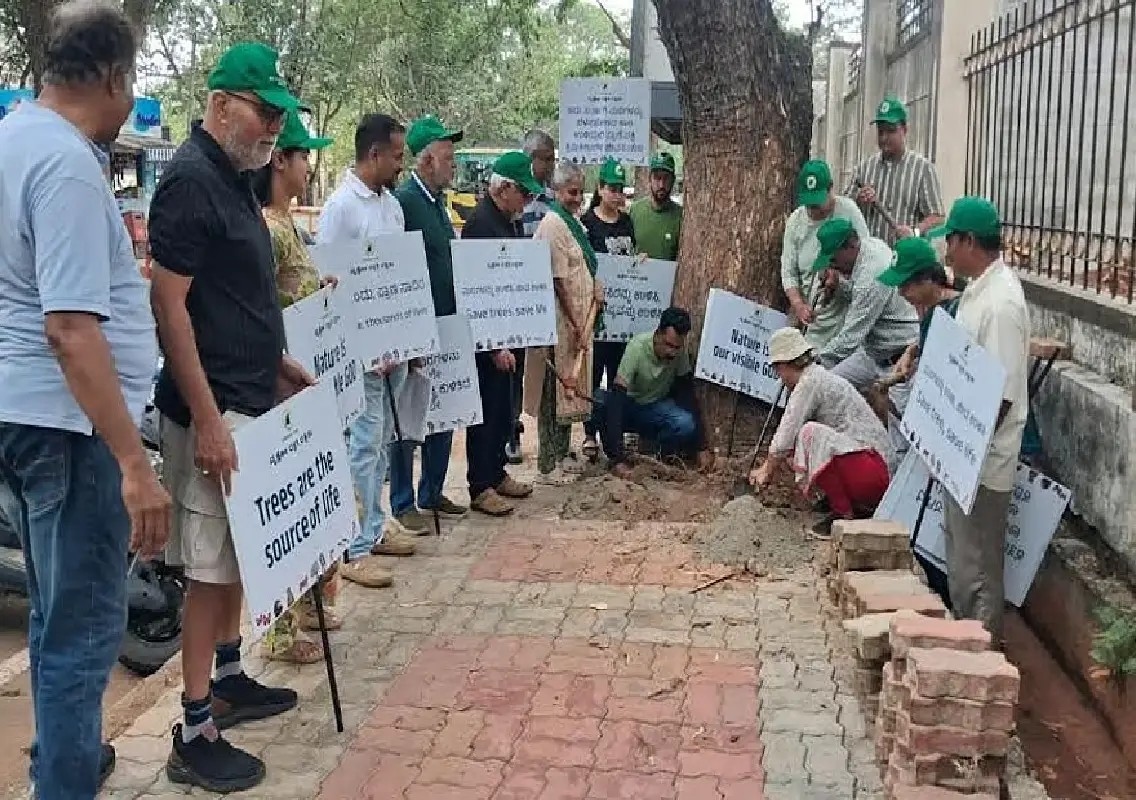


Mysuru: Even as environmentalists continue to oppose the felling of trees for infrastructure projects in Mysuru, official records reveal a sharp rise in applications from private landowners seeking permission to remove trees. The trend has sparked fresh concerns over the city’s shrinking green cover at a time when climate change, rapid urbanisation and rising temperatures are posing significant environmental challenges.
According to data from the Forest Department, members of the public have submitted 353 applications over the past four years seeking permission to fell 11,198 trees on private land across Mysuru district. During the 2025-26 financial year alone, 85 applications were received for the removal of 3,115 trees.
The figures come amid ongoing debates over balancing urban development with environmental conservation in Mysuru, a city long recognised for its tree-lined avenues, pleasant climate and heritage character.
Public applications outnumber project-related requests
The issue has gained prominence after environmental groups protested the Forest Department’s permission to fell 559 trees in Mysuru district during 2025-26 for various development projects.
However, official data indicate that requests from private individuals account for a much larger number of trees proposed for removal.
While more than 11,000 trees have been included in applications submitted by private landowners over four years, the Forest Department has approved the felling of 600 trees during the same period.
The approvals include:
- 154 trees in 2025-26
- 145 trees in 2024-25
- 181 trees in 2023-24
- 120 trees in 2022-23
Officials maintain that every application is scrutinised before permission is granted.
Experts call for scientific urban planning
Environmental expert U. N. Ravi Kumar said Mysuru’s tree cover was developed with long-term vision during the reign of the Wadiyar rulers.
He observed that unplanned and unscientific planting practices in recent decades have resulted in situations where mature trees later interfere with roads, buildings and public infrastructure, leading to requests for their removal.
He suggested that the government establish a vision group comprising environmental experts, urban planners and representatives from green organisations to scientifically plan future tree plantations.
According to him, selecting suitable tree species and appropriate planting locations would reduce the need to remove trees in future while supporting sustainable urban development.
Forest Department explains approval process
Deputy Conservator of Forests (DCF) K. Paramesha said the department plants saplings only after ensuring that no major development projects are planned at the location for at least the next 20 years.
He added that the department maintains newly planted saplings for five years and aims for a survival rate of at least 80 per cent.
Under the Karnataka Preservation of Trees Act, 1976, permission to remove trees is granted in specific situations, including road widening projects, accident black spot improvements and cases where dead or hazardous trees pose a threat to life or property.
The DCF said that although public objections are legally required only when applications involve more than 50 trees, the department has recently begun inviting public responses even for proposals involving more than 10 trees following widespread opposition to the removal of 40 Peltophorum trees on Hyder Ali Road last year.
He added that the department also attempts to save as many trees as possible through translocation and requires the planting of 10 compensatory saplings for every tree that is felled.
Awareness among residents emphasised
Environmental activist Parashuramegowda of Parisarakkaagi Naavu said many applications arise because people lack awareness about suitable tree species and scientific planting practices.
According to him, residents often seek permission to remove trees after roots damage building foundations or interfere with drainage systems, pipelines or compound walls.
He stressed the need to educate the public about selecting tree species with vertical root systems for residential areas and maintaining adequate distance between trees and buildings.
He also expressed concern that some applications are filed because trees obstruct commercial signboards, house aesthetics or create maintenance issues through falling leaves.
He urged the Forest Department to avoid granting permissions for such reasons wherever possible.
Urban expansion contributing to tree removal
Construction sector representatives noted that although Mysuru continues to expand, only around 10 per cent of sites in newly developed layouts on the city’s outskirts have been built upon.
They said vacant sites often become overgrown with bushes and trees over time, following which owners seek permission to remove vegetation before construction begins.
Parashuramegowda suggested that authorities should strictly enforce rules requiring site owners to construct buildings within the stipulated period after purchasing plots.
He also called upon local bodies to maintain vegetation on vacant public lands to prevent future conflicts over tree removal, citing areas such as Sathagalli, where development proposals including a velodrome and Kambala facilities have attracted opposition from environmental groups.
Environmentalist Ravi Bale also recommended avoiding the planting of large trees on road medians.
Instead, he suggested growing shrubs that reduce glare from oncoming vehicles while eliminating the need to remove mature trees later for road widening or flyover construction.
He referred to proposals involving the removal of 48 neem trees planted on the median of NH-275 near the Mysuru Ring Road for a proposed flyover at Devalapura Cross.
Green cover below recommended levels
According to environmental data, Mysuru currently has around 14 per cent green cover, significantly below the recommended 33 per cent. Karnataka’s overall green cover stands at approximately 21 to 22 per cent.
The city has also experienced rising temperatures, with the India Meteorological Centre recording a maximum temperature of 37.2 degrees Celsius on April 24 and 36 degrees Celsius on March 27 this year.
To strengthen oversight, DCF K. Paramesha said a proposal for constituting the long-awaited Tree Authority under the Karnataka Preservation of Trees Act, 1976, was submitted to the State Government in March.
The proposed authority would include representatives from government departments, non-governmental organisations and environmental experts to examine applications for tree felling, explore alternatives such as transplantation and minimise conflicts between development agencies and environmental groups.
Experts believe the formation of the Tree Authority will play a crucial role in ensuring that Mysuru’s future development proceeds without compromising its ecological heritage and green identity.