







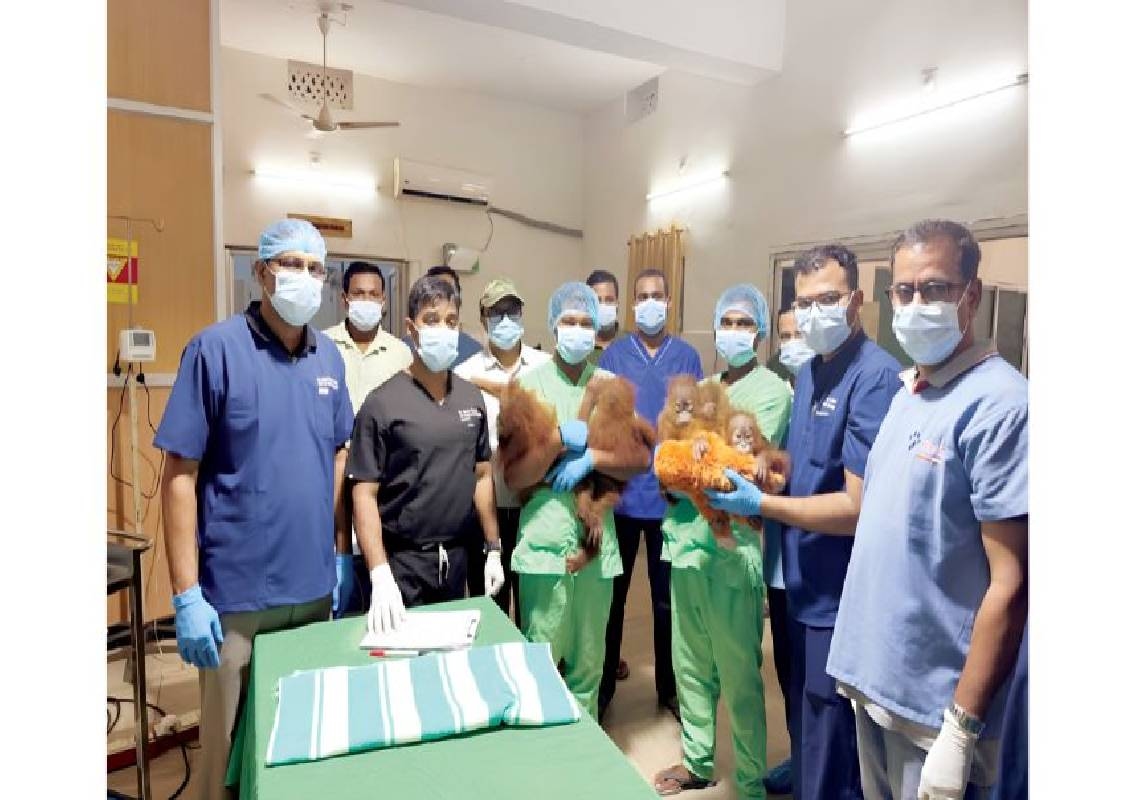


Mysuru: Two veterinarians from Mysuru Zoo have travelled to Odisha to provide specialised guidance on the care of five orphaned orangutan cubs rescued from a forest in Balasore district, where their unexpected presence has raised concerns over possible wildlife trafficking.
The five cubs were found abandoned in the Bichitrapur-Ranakatha Protected Reserve Forest near Badapai in Balasore on September 8 during a patrol by Forest Department officials. The discovery was unusual because orangutans are native to Southeast Asia, particularly the islands of Borneo and Sumatra, and are not naturally found in India.
The cubs, comprising three males and two females, were found without their mother or any adult orangutan. They were subsequently shifted to Nandankanan Zoological Park in Bhubaneswar, where they are being kept under specialised care.
Mysuru Zoo veterinarians join Odisha expert panel
Recognising Mysuru Zoo’s experience in caring for orangutans, the Odisha Government constituted a five-member technical committee to oversee the health and welfare of the rescued animals.
Mysuru Zoo veterinarians Dr Shashidhar and Dr Madan are members of the committee. The panel also includes representatives and experts from the Wildlife Institute of India, Odisha University of Agriculture and Technology and other zoological institutions.
The committee was formed to assess the welfare requirements of the infants and provide technical guidance on their upkeep. Its initial tenure is six months and can be extended if necessary, according to Odisha officials.
Dr Shashidhar and Dr Madan visited Nandankanan Zoo and shared recommendations based on Mysuru Zoo’s experience in orangutan management, veterinary care and hand-rearing.
Five cubs undergo specialised care
The rescued orangutans are currently housed in a controlled environment at Nandankanan Zoo, where they are undergoing medical observation, disease screening and acclimatisation.
Their care involves round-the-clock monitoring, specialised milk formula, medication, veterinary supervision and environmental enrichment. Toys and swings have also been provided to encourage activity and reduce stress. Temperature and humidity are being artificially regulated because the local climate is not naturally suited to the young animals.
The five cubs are believed to be from different mothers and range in age from around six months to two years. The youngest is estimated to be six to eight months old, while the oldest is around one-and-a-half to two years old, according to Dr Shashidhar.
Cubs show signs of stress and anaemia
Although the animals are generally doing well under care, the early separation from their mothers has affected their health.
Dr Shashidhar told Star of Mysore that all five cubs are experiencing stress. One has anaemia, while two others have mild-to-moderate anaemia. The remaining two are considered relatively stable.
The veterinarians have recommended appropriate milk formula and medication while closely monitoring the cubs’ health.
Special precautions are also being taken to prevent disease transmission. Primates can be susceptible to human diseases, and officials are therefore restricting the number of keepers who come into contact with the animals to minimise the possibility of cross-contamination.
How did orangutans reach Odisha?
The discovery of five young orangutans in a forest in Odisha has raised questions about how the animals reached India.
Since orangutans are not native to the country, authorities have launched an investigation into their origin and the circumstances in which they were brought to Odisha.
The Odisha Police Special Task Force and Wildlife Crime Control Bureau are investigating the circumstances surrounding the animals’ arrival in India, with possible international wildlife trafficking among the concerns being examined.
Blood samples have already been collected from the animals. Genetic sequencing is planned to help determine their exact origins, although the immediate priority remains their health and survival.
Mysuru Zoo ready to receive the cubs
Mysuru Zoo has extensive experience in caring for orangutans. The species returned to the zoo in 2021 through international animal-exchange arrangements after Mysuru had been without orangutans for several decades.
The zoo currently houses two pairs — Merlin and Atina, who came from Singapore Zoo, and Afa and Minnie, who came from Malaysia.
Given this experience, there has been speculation that the five rescued cubs could eventually be shifted to Mysuru Zoo.
However, no official decision on their relocation has been communicated so far.
Mysuru Zoo Assistant Conservator of Forests Lakshmikanth said the zoo is prepared to welcome the animals and provide specialised care, but it is awaiting confirmation from Odisha authorities regarding any possible transfer.
Dr Shashidhar also said Mysuru Zoo is fully equipped and prepared to receive the orangutans if the Government decides to relocate them.
Mysuru’s expertise in orangutan conservation
Mysuru Zoo’s involvement reflects the specialised knowledge developed by the institution in managing exotic and endangered species.
The zoo first housed orangutans in the early 1970s, when a pair popularly known as “Subba” and “Subbi” was kept there. After their deaths, the zoo remained without the species for nearly five decades before orangutans were brought back in 2021.
The institution’s experience includes veterinary care, nutrition, enrichment and hand-rearing of animals, making its veterinarians valuable members of the Odisha technical committee.
The Odisha Government has also indicated that the technical panel can consult national and international experts or organisations whenever specialised assistance is required.
Immediate focus remains on the cubs’ health
For now, authorities are concentrating on stabilising the five young orangutans rather than determining their long-term location.
Their early separation from their mothers, young age and unfamiliar environment make close veterinary monitoring essential. Officials are continuing to monitor temperature, humidity and other health parameters while ensuring that the cubs receive appropriate nutrition and medication.
The investigation into their origin is expected to provide more information about how the animals reached India. Genetic testing could also help establish their geographical origin in the future.
Until a decision is taken on their permanent rehabilitation, the technical guidance provided by Mysuru Zoo veterinarians is expected to support the cubs’ survival and recovery.
The involvement of Dr Shashidhar and Dr Madan also highlights Mysuru Zoo’s specialised role in wildlife care beyond Karnataka, particularly when rare or unusual animal rescue cases require expertise in managing exotic species.