


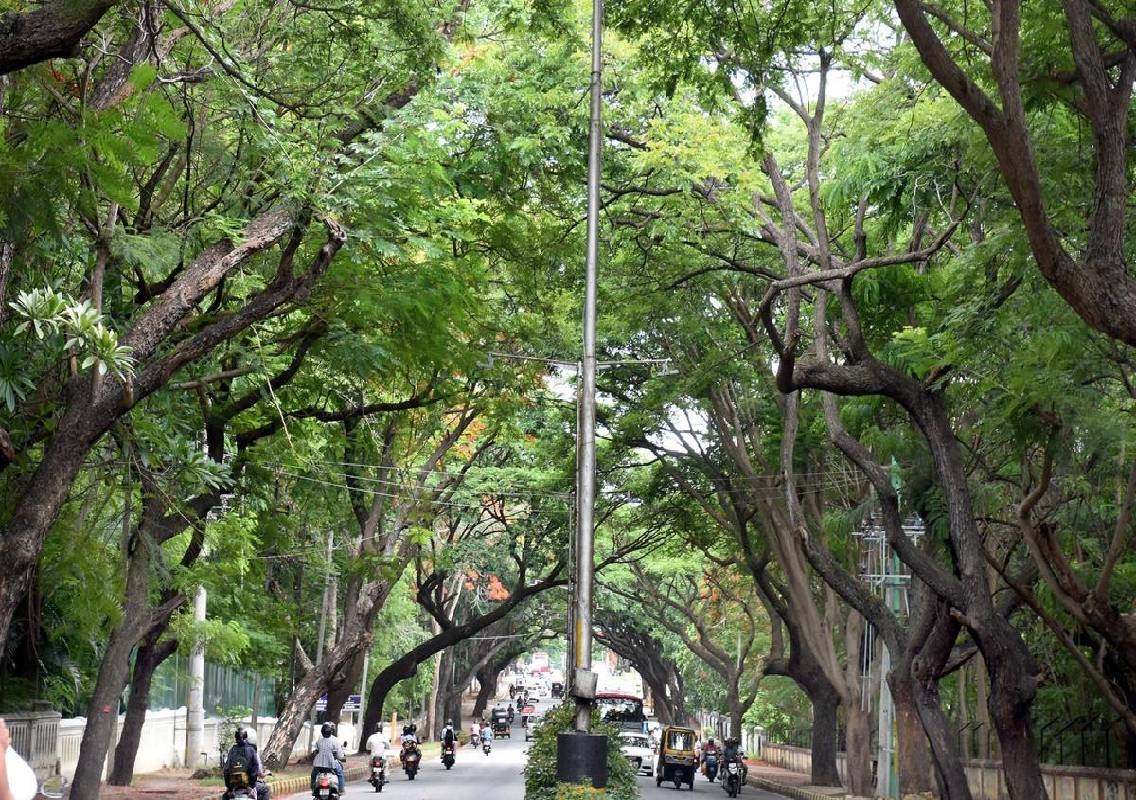


MYSURU: Mysuru’s green cover stands at just 13.3% across 65 wards under the Mysuru City Corporation (MCC), according to the city’s first tree census, NAMMARA. The findings highlight significant differences in tree distribution across neighbourhoods, with some wards recording fewer than 500 trees and several streets lacking shade trees.
The Tree Audit Report 2025–26 documented 1,17,131 plants, including 1,16,764 trees, representing more than 900 species. The city recorded a Shannon’s Diversity Index of 3.7, indicating a high level of tree-species diversity.
The findings offer a detailed picture of Mysuru’s urban greenery and provide a baseline for identifying areas that need more trees and improved green-space planning.
Green cover varies widely across wards
The census revealed substantial differences in green cover across Mysuru. Vidyaranyapuram, Ward 61, recorded the highest green cover at 28.9%, while Ajeej Seth Nagar, Ward 33, had the lowest at just 0.09%.
Other wards also recorded low green-cover levels. KN Pura, Ward 31, had 0.8%, while Gandhi Nagar, Ward 28, recorded 1%.
The figures indicate that greenery is unevenly distributed across the city. While some neighbourhoods have comparatively extensive tree cover, others have limited vegetation, potentially reducing access to shade and other benefits associated with urban trees.
Twenty wards had fewer than 500 trees each, highlighting the need to assess local requirements rather than relying only on citywide totals.
Dattagalli records highest number of trees
The census also identified significant differences in the number of trees across individual wards.
Dattagalli, Ward 46, recorded the highest number, with 8,024 trees. In contrast, Meenabazar, Ward 26, had just 105 trees.
The figures underline the concentration of trees in certain parts of Mysuru and the need to identify suitable locations for additional planting in areas with limited greenery.
Ward-level data can help civic authorities plan plantation drives more effectively by identifying neighbourhoods where tree cover is particularly low.
More than 900 species recorded
The tree census recorded more than 900 species, reflecting the diversity of Mysuru’s urban vegetation.
Vijayanagar recorded the highest species richness, with around 300 species among its 7,420 trees. Ajeej Seth Nagar had the lowest species richness, with 17 species.
The report recorded a citywide Shannon’s Diversity Index of 3.7. This index is commonly used to assess biodiversity by considering both the number of species and their relative distribution.
Maintaining a diverse urban tree population can support ecological resilience, provide habitats for birds and other wildlife, and improve the quality of public spaces.
Why urban tree cover matters
Trees play an important role in urban environments by providing shade, helping moderate local temperatures, supporting biodiversity and absorbing carbon dioxide. They can also contribute to better stormwater management and improve the experience of walking and spending time outdoors.
Neighbourhoods with limited tree cover may face greater exposure to direct sunlight, particularly along roads and in densely built-up areas. Increasing greenery in such locations can improve pedestrian comfort while contributing to the city’s environmental goals.
However, increasing tree numbers alone is not sufficient. The selection of suitable species, availability of planting space, maintenance and survival rates are also important to ensure that plantation programmes deliver lasting benefits.
Tree census provides a baseline for future planning
The NAMMARA census gives Mysuru a ward-level record of its existing trees and their distribution. Such information can help civic authorities identify areas requiring attention, plan future plantation programmes and monitor changes in urban greenery.
The findings also point to the importance of protecting existing mature trees while expanding greenery in wards with low coverage. Planting suitable species along streets and in public spaces, combined with consistent maintenance, could help address some of the gaps identified by the census.
With green cover recorded at 13.3%, the report highlights the scale of the task facing Mysuru as it seeks to maintain its environmental character while accommodating urban growth. The next challenge will be translating the census findings into targeted conservation and plantation measures across the city.