







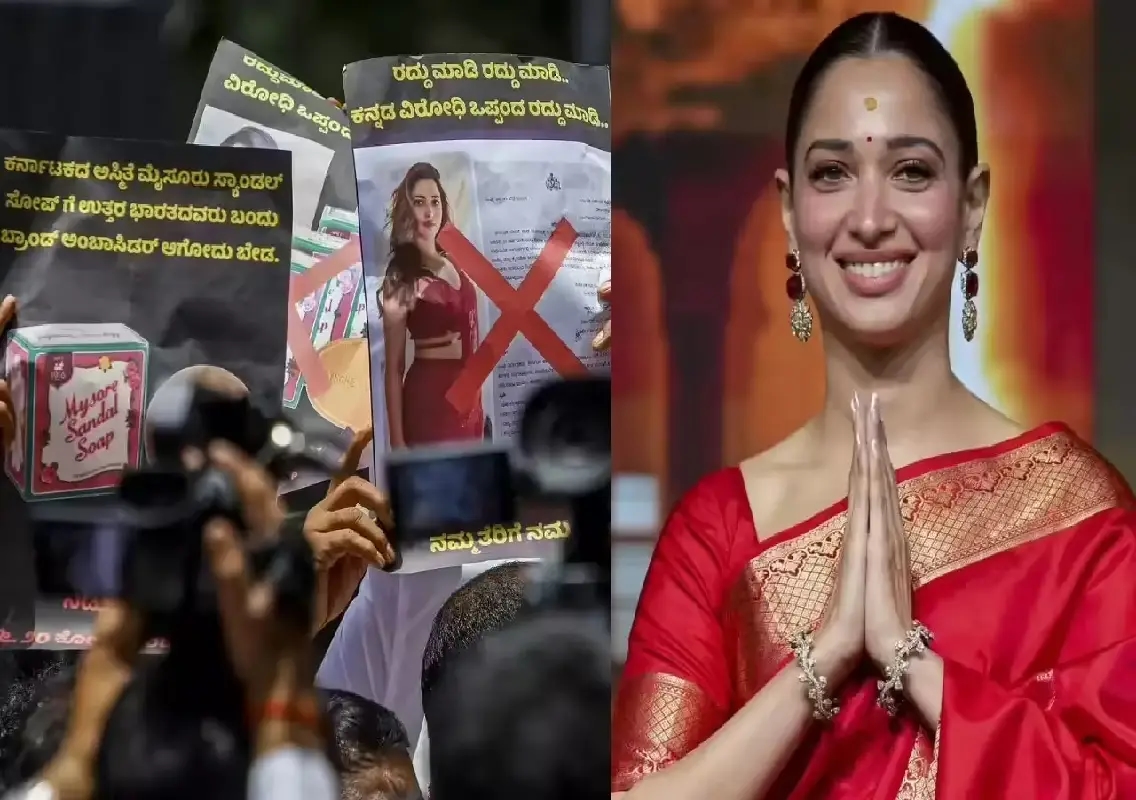


Mysuru: The appointment of actor Tamannaah Bhatia as brand ambassador of the iconic Mysuru Sandal Soap has triggered a sharp political and cultural debate, with opposition leaders and pro-Kannada groups questioning the choice and the message it sends about regional identity. What began as a branding announcement by the state-owned manufacturer has escalated into a wider argument over representation, heritage and commercial strategy.
Ambassador appointment triggers backlash
The controversy began after Karnataka Large and Medium Industries Minister MB Patil announced that Tamannaah Bhatia would serve as brand ambassador for Karnataka Soaps and Detergents Limited (KSDL) for a two-year term. The reported endorsement fee is about Rs 6.2 crore, and the agreement, finalised earlier, came into force this month.
The announcement coincided with a relaunch campaign for Mysuru Sandal Soap, including refreshed packaging and a large product line expansion. Advertising films and promotional material featuring the actor were unveiled along with nearly 60 personal care products.
Soon after, political leaders and Kannada organisations objected, arguing that a heritage brand rooted in Karnataka should be represented by a Kannada-speaking or Karnataka-based personality rather than a Mumbai-born actor.
Opposition calls move anti-Kannada
Leaders from the Bharatiya Janata Party criticised the decision, calling it insensitive to regional identity. Some MPs and MLAs alleged that the choice reflected an “anti-Kannada mindset” and overlooked well-known Kannada film actors with national visibility.
Names of several actors from the Kannada film industry were cited by critics, who argued that they have contributed to taking regional cinema to national and global audiences and would have been more culturally aligned with the brand.
Pro-Kannada groups staged protests and demonstrations, saying a legacy public-sector brand should reinforce linguistic and cultural pride instead of opting for a pan-India celebrity primarily for market reach.
A legacy brand with royal origins
The emotional response is tied to the soap’s long history. Mysuru Sandal Soap traces its origins to 1916 in the erstwhile Kingdom of Mysore under the rule of Nalwadi Krishnaraja Wadiyar. At the time, the region had abundant sandalwood reserves, but World War I disrupted exports.
To add value locally, the administration established a soap unit using pure sandalwood oil rather than exporting raw wood. The result was a premium soap that went on to become one of the few globally known products made with genuine sandalwood oil.
In 1980, operations were reorganised under KSDL, a state enterprise. Over the decades, the company expanded into detergents, cosmetics and allied goods, but the sandal soap remained its flagship product and a symbol of regional heritage and nostalgia.
Government defends marketing logic
Minister MB Patil defended the appointment, stating that the decision was driven by business strategy rather than politics. According to him, the company has set an ambitious turnover target of about Rs 5,000 crore by 2030.
KSDL’s turnover is projected at roughly Rs 2,000 crore this year, with profits reported at over Rs 500 crore. However, officials say only a limited share of sales comes from within Karnataka, with strong markets in neighbouring states and growing demand in north India and abroad.
The government argues that a brand seeking national and global expansion requires a face with cross-regional recognition. Tamannaah Bhatia, who has acted in Tamil, Telugu and Hindi films and has a strong social media following, was selected on that basis.
Officials also indicated that several potential ambassadors from Karnataka were evaluated, but some were already endorsing competing brands, making them unsuitable under marketing guidelines.
Cultural identity versus commercial expansion
Critics counter that public sector brands are not purely commercial entities and must also reflect regional culture. They argue that when a product is closely tied to state identity, ambassador choices carry symbolic weight.
Some public representatives, including members of the erstwhile Mysore royal lineage, questioned the logic of choosing a film actor at all, suggesting that a sportsperson or widely respected Kannadiga figure could have represented the brand instead.
Ministers within the ruling establishment expressed mixed views, with some defending the decision and others informally acknowledging that Kannada actors could have been considered.
Brand refresh and product expansion
Amid the controversy, KSDL is pushing ahead with a major brand transition. The company recently unveiled 57 products, including new soap variants, perfumes, sandalwood oil products, toothpaste, coconut oil, petroleum jelly and organic personal care lines.
It has also launched an e-commerce platform and strengthened distribution systems to improve delivery speed and product freshness. The new packaging and branding are aimed at younger and premium consumers who are increasingly drawn to natural and heritage-based products.
From a market perspective, the celebrity endorsement is part of a broader repositioning exercise designed to increase visibility across India and in export markets.
Debate over state-owned brand choices
The episode has reopened a larger debate: should state-owned enterprises prioritise regional representation in branding, or operate strictly on commercial metrics like reach and recall?
Supporters of the decision say business growth, exports and profitability should guide such choices. Opponents argue that cultural symbolism cannot be separated from legacy brands built with public resources.
For now, the endorsement contract remains in force and campaigns are rolling out. Whether the controversy fades or reshapes future branding decisions will depend on public response and political pressure.