







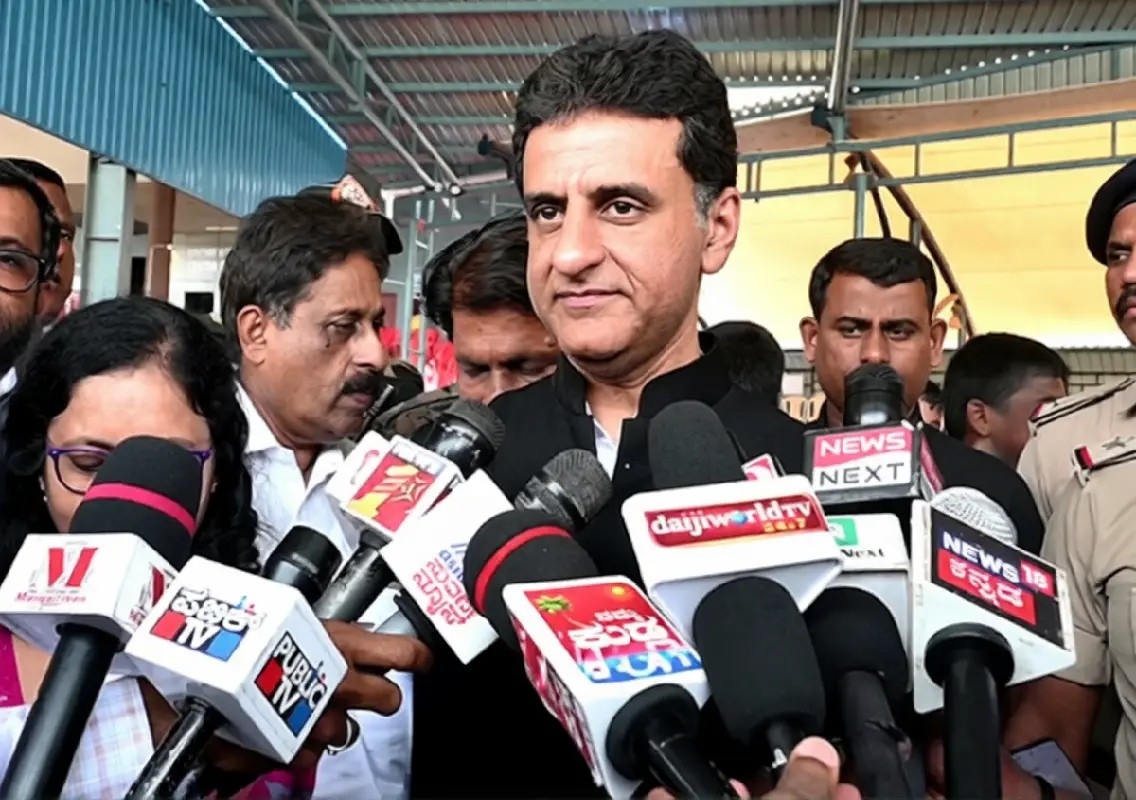


Udupi: The Karnataka government has temporarily halted the cancellation of Below Poverty Line (BPL) ration cards to allow a fresh review and verification of beneficiaries, Minister of State for Food, Civil Supplies and Consumer Affairs and Udupi district in-charge minister Rizwan Arshad said on Friday.
Addressing the media in Udupi on August 15, Arshad said the Centre had directed Karnataka to cancel around 7.59 lakh BPL ration cards, of which approximately 4 lakh cards had already been cancelled following the directions.
He said he had instructed officials to stop further cancellations temporarily and undertake proper verification before proceeding with the exercise.
Cancellation of 3.5 lakh cards put on hold
Arshad said the cancellation of approximately 3.5 lakh BPL cards had been kept on hold for the time being.
“I have directed officials to temporarily stop the process of cancellation and conduct a proper verification. No further cards should be cancelled for the time being,” he said.
The minister added that the government would discuss the next course of action at the official level after reviewing the situation.
The decision is expected to provide temporary relief to beneficiaries whose eligibility may require further examination. The verification process will seek to ensure that genuine beneficiaries are not removed from the public distribution system without proper scrutiny.
e-KYC mandated for 2.59 crore ration cards
Speaking about e-KYC, Arshad said the verification exercise for ration cards had last been completed around five years ago and that the Centre had now directed Karnataka to undertake the process again.
According to the minister, around 2.59 crore ration cards in Karnataka have to undergo e-KYC.
The exercise is intended to help the authorities identify beneficiaries who have died, people whose economic circumstances have changed and those who may have moved above the poverty line. It could also help identify cases where individuals no longer require a ration card.
Arshad called for the e-KYC exercise to be completed by September 31.
The process is expected to help the government update its beneficiary database and improve the accuracy of the public distribution system. At the same time, the temporary halt on BPL card cancellations indicates the government’s intention to undertake further verification before removing additional beneficiaries.
New BPL cards under government consideration
On the issue of issuing new BPL ration cards, Arshad said the matter would be discussed at the government level.
He noted that he had taken charge of the department only a day earlier and indicated that decisions regarding new cards would be considered after discussions within the government.
The issue of new BPL cards has remained important for families seeking access to subsidised food and other welfare benefits linked to ration cards.
Government to examine Kuchalakki rice demand
Arshad also responded to demands from coastal Karnataka for the inclusion of Kuchalakki, or boiled rice, in the public distribution system.
He said he would examine whether the variety could be supplied through the public distribution system in the coastal districts.
“We have made changes according to the requirements of different regions. I will examine whether Kuchalakki can also be supplied here,” he said.
Kuchalakki is widely consumed in coastal Karnataka, where boiled rice forms an important part of the traditional diet. The minister’s assurance has raised hopes among consumers and sections of the region’s population seeking the inclusion of the rice variety in subsidised food distribution.
Arshad hits back at BJP criticism
Responding to BJP criticism over reports that Minister Zameer Ahmed Khan had declined to hoist the national flag on Independence Day, Arshad said the BJP had no moral right to criticise the Congress on the issue.
Arshad said he did not wish to respond to the BJP’s criticism but referred to the Rashtriya Swayamsevak Sangh (RSS) and its history concerning the hoisting of the national flag at its headquarters in Nagpur.
He said the Congress had fought against British rule under the national flag and maintained that the same spirit continued within the party.
Regarding Zameer Ahmed Khan, Arshad said he had reportedly declined the responsibility because he did not want the charge of district in-charge minister and believed he had other responsibilities. However, Arshad added that he had been travelling and did not have complete information about the matter.
Government rejects RSS targeting allegations
The minister also responded to BJP allegations that the Karnataka government was targeting the RSS by restricting programmes on school premises and Muzrai temple properties.
Arshad said the government had not specifically named the RSS in its instructions.
“I do not understand why the RSS is taking this upon itself. Several organisations are not registered, and we do not know which organisations they are,” he said.
He explained that parks and school grounds were being used by various organisations and that the government needed to know which organisations were using public spaces and assess the possible impact of such activities on children.
Focus on authorised use of public spaces
Arshad said registered organisations could use such premises in accordance with the rules, but unauthorised organisations should not be permitted to conduct activities there.
He reiterated that the government had not specifically mentioned the RSS in its directions.
The minister’s comments came amid an ongoing political debate over the use of government-owned spaces for organisational activities. The government has maintained that its focus is on ensuring that public properties, including school grounds and temple premises, are used in accordance with established rules.
With the temporary suspension of BPL card cancellations and the planned e-KYC exercise covering 2.59 crore ration cards, the Food and Civil Supplies Department is now set to undertake a large-scale verification process. The government will have to balance the need to remove ineligible beneficiaries with ensuring that genuine economically vulnerable families continue to receive their entitled benefits.