







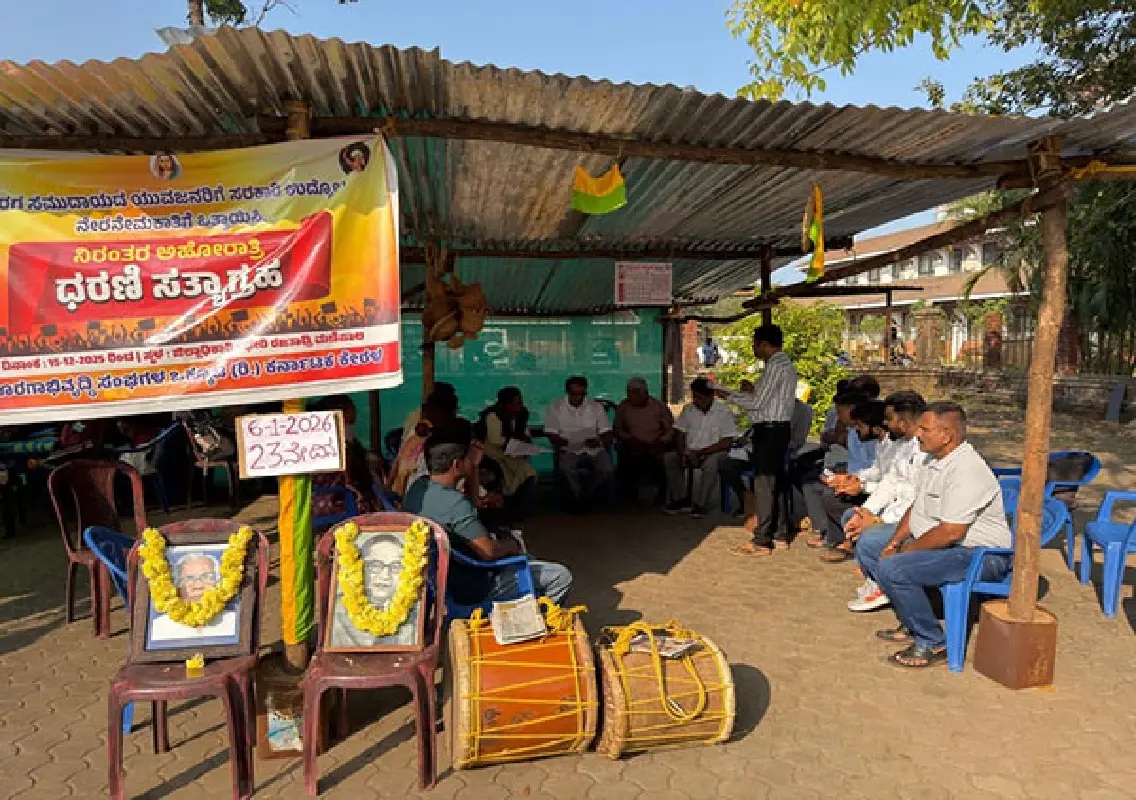


Udupi: The continuous day-and-night protest demanding direct government job recruitment for youth from the Koraga community entered its 23rd day on Tuesday at the premises of the Udupi District Collector’s office. The agitation is being organised by the Koraga Development Associations Federation (Reg) and has been drawing sustained participation from community members and supporters, highlighting long-pending demands related to employment and social justice.
Protesters said the Koraga community, recognised as a Particularly Vulnerable Tribal Group (PVTG), continues to face severe socio-economic challenges despite constitutional safeguards and welfare schemes. They asserted that assured and direct recruitment to government jobs is essential to uplift Koraga youth and ensure long-term livelihood security.
KPCC working president visits protest site
KPCC working president and Member of the Legislative Council Manjunath Bhandary visited the protest site on Tuesday and interacted with the agitators. Addressing the gathering, he assured the protesters that their grievances would be brought to the notice of the Chief Minister at the earliest.
Bhandary said that a high-level meeting would soon be convened under the chairmanship of the Deputy Commissioner to deliberate on the demands put forth by the Koraga community. “The issues raised by the Koraga youth are genuine and require serious consideration. Efforts will be made to arrive at a suitable and lawful resolution,” he told the protesters.
His visit was seen as a morale booster for the agitators, who have been staging a peaceful protest despite adverse weather conditions and logistical challenges.
Long-standing demand for direct recruitment
The protesters reiterated that their primary demand is for direct recruitment of Koraga youth to government jobs, without routing appointments solely through outsourcing or temporary arrangements. They argued that such measures do not provide job security or long-term benefits and fail to address systemic marginalisation.
Community representatives said that unemployment among Koraga youth remains high, forcing many to depend on daily wage labour or migrate in search of work. They maintained that direct government employment would help break the cycle of poverty and social exclusion faced by the community for generations.
Leaders of the Koraga Development Associations Federation said that while several welfare schemes exist on paper, their impact on the ground remains limited. “Without assured jobs, skill development and education alone will not lead to empowerment,” a protest organiser said.
Support from Congress leaders
Several Congress leaders and representatives expressed solidarity with the protesters and attended the programme at the protest site. Those present included Udupi District Congress Committee president Ashok Kumar Kodavoor, working president Kishan Hegde, State RGPRS vice president Roshni, Dr Sunitha Shetty, Chittaranjan Shetty, Vishwas Amin, Naveen Saliyan and other local leaders.
The leaders said the Congress party has consistently supported the cause of marginalised communities and would continue to raise the issue at appropriate forums. They also appealed to the district administration and the State government to engage in meaningful dialogue with the protesters.
Protest continues peacefully
Despite entering its fourth week, the protest has remained peaceful and disciplined. Participants said they would continue their agitation until concrete assurances and timelines are provided by the government. They also urged the authorities not to delay decisions, warning that prolonged inaction could deepen frustration among Koraga youth.
The district administration has been monitoring the situation, and officials said efforts are being made to facilitate discussions between community representatives and the government.
Conclusion
As the protest enters its 23rd day, the demand for direct government job recruitment for Koraga youth has gained renewed political attention. With assurances of a high-level meeting and intervention from senior leaders, protesters remain hopeful but firm in their resolve, stating that meaningful action, rather than promises, will determine the future course of their agitation.