







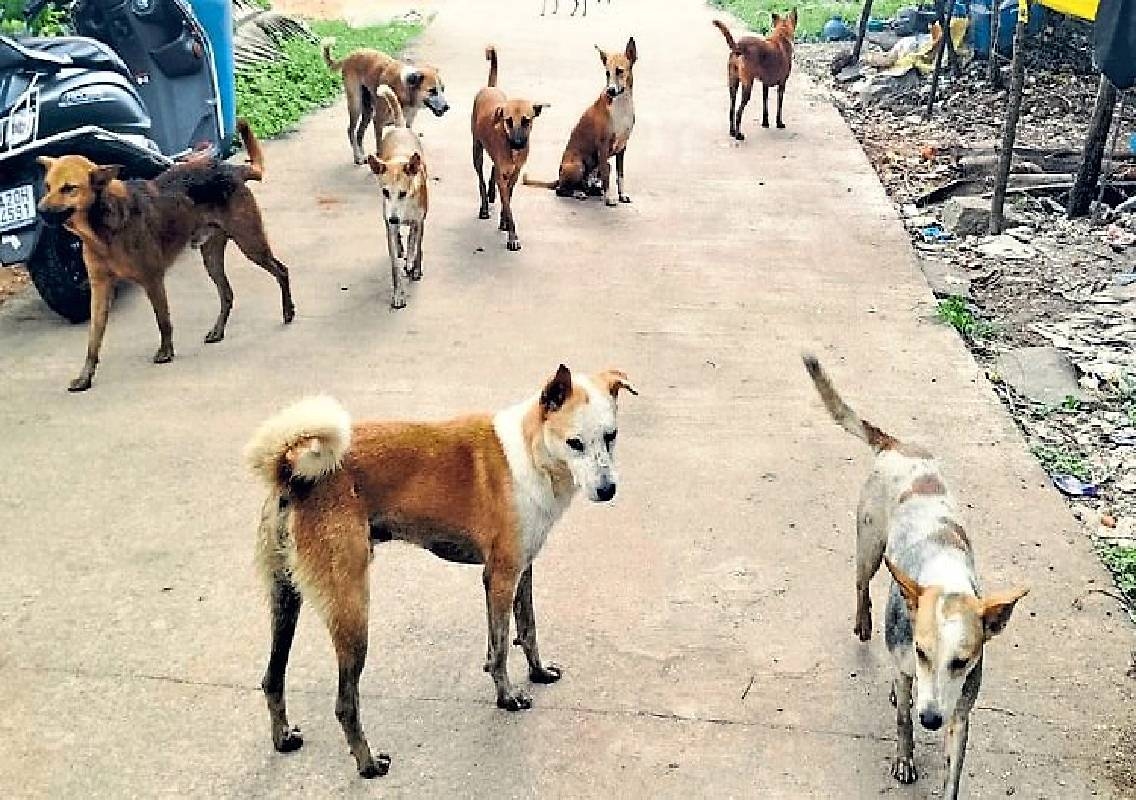


Kundapura: Residents of the Maddugudde area in Kundapura are facing increasing problems due to the growing presence of stray dogs, with pedestrians and two-wheeler riders reportedly living in fear while moving through the locality.
The issue has become a concern for residents as groups of stray dogs are frequently seen in the area. The situation has raised questions about public safety and the need for effective measures by the local civic authorities to control the stray-dog population and prevent incidents involving residents.
The Udayavani report published on September 23 highlights the difficulties faced by people in the Maddugudde surroundings.
Pedestrians and two-wheeler riders face difficulties
Residents say the presence of stray dogs has made movement through the locality increasingly difficult, particularly for people travelling on foot and those using two-wheelers.
Stray dogs gathering along roads can create a safety risk when they suddenly run across the road or chase passing vehicles. Two-wheeler riders can be particularly vulnerable because sudden attempts to avoid dogs can result in loss of balance or accidents.
For pedestrians, groups of dogs moving together can also create anxiety, especially among children, elderly people and those travelling alone.
The concerns raised by residents indicate that the issue is no longer being viewed simply as a nuisance but as a matter connected with road safety and public movement in the locality.
Residents seek civic intervention
People in the Maddugudde area have sought effective intervention from the local authorities to address the problem.
The increasing number of stray dogs has prompted residents to expect measures that can address both the immediate safety concerns and the longer-term management of the animal population.
Civic authorities have the responsibility of implementing appropriate measures for stray-dog management while also ensuring that animal welfare requirements are followed.
The issue requires a coordinated approach involving local bodies and veterinary authorities rather than isolated action.
Stray-dog management requires a systematic approach
Controlling the stray-dog population is generally linked to measures such as Animal Birth Control (ABC) programmes, vaccination, identification of aggressive or rabies-infected animals and appropriate shelter arrangements.
In March 2026, Udupi Deputy Commissioner Swaroopa T K directed officials to strictly implement Supreme Court guidelines on stray-dog management through humane and scientific methods. Officials were instructed to strengthen ABC programmes, vaccinate dogs against rabies and prioritise public safety.
The district administration had also identified land for shelters in different taluks, including a 1.5-acre site near the Kundapura Kandavar dumping yard. The proposed shelters were to provide food, water, shade and veterinary care in accordance with the prescribed standard operating procedures.
Such measures are intended to address stray-dog-related problems without resorting to indiscriminate removal of animals.
Feeding zones also part of the discussion
The management of stray dogs in Kundapura has previously involved discussions around designated feeding areas.
A recent report carried by Udayavani said residents in several Kundapura wards had objected to feeding zones identified by the Town Municipal Council when such locations were close to residential areas and places with heavy public movement.
Residents reportedly said feeding points near busy roads could attract groups of dogs and create difficulties for pedestrians, schoolchildren and elderly people.
The issue illustrates the challenge authorities face in balancing animal welfare with public safety. Designated feeding areas can help regulate where food is provided, but residents have also sought locations away from heavily populated areas and busy roads.
Public safety remains a concern
The growing presence of stray dogs can create several safety concerns in residential neighbourhoods.
Sudden chasing by dogs may cause two-wheeler riders to accelerate or make abrupt turns, increasing the possibility of accidents. Children walking to school or playing in neighbourhood areas can also be vulnerable when confronted by groups of dogs.
Dog bites also remain a public-health concern because of the risk of rabies. Udayavani had earlier reported that eight people were bitten by stray dogs in Kundapura in January 2026.
While individual incidents do not necessarily indicate the scale of the current problem in Maddugudde, they demonstrate why residents continue to seek preventive measures.
Need for vaccination and birth control measures
Experts and authorities generally consider sterilisation and vaccination important components of long-term stray-dog management.
Animal Birth Control programmes can help regulate the population over time, while vaccination helps reduce the risk of rabies transmission.
The Udupi district administration had earlier instructed local bodies and gram panchayats to identify designated locations for feeding stray dogs based on the local population and restrict feeding to those locations. It also called for a helpline for complaints related to stray dogs.
Effective implementation of these measures at the local level can help authorities identify areas with high concentrations of stray dogs and respond to complaints more systematically.
Residents await concrete action
For people living around Maddugudde, the immediate concern remains safe movement through their neighbourhood.
The residents’ complaints underline the need for authorities to assess the number and behaviour of stray dogs in the affected areas and take appropriate measures under the existing animal-control framework.
At the same time, long-term management requires regular vaccination, sterilisation, monitoring and responsible waste management so that stray dogs do not have easy access to food sources.
Addressing these factors together can help reduce repeated complaints and improve safety in residential areas.
Conclusion
Residents of Maddugudde in Kundapura have raised concerns over the increasing presence of stray dogs, saying pedestrians and two-wheeler riders are facing difficulties and safety concerns. The issue comes amid wider efforts by the Udupi district administration to implement scientific stray-dog management, including Animal Birth Control, vaccination, shelters and designated feeding locations.
The immediate concern for residents is safer movement in the locality, while sustained action through scientific population control and vaccination could form part of the longer-term response.