







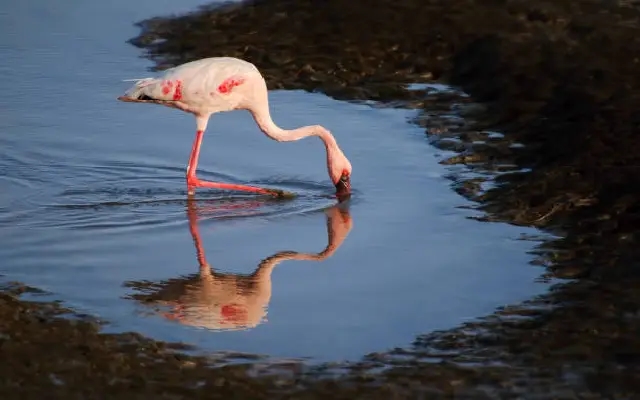


Udupi: Bird enthusiasts and ornithologists were thrilled on Thursday after a lesser flamingo, popularly called Raj Hamsa, was sighted near the Fish Mill in Malpe. The lone bird’s unexpected appearance marks a rare event for the coastal district, drawing significant interest from the local birdwatching community.
First-ever flamingo sighting on Udupi coast
The flamingo was spotted in a small pond by birdwatchers Aditya, Mohit, Shanmukh Muroor and Tejas Rao, who were on a routine observation trip. Unlike the species’ usual large flocks, this individual was solitary, likely due to having been carried off course by strong monsoon winds.
According to senior ornithologist Prof Lakshminarayana Upadhyaya of Kundapur, this is the first recorded sighting of a flamingo on the Udupi coast. “If a flock had arrived, they might have been found in the backwaters of Kodi and Pancha Gangavali. Proper surveys in these areas could reveal more surprises,” he said.
Significance for Udupi’s birding records
Prof Shanmukhraj of MIT, Manipal, called the event “historic” for the district’s birding community. “Documenting this rare sighting will be recorded in golden letters in Udupi’s birdwatching history,” he said.
Young birder Tejas Rao added, “Seeing such a striking bird in our coastal region is nothing short of magical. It gives us hope that our local wetlands can support diverse avian species if conserved well.”
About the lesser flamingo
The lesser flamingo (Phoeniconaias minor) belongs to the Phoenicopteridae family. India is home to two flamingo species—the greater flamingo and the lesser flamingo—the latter being smaller in size.
Lesser flamingos are primarily found in Gujarat’s Rann of Kutch, Rajasthan’s Sambhar Salt Lake, Tamil Nadu’s Point Calimere, and Odisha’s Chilka Lake. Breeding grounds are usually concentrated in the Great Rann of Kutch and East Africa.
With pale pink-and-white plumage, long slender legs, and a flexible, snake-like neck, the lesser flamingo stands at about 1.5 metres tall. Its distinctive curved, pinkish beak, designed for filtering algae and small crustaceans, adds to its unique appearance.
Potential for more sightings
Experts suggest that if local wetlands and backwaters are surveyed systematically, more migratory birds could be recorded along the Udupi coast. The monsoon winds, rich feeding grounds, and calm estuaries could make the region a potential resting stop for rare species.
Environmentalists have called for greater awareness about wetland conservation, pointing out that shrinking habitats and pollution could limit such rare sightings in the future.
Birdwatching community excited
Birdwatchers across Karnataka are sharing images and videos of the Malpe sighting, calling it one of the most memorable events of the year. Ornithology groups are planning more surveys in the Kundapur and Udupi backwaters to check for any possible flocks or other migratory birds.
As the excitement spreads, the sighting serves as a reminder of the ecological richness of Udupi and its surrounding coastal belt—an area that could become a birdwatching hotspot with proper preservation and documentation.