


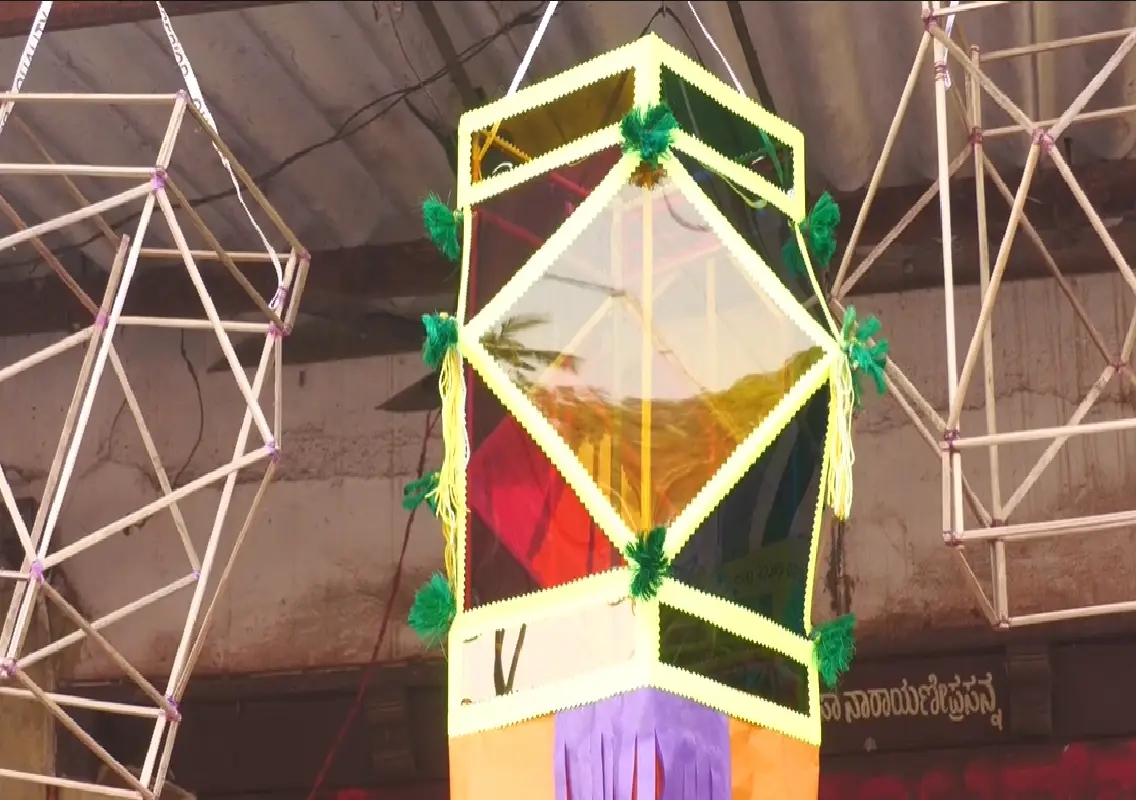


Saligrama: As Deepavali brings homes and streets alive with earthen lamps, colourful rangolis and festive decorations, traditional hanging lanterns known as Akasha Deepa or Goodu Deepa continue to hold a special place in the celebrations of coastal Karnataka. While the market is increasingly filled with mass-produced and Chinese-made decorative lanterns, Narahari Shenoy of Saligrama in Udupi district has remained committed to preserving the traditional craft through handmade, plastic-free lanterns.
For Shenoy, a resident of Shivaram Karanth Street in the Saligrama Town Panchayat limits of Brahmavar taluk, making Goodu Deepas is much more than a seasonal occupation. It is a passion rooted in art, a way of preserving cultural heritage and an effort to ensure that traditional craftsmanship is passed on to younger generations.
He has been making these lanterns for the past 45 years, using simple materials such as bamboo strips, thread, glue and coloured paper. Despite changing market trends and the arrival of newer designs, his dedication to the traditional art has remained strong.
Two days of work go into each traditional lantern
The beauty of a handmade Goodu Deepa is easy to admire, but creating one requires considerable patience, precision and experience.
The process begins with cutting bamboo strips to the required measurements. These strips are then arranged carefully and tied together with thread to form the basic frame of the lantern. Once the structure is ready, coloured paper is cut according to the dimensions and pasted onto the frame to create the desired patterns and designs.
Every stage requires attention to detail. Even a minor difference in the arrangement of the bamboo strips can affect the shape and appearance of the finished lantern. The selection and combination of paper colours, accurate measurements and careful application of glue are equally important.
It takes Shenoy approximately two days to complete a single lantern. The work cannot be rushed, as the quality of the finished product depends on the precision with which each component is assembled.
Over four and a half decades, he has developed the experience and skill needed to create lanterns with attractive designs and balanced structures. Each finished piece reflects not only his craftsmanship but also the patience and dedication involved in keeping the traditional art alive.
Plastic-free lanterns offer an eco-friendly alternative
Decorative lanterns made from plastic and synthetic materials are widely available in today’s markets. Their bright colours and variety of designs attract buyers looking for convenient festive decorations.
However, Shenoy has chosen to stay away from plastic in his creations. His lanterns are made using bamboo strips, thread, glue and coloured paper, retaining the traditional character of the craft while offering an alternative to plastic-based decorations.
The use of these materials gives his Goodu Deepas a distinct identity in a market dominated by factory-made products. Beyond their decorative appeal, the lanterns also reflect an approach that values traditional materials and more environmentally conscious festive celebrations.
For buyers who appreciate handmade products, this distinction is an important attraction. The lanterns combine traditional design with the personal touch of an artisan, making each piece different from mass-produced decorations.
Customers travel from Bengaluru to buy his lanterns
Despite competition from modern decorative products, Shenoy’s traditional lanterns continue to attract considerable interest.
Customers from Saligrama and neighbouring areas regularly purchase his creations. Some buyers even travel from Bengaluru to Saligrama specifically to buy the handmade lanterns.
The demand is such that certain customers pay in advance to reserve their preferred designs. This continued interest indicates that traditional Goodu Deepas retain their appeal among people who wish to celebrate Deepavali with familiar decorations and cultural elements.
The lanterns are particularly striking when hung outside houses after sunset. Once a lamp is lit inside, its glow spreads through the coloured paper panels, creating patterns of light across the courtyard. As the lantern sways gently in the evening breeze, it adds to the festive atmosphere.
For older generations, the sight brings back memories of Deepavali celebrations from their childhood. For children, the colourful lanterns offer a glimpse of a traditional form of decoration that is increasingly being overshadowed by modern alternatives.
Passing the craft on to the next generation
Preserving a traditional art form requires more than continuing to practise it. It also depends on teaching the skills and techniques to those who will carry it forward.
Recognising this, Shenoy has taught the craft of making Goodu Deepas to younger members of his family. He hopes that the art he has nurtured for 45 years will not end with him but will continue through the next generation.
His effort highlights the importance of individual artisans in safeguarding local traditions. While mass-produced products may offer greater variety and convenience, handmade crafts retain a cultural and personal value that cannot easily be replicated.
In Saligrama, Shenoy’s lanterns are more than festive decorations. They represent decades of dedication, the enduring appeal of traditional craftsmanship and a commitment to passing cultural knowledge to future generations.
As Deepavali approaches, the glow of these bamboo-and-paper lanterns serves as a reminder that festivals are not only about lights and celebrations but also about preserving the traditions that give them their distinct identity. Through artisans such as Narahari Shenoy, the charm of the coastal region’s traditional Goodu Deepas continues to shine.