







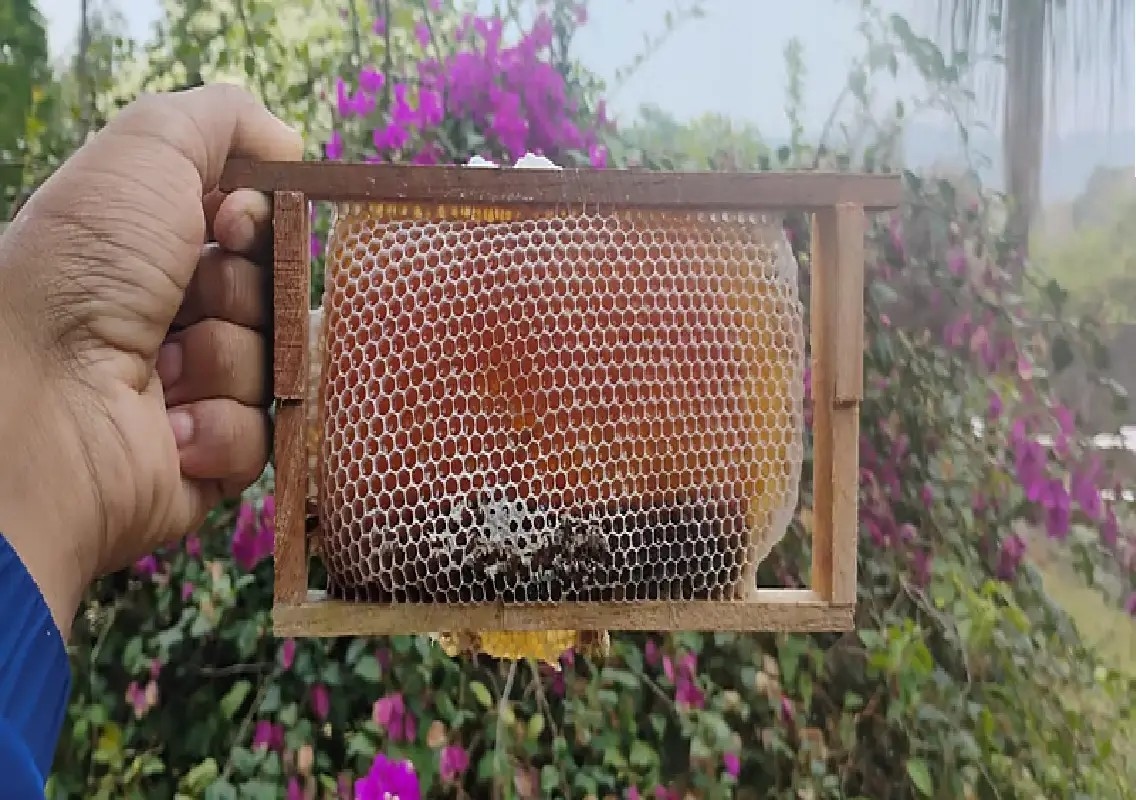


Kodagu: Known for its coffee plantations and scenic landscapes, Kodagu is also earning recognition for another prized natural product—Coorg honey. Valued for its distinctive flavour, nutritional benefits and multifloral composition, the region’s honey has long been a staple in Kodava households. Today, increasing consumer demand, growing awareness of the ecological importance of bees and renewed interest in beekeeping are helping revive the industry, while producers are also seeking a Geographical Indication (GI) tag to protect the product’s identity.
Traditionally consumed with puttu, dosa, idli and bread, Coorg honey is also widely used as a home remedy for cough and sore throat.
Multiflora honey gives Coorg its unique identity
Unlike honey derived from a single floral source, Coorg honey is multifloral, meaning bees collect nectar from a wide variety of flowering plants found across the district.
The rich biodiversity of Kodagu, located in the Western Ghats, contributes to its unique aroma, texture and flavour.
According to Nadikerianda Subbaya, President of Kodagu Bee Farms Producers Company Limited, the taste of Coorg honey varies depending on the flowers visited by the bees.
“It can range from mildly sweet to intensely sweet, while some varieties may even carry a slight bitter note depending on the nectar source,” he explained.
Important nectar-producing plants in Kodagu include coffee, coconut, arecanut, teak, schefflera, avocado, mango and the peacock’s foot tree. The district’s large forest trees also provide ideal locations for wild bee colonies to build their hives.
Nutritional value and rising demand
Nutrition experts say raw Coorg honey contains naturally occurring enzymes and antioxidants that make it a healthier alternative to refined sweeteners.
Clinical dietician Nimisha Muddappa said its nutritional profile and forest-based origin have contributed to growing consumer demand.
Apart from being used as a natural sweetener, honey is also valued for its traditional medicinal uses and is commonly consumed during seasonal illnesses.
Bees support biodiversity and coffee cultivation
Experts emphasise that beekeeping is important not only for honey production but also for improving agricultural productivity.
Bees play a crucial role in pollination, especially in coffee plantations, helping improve crop yield and maintain biodiversity.
According to Prof. Raghupati Kencharaddi, Head of the Department of Forest Biology and Tree Improvement at the College of Forestry, Ponnampet, awareness among farmers has increased significantly in recent years.
He said many people now practise beekeeping not just to produce honey but also to improve pollination and ecological sustainability.
Around 13,000 people, mainly in northern Kodagu, are currently engaged in beekeeping, while several entrepreneurs have established businesses to meet the increasing market demand.
The growth of apiculture has also encouraged related industries such as beehive box manufacturing and value-added products made from beeswax and bee pollen.
GI tag sought for Coorg honey
With adulterated products being sold under the name of Coorg honey, producers are seeking a Geographical Indication (GI) tag to safeguard its authenticity.
Experts believe a detailed scientific study demonstrating the unique characteristics of Coorg honey would strengthen the case for GI registration.
They say the recognition could enhance national and international demand, improve consumer awareness and provide better market opportunities for local beekeepers.
Bee species found in Kodagu
The most commonly domesticated bee in Kodagu is Apis cerana indica, locally known as Potti then. Adapted to the Western Ghats and relatively gentle in nature, it is the preferred species for traditional beekeeping.
Another domesticated species is the stingless bee Trigona, locally called Mooli then. Although it produces only around 500 grams of honey per year from a hive box, its honey is considered highly valuable and can fetch prices of up to Rs 5,000 per kg.
By comparison, regular honey generally sells for Rs 300 to Rs 400 per kg, while honey produced by Apis cerana indica may fetch around Rs 1,000 per kg.
Wild species such as Apis florea (Kol then) and Apis dorsata (Ponn then) are not domesticated. The giant rock bee, Apis dorsata, traditionally builds hives on tall trees and cliffs but has increasingly been nesting on high-rise buildings because of declining forest cover.
The European honeybee (Apis mellifera) was introduced during the 1960s for commercial honey production. However, experts say it is less suited to Kodagu’s tropical climate and is more vulnerable to predators and diseases than native bee species.
Traditional beekeeping practices
Beekeepers in Kodagu generally use eight-frame ISI boxes and six-frame Janata boxes, each containing a brood chamber for raising young bees and a super chamber for storing surplus honey.
The ideal period to begin beekeeping is December and January, while honey harvesting generally takes place every 21 days between late March and the third week of May.
According to apiarist Chethan Changappa, each hive can yield two to four kilograms of honey per harvest, depending on colony strength and proper maintenance.
Kodagu is also home to the Jenu Kuruba community, whose traditional knowledge of honey gathering and forest ecosystems has been passed down through generations.
Industry recovering after decades of decline
Kodagu was once among India’s leading honey-producing regions, with many households maintaining traditional beehives.
Production declined sharply during the late twentieth century because of shrinking floral resources, reduced forest cover and outbreaks of Thai sacbrood virus, which devastated native bee populations.
Experts also cite the widespread use of pesticides and insecticides, along with habitat loss following the decline of cardamom cultivation, as major reasons for the fall in bee numbers.
Despite these challenges, renewed interest in sustainable beekeeping and growing awareness of the ecological importance of pollinators are helping revive the sector.
Experts believe that protecting bee habitats and preserving Kodagu’s rich floral diversity will be essential to maintaining the quality and reputation of Coorg honey for future generations.