







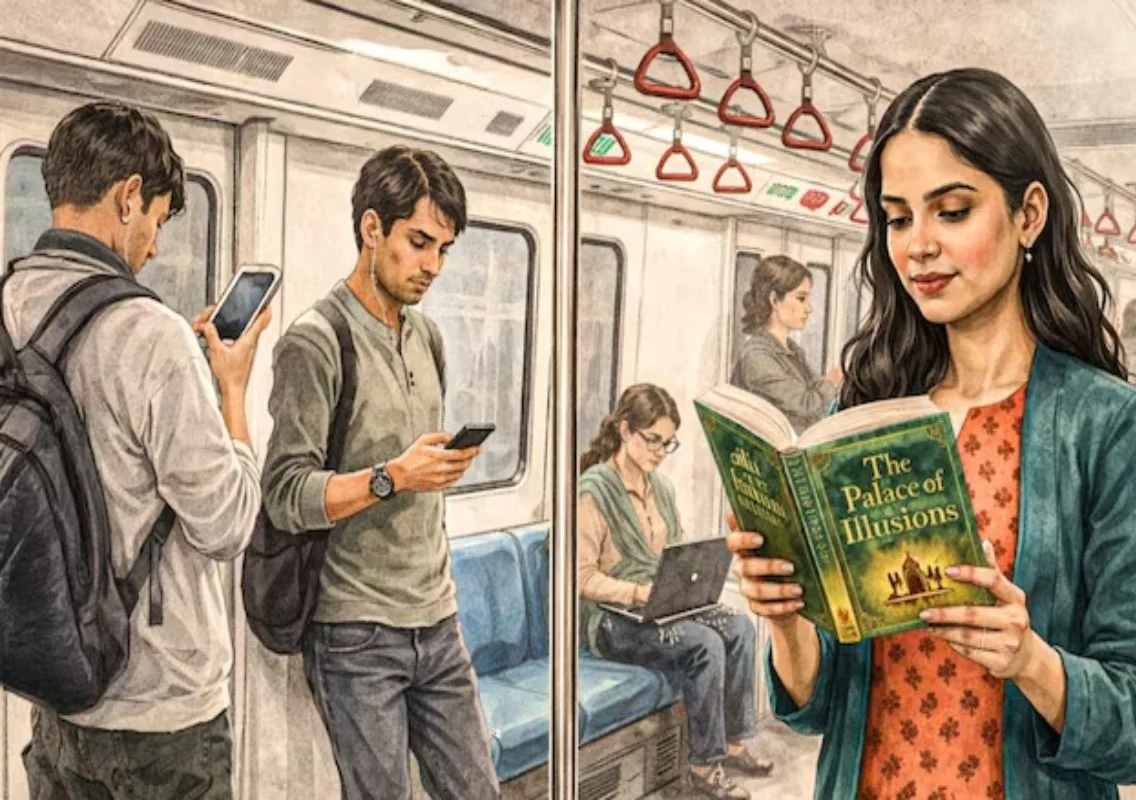


New Delhi: What began as a small viral idea in 2017 has quietly evolved into a lasting literary movement inside the Delhi Metro. The initiative, known as Books on the Delhi Metro (BODM), continues to connect readers through a simple yet powerful concept — leave a book behind, let a stranger find it, read it, and pass it on.
In an era dominated by digital content, streaming platforms, and endless scrolling, the persistence of this initiative highlights a deeper truth: the joy of reading physical books still resonates with many.
From viral idea to community movement
The initiative was started by Shruti Sharma, inspired by the global “Books on the Underground” movement in London, popularised by actor Emma Watson. What began with a handful of participants soon grew into a community-driven effort involving readers, volunteers, publishers, and authors.
The idea was intentionally simple — no rules, no tracking system, and no ownership. Books labelled with BODM stickers are meant to be discovered organically during metro journeys and then released back into circulation.
Over the years, this approach has transformed routine commutes into moments of unexpected discovery, turning metro coaches and platforms into informal reading spaces.
How the initiative works
Every day, volunteers known as “book fairies” place selected books at metro stations or inside coaches, typically after security checks. These books carry a BODM sticker indicating that they are part of the initiative.
A commuter who finds the book can take it, read it, and ideally leave it behind again for someone else. While there is no formal tracking mechanism, Sharma estimates that around 20 to 30 per cent of books continue their journey to new readers.
The organisers are also mindful of content selection, avoiding politically or religiously sensitive material to ensure safety and inclusivity for volunteers and readers alike.
Surviving the digital era
Despite the growing popularity of OTT platforms and smartphones, BODM has managed to sustain itself. During the Covid-19 pandemic, when physical movement was restricted, the initiative adapted by going digital and organising online giveaways.
According to Sharma, the reading community remains active, with regular messages, recommendations, and participation from readers. Publishers have also supported the initiative, using it as a platform to increase visibility for books.
Kartik Chauhan, a commissioning editor, notes that such initiatives help generate curiosity around books, often leading to increased online searches and, in some cases, higher sales.
Popular titles like Too Good to Be True and While We Wait have benefited from this exposure, while niche titles also find new audiences through such circulation.
Expansion beyond Delhi
The idea has inspired similar efforts in other cities. In Mumbai, Books on Mumbai Metro (BOMM) was launched in 2023 by literature enthusiast Namrata under Keemiya Creatives.
Unlike Delhi, the Mumbai initiative experiments with creative placements — such as leaving children’s books near student-heavy stations or placing themed books at specific locations to enhance the experience.
The initiative also aims to improve access to books in areas with limited bookstore availability, including suburbs like Vasai-Virar and Mira-Bhayandar. Plans are underway to introduce more Indian language titles, particularly Marathi, to cater to local readers.
Is digital content a threat?
While digital entertainment has undoubtedly changed reading habits, organisers do not see it as direct competition. Sharma believes that readers will always return to books, noting that much of today’s OTT content is itself adapted from literature.
Similarly, proponents argue that initiatives like BODM address accessibility and affordability challenges, especially for readers who may not be able to purchase books regularly.
A quiet but meaningful impact
Measuring the success of such an initiative is not straightforward. There are no metrics, downloads, or view counts. Instead, its impact is reflected in personal stories — readers discovering comfort, inspiration, or even hope through a book found unexpectedly.
From a queer memoir offering reassurance to its reader, to everyday commuters finding brief moments of escape, the initiative continues to shape a subtle yet meaningful reading culture.
Conclusion
Nearly a decade since its viral beginnings, “Books on the Delhi Metro” may no longer trend on social media, but its relevance endures. In a fast-paced digital world, it offers something rare — a slow, shared, and human experience. As long as there are readers willing to pick up a book and pass it on, this quiet literary journey is likely to continue.