







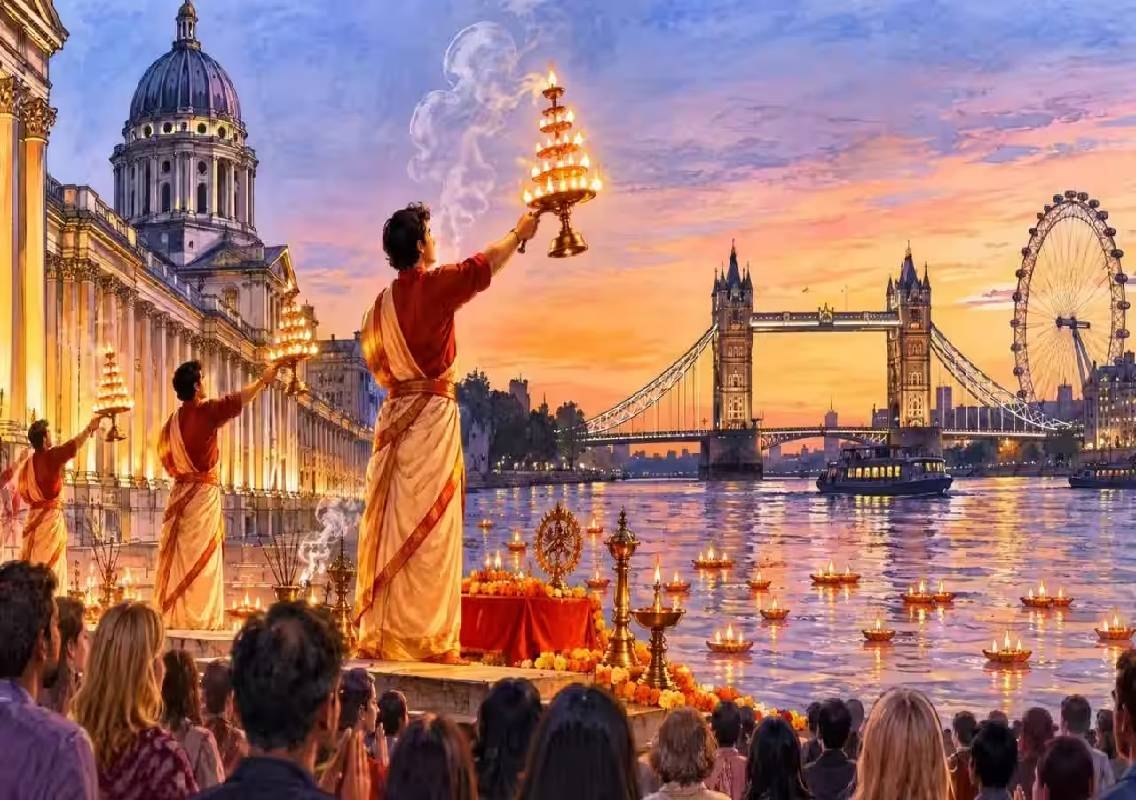


London: Varanasi’s iconic Ganga Aarti is set to cross borders this September, with the traditional ceremony of light scheduled to take place on the banks of the River Thames in London. The event will be held at the historic Old Royal Naval College in Greenwich on September 13, bringing Indian spiritual traditions and cultural celebrations to one of Britain’s most recognisable rivers.
Organised by Chinmaya Mission UK in collaboration with Totally Thames, the event is being presented as a celebration of Indian heritage, community and reverence for nature. It will form part of the month-long Totally Thames 2026 festival, which features arts, cultural and environmental events along the river.
Ganga Aarti to take place on September 13
The ceremony is scheduled for Sunday, September 13, 2026, at the Old Royal Naval College in Greenwich. The wider event will run from 4 pm to 8 pm, with the main Ganga Aarti planned for 7:15 pm, around sunset.
The programme will begin several hours before the aarti, with visitors able to attend community stalls, enjoy Indian food and watch live music and dance performances.
The main ceremony will take place on the Royal Steps overlooking the Thames, creating a setting intended to echo the riverside atmosphere of India’s traditional aarti ceremonies.
From the Ganga to the Thames
Ganga Aarti is traditionally performed along the banks of the River Ganga, particularly in cities such as Varanasi, Haridwar and Rishikesh.
The ceremony involves prayers, devotional music and the offering of light, with priests traditionally using large lamps as part of the ritual.
The London event seeks to bring this living tradition to a different river while retaining its emphasis on gratitude, reflection and reverence for water.
Organisers describe the event as a meeting of two ancient rivers, with the Ganga and Thames having played significant roles in shaping the civilisations and communities around them.
A free cultural event for families
The Thames-side celebration is not being planned as a religious gathering exclusively for the Indian or Hindu community.
The organisers say the event is free and open to all, with people of all backgrounds invited to attend. Families and visitors can participate in the wider cultural programme before the main ceremony.
The event will combine spiritual elements with food, music, dance and community activities, making it as much a cultural celebration as a religious ceremony.
The organisers have encouraged families to attend together and spend the afternoon at the riverside venue before the aarti begins.
Environmental responsibility at the centre
One of the notable aspects of the London ceremony is its focus on protecting the Thames.
Unlike some traditional riverside practices in India, flowers, idols and other offerings will not be placed into the River Thames during or after the ceremony. Organisers have specifically highlighted this measure as part of their commitment to environmental responsibility.
The decision reflects the broader message of respecting rivers and treating water as something that needs to be protected.
The event’s organisers describe reverence for nature as an important part of the ceremony, making environmental stewardship a central component of the London celebration.
Part of Totally Thames 2026
The Ganga Aarti is one of several events being presented as part of Totally Thames 2026, a month-long festival running throughout September.
The festival celebrates the River Thames through art, heritage, community activities and environmental initiatives. Its 2026 programme includes performances, exhibitions, open-water activities and family events at different locations across London.
The inclusion of Ganga Aarti gives the festival an Indian cultural dimension while creating an opportunity for London’s wider communities to experience a traditional ceremony associated with India’s sacred river.
Historic Greenwich venue
The ceremony will be held at the Old Royal Naval College in Greenwich, one of London’s major historic landmarks.
The venue is located beside the Thames and forms part of Maritime Greenwich, a UNESCO World Heritage Site. Its riverside Royal Steps will provide the backdrop for the evening ceremony.
The location also makes the event particularly striking visually, placing an ancient Indian ritual against the historic architectural setting of Greenwich.
Strong response from the public
The announcement has already attracted significant attention.
The official registration page temporarily paused registrations after receiving an “incredible response”, with organisers saying they were assessing how to accommodate as many people as possible before reopening registration.
The event has also generated discussion on social media. While some people have welcomed it as an example of cultural exchange and a way of showcasing Indian traditions internationally, others have questioned whether a ritual associated with the sacred Ganga should be recreated on another river.
The debate has added another dimension to what was initially announced as a cultural and spiritual celebration.
Why Ganga Aarti is significant
For generations, Ganga Aarti has been an important part of India’s riverfront religious traditions.
In Varanasi, the evening ceremony draws large crowds to the ghats, where lamps, chants and devotional music create a distinctive atmosphere along the Ganga.
The ritual is closely connected to the Hindu reverence for the river, which is regarded as Ganga Mata, or Mother Ganga.
Bringing the ceremony to London does not attempt to replicate the Ganga itself. Instead, organisers describe the Thames event as an opportunity to share the ritual’s broader values of gratitude, light, community and respect for nature.
Not the first Ganga Aarti on the Thames
Interestingly, the September ceremony will not be the first time a Ganga Aarti has been performed on the Thames.
In April 2026, the International Siddhashram Shakti Centre UK organised a “Prayer for Global Peace” on the Thames, featuring a Ganga Aarti ceremony aboard a specially arranged boat. The event brought together more than 250 devotees, according to an ANI press release.
However, the September event is being presented as a large public cultural celebration at a major riverside landmark, with an afternoon programme leading up to the ceremony.
What visitors can expect
Those attending the September event can expect more than the main aarti.
The programme includes:
- Community stalls
- Indian food
- Live music
- Dance performances
- Family activities
- Cultural celebrations
- The main Ganga Aarti at 7:15 pm
The event will run for four hours, from 4 pm to 8 pm.
Visitors have also been advised to bring a warm layer for the evening and, if desired, a picnic blanket.
A cultural bridge between India and Britain
The event comes at a time when Indian cultural traditions are increasingly being showcased internationally.
For the Indian diaspora in Britain, the ceremony could offer an opportunity to connect with a familiar tradition away from home. For other London residents and visitors, it provides a chance to experience an important element of Indian spiritual culture in a different setting.
The organisers’ emphasis on inclusivity means visitors do not need to belong to a particular faith or have prior knowledge of the ceremony to attend.
Conclusion
The Ganga Aarti on the Thames will take place on September 13, 2026, at the Old Royal Naval College in Greenwich, with the main ceremony scheduled for 7:15 pm. The free event will combine Indian food, music, dance and cultural activities before culminating in the traditional ceremony of light beside the Thames.
Organised by Chinmaya Mission UK in collaboration with Totally Thames, the event is being positioned as a celebration of Indian heritage, community and respect for nature. Its decision to prohibit flowers, idols and other offerings from being placed in the Thames also reflects an effort to combine tradition with environmental responsibility.
With registrations already attracting a strong response, the September ceremony is expected to become a notable cultural event in London’s 2026 calendar.