







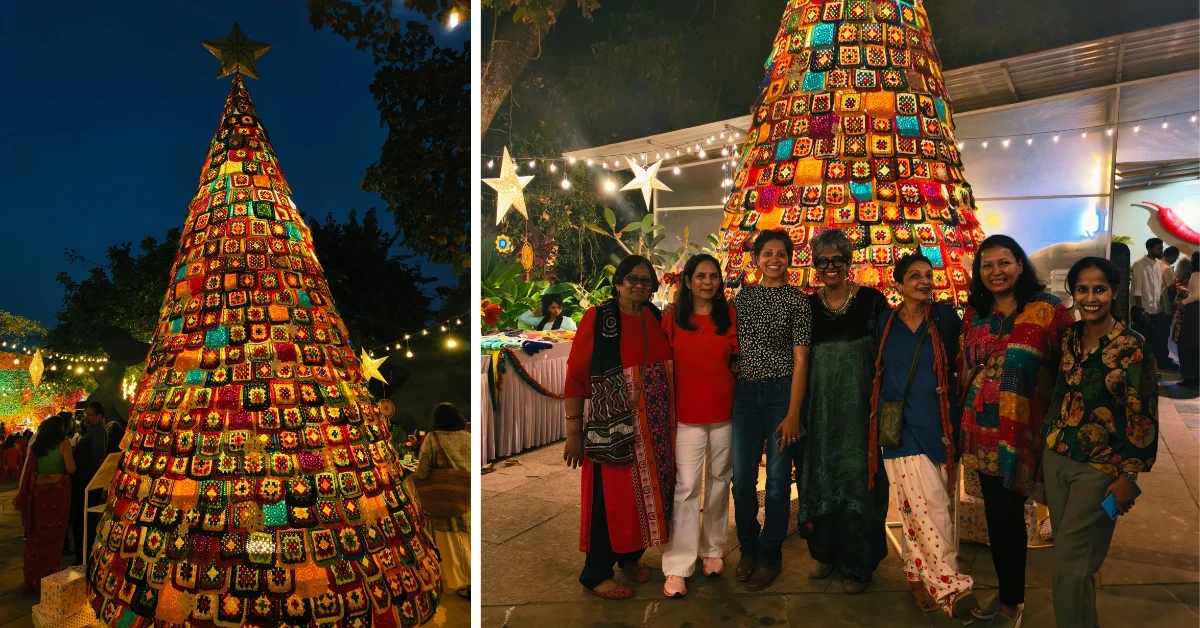


An 18-foot Christmas tree standing inside the Museum of Goa is drawing attention this festive season—not for glitter or lights, but for what it deliberately avoids. There is no plastic, no PVC needles and no factory-made decorations. Instead, the tree is made of more than 1,000 crocheted pieces, entirely hand-crafted by women from across Goa.
The installation is Goa’s first large-scale crochet Christmas tree and reflects a growing shift towards sustainability rooted in skill and community rather than consumption.
Women-led effort brings craft out of homes
The tree was created by The Crochet Collective, Goa, led by Sheena Pereira, Sharmila Majumdar and Sophy V Sivaraman. Over 25 women worked for nearly three months, crocheting individual pieces from their homes before assembling them together.
Many of the women had never met before the project began. Crochet, a craft introduced to Goa during Portuguese rule, has traditionally remained a domestic skill, often practised quietly and stored away in cupboards. This project brought that invisible labour into a public, respected space.
Some contributors have been crocheting for over 50 years, while others picked up the craft more recently. Much of the yarn used came from personal collections and leftover skeins, reinforcing the project’s zero-plastic, low-waste ethos.
Built on trust, not transactions
When the crochet work was ready, the project faced a challenge—there was no structure to hold it up. A civil engineer, Laxmikant, stepped in and donated the metal framework, transport and logistics without charging for materials or labour.
The Museum of Goa supported the idea as part of its Where We Gather curation under the Festivals of Goa, allowing the installation to grow organically rather than turning it into a commercial spectacle.
Sustainability beyond symbolism
Artificial Christmas trees, often marketed as reusable, are typically made of PVC and metal composites that are difficult to recycle in India. Environmental groups have flagged festive décor as a hidden but significant contributor to plastic waste.
Against this backdrop, the crochet tree offers an alternative model—decor that can be repaired, repurposed and dismantled without waste. More importantly, it shows how sustainability can emerge from tradition, skill and collaboration rather than branding.
More than a festive installation
For the women involved, the tree represents more than a seasonal display. It marks the formation of a creative community that plans to continue working together on future projects, ensuring crochet does not return to cupboards.
As visitors touch the uneven surface and recognise the time stitched into every piece, the installation quietly challenges how festive décor is imagined—and who gets seen in the making of culture.