







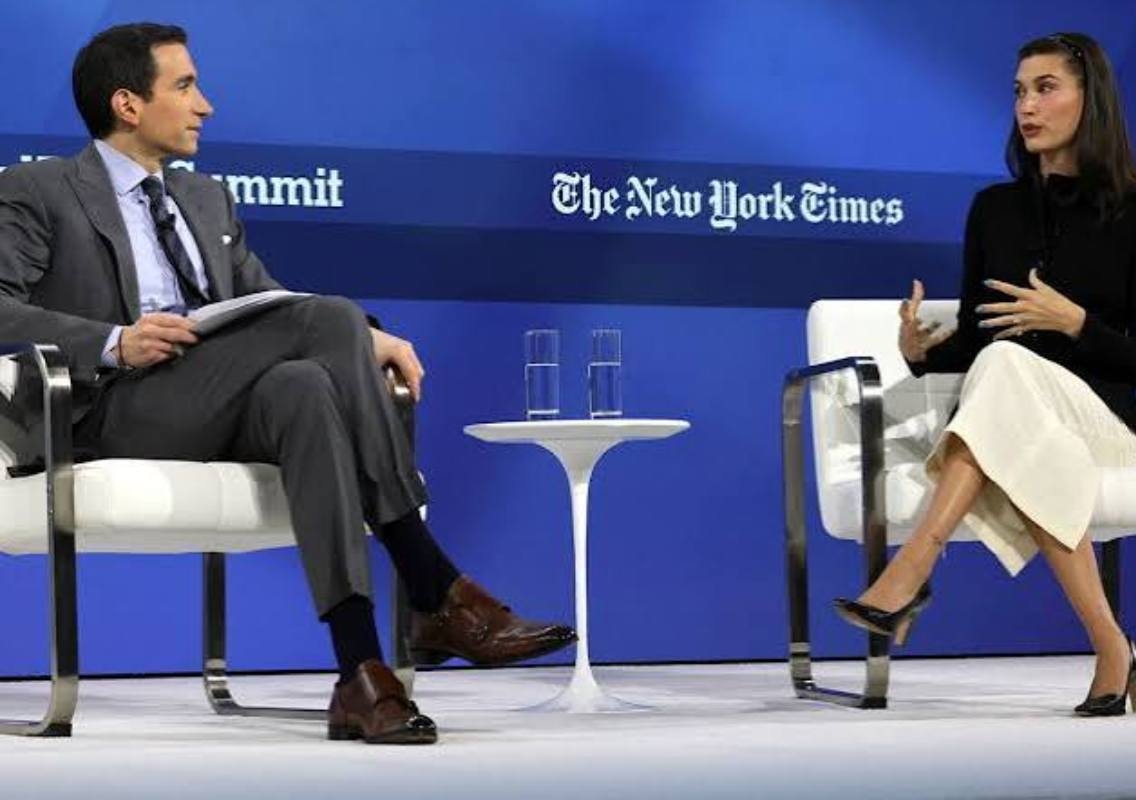


New York: Model and entrepreneur Hailey Bieber has become the subject of an online debate following her appearance at the New York Times’ annual DealBook Summit on November 18. Her conversation with journalist Andrew Ross Sorkin covered her beauty brand Rhode, its billion-dollar sale to e.l.f. Beauty and the impact of social media on her personal life.
However, a particular exchange about the valuation of Rhode quickly went viral, drawing criticism from social media users. While some mocked her choice of words, others felt she had missed an opportunity to explain the business strategy behind the brand’s success.
Bieber was among the prominent speakers at the summit, which also featured Tesla CEO Elon Musk, OpenAI chief executive Sam Altman, Microsoft CEO Satya Nadella and New York City Mayor Zohran Mamdani.
Although the discussion was expected to offer insights into how Bieber built Rhode into a billion-dollar business, online attention soon shifted to her responses and the way she described her approach to entrepreneurship.
Why Hailey Bieber’s interview attracted criticism
During the interview, Sorkin asked Bieber what had helped Rhode distinguish itself in the increasingly competitive celebrity beauty market.
Bieber explained that she wanted to build a brand that felt like an extension of her personality. She also spoke about creating a larger identity around Rhode, with its products, packaging, branding and storytelling contributing to the overall experience.
The conversation took a different turn when Sorkin asked about the company’s valuation and the circumstances surrounding its sale.
Bieber said that a billion dollars was the minimum figure below which she would not have considered selling Rhode. When Sorkin asked why she believed she could achieve that valuation, she responded with one word: “Delusion.”
She then elaborated: “You have to have a certain sense of optimistical delusion.”
The word “optimistical” immediately became a talking point online. Several social media users questioned whether it was a real word, while others used the remark to poke fun at her response.
The criticism, however, went beyond the vocabulary used during the interview. Some viewers felt Bieber had not provided enough detail about the business decisions, marketing approach and strategy that helped Rhode reach its reported valuation.
Others argued that the interview was an opportunity for her to demonstrate her capabilities as a business founder, rather than being viewed primarily as a celebrity associated with a beauty label.
Debate over the interview and Andrew Ross Sorkin’s questions
The conversation also triggered a wider debate about how celebrity entrepreneurs should be interviewed.
Some viewers felt Sorkin’s questions were challenging, while others defended his approach. They argued that a journalist speaking to the founder of a billion-dollar business should ask detailed questions about the company’s growth, valuation and commercial decisions.
For critics, the discussion did not provide enough insight into the factors that made Rhode successful. They wanted more information about how the company built its customer base, positioned its products and established itself in a crowded beauty market.
At the same time, others pointed out that the interview covered several personal and professional subjects, including the emotional consequences of online criticism.
The viral reaction therefore became about more than a single word, with viewers discussing the expectations placed on celebrity business founders when they speak about their companies in public forums.
Hailey Bieber responds to the ‘optimistical’ trolling
Bieber appeared to address the online mockery two days after the summit.
On November 20, she shared a screenshot of a dictionary definition of the word “optimistical” on her Instagram Story. The definition described it as a version of “optimistic”.
She accompanied the screenshot with a brief caption: “Anyways…”
The post appeared to be a direct response to those who had questioned her use of the word during the interview.
The exchange had already gained traction on social media, with users sharing clips of the conversation and commenting on her choice of vocabulary.
By posting the dictionary definition, Bieber seemed to push back against the criticism rather than issue a lengthy explanation.
Hailey Bieber opens up about online abuse
Away from the discussion about Rhode’s valuation, Bieber also spoke about the personal toll of years of online scrutiny.
She recalled the abuse she experienced after she began dating singer Justin Bieber. According to her, the hostility included people telling her to kill herself in social media comments every day.
She also described being shouted at in public and encountering tip jars at Starbucks that were framed around her and another person.
Reflecting on the intensity of the abuse, she said: “The way people were making me feel was that maybe it would be better if I wasn’t here anymore.”
Her comments highlighted the emotional impact of sustained online harassment and the difficulty of dealing with public hostility while living under constant scrutiny.
Bieber acknowledged that she pays attention to what people say about her and does not pretend that negative comments have no effect. However, she said she has gradually learnt to develop resilience and practise what she called “internal regulation”.
She explained that this involves reminding herself to put her phone away, step back from online conversations and remain present in her everyday life.
Social media filters and plans beyond Rhode
Bieber also discussed the complicated relationship people have with social media, particularly the growing use of filters that can change appearances.
She acknowledged that such tools can create misleading expectations about physical appearance and influence how people view themselves. Although filters have become a familiar part of online culture, she suggested that their effects can be harmful.
The discussion reflected another aspect of her experience as a public figure who has spent years being scrutinised online.
Bieber also offered a glimpse into her professional plans, revealing that she was in the early stages of thinking about her next venture.
However, she made it clear that she intends to remain closely involved with Rhode and has no immediate plans to step away from the brand.
While the “optimistical” remark became the most widely discussed moment from her DealBook appearance, the conversation also touched on the pressures of celebrity entrepreneurship, online harassment and the challenges of maintaining a public image in the social media age.