







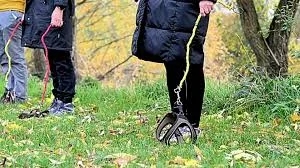


A new lifestyle trend from Germany has taken social media by surprise, drawing equal parts curiosity and ridicule. Dubbed “hobby dogging”, the activity involves adults simulating the experience of walking, training and completing agility courses with imaginary dogs—complete with leashes, harnesses and commands.
Viral clips spark mockery and debate
Videos of the trend have racked up millions of views on platforms such as TikTok and Instagram, prompting a flood of reactions. While some users expressed fascination, many mocked the practice as bizarre.
“I took the dog’s harness off and now I can’t find him,” one user joked, while another commented, “The world is getting crazier and crazier.” Others were simply stunned that adults were earnestly training pets that did not exist.
Where did ‘hobby dogging’ come from?
According to a report by the South China Morning Post, the trend originated in the small German town of Bad Friedrichshall. It was started by 65-year-old dog trainer Barbara Gerlinger, who says the idea began as a joke at a local clubhouse before evolving into structured training sessions.
Gerlinger runs organised courses featuring cones, poles and obstacles. Participants attach reinforced leashes to empty harnesses, gesture toward their feet as if guiding a dog, and even reach into pockets to offer “treats” to invisible pets. She has designed special leashes herself to enhance the illusion.
‘It’s about the handler, not the dog’
Unfazed by online ridicule, Gerlinger insists the practice has value. “The problem is never the dog—it’s the person holding the leash,” she has said, explaining that hobby dogging focuses on posture, voice control, body tension and concentration.
She argues that training with an imaginary dog removes distractions and turns the exercise inward. “It’s quite exhausting to concentrate for 20 minutes on something that isn’t there,” she noted, describing it as a form of self-training.
Therapy, preparation or performance?
Some psychologists suggest the trend may help relieve loneliness or stress by offering structure, movement and a sense of community. For others, it serves as preparation for real dog handling. One participant, Anette Hilkert, said rehearsing with an imaginary dog helps her practise before walking her real pet.
Whether viewed as therapeutic, eccentric or simply cringe-worthy, hobby dogging continues to grow—proving once again that the internet’s capacity for surprise is far from exhausted.