







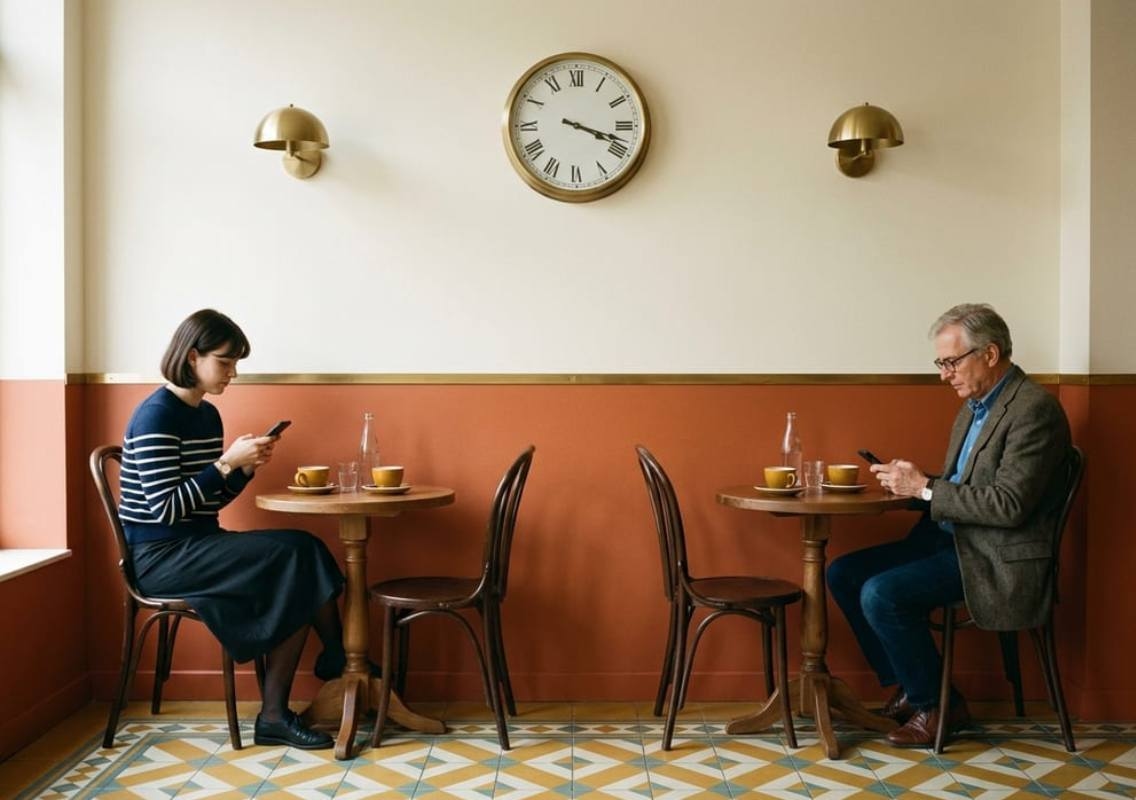


Bengaluru: Work-from-cafe culture has sparked a debate about customer etiquette, table occupancy and whether ordering just one coffee justifies sitting for hours.
Work-from-cafe culture has become a part of urban life, particularly since the Covid-19 pandemic. Whether it is escaping the monotony of working from home, meeting a client or simply finding a change of scenery, cafes have increasingly become convenient workspaces. And, of course, there is always a cup of coffee to keep you going.
However, the growing cafe culture is now at the centre of a debate. A recent post on X has sparked a conversation about whether it is fair for customers to order just one cup of coffee and occupy a table for hours. Is it bad business etiquette, a matter of customer convenience or simply an accepted part of modern cafe culture?
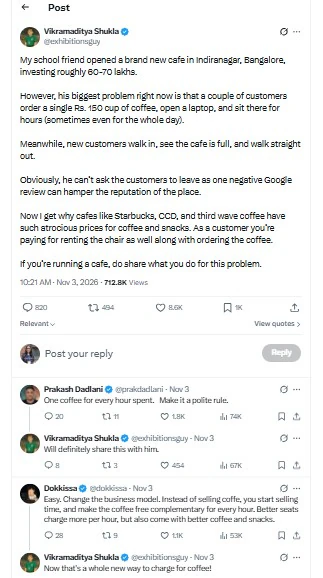
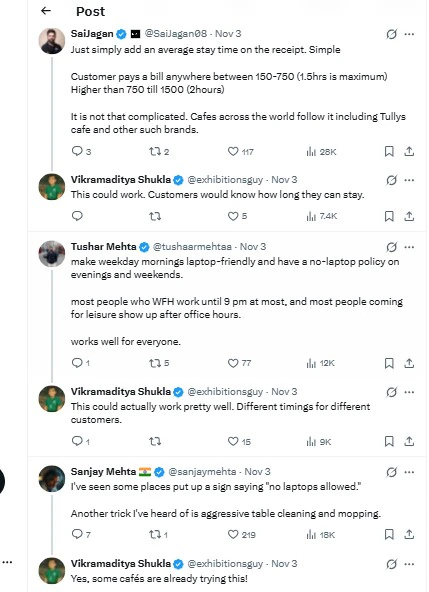
The internet, as expected, had plenty to say. While some sided with cafe owners, others argued that customers are paying for the ambience and experience, not just the coffee. Some also questioned the growing trend of cafes putting up signboards restricting laptop use.
Suggestions ranged from introducing a one-coffee-per-hour rule to charging customers for the time they spend at a cafe.
Sanvi Sharma, a Pune-based marketing professional, admits she had never really given the issue much thought.
“I have occupied a table for four hours straight with one cup of cappuccino once. But honestly, I have never been asked to leave or asked to order, so it never really occurred to me because I’m usually too engrossed in work and lose track of time. And if someone does ask me to order or leave, I might feel bad about it because I did make a purchase, right?” she said.
Perhaps that is how it happens for many customers. Nobody walks into a cafe planning to spend four hours nursing one cappuccino. Sometimes, deadlines simply outlast the coffee. Several people in the online discussion also shared similar experiences.
But what about the cafe owners who have to balance hospitality, customer comfort and business expenses?
While some establishments allow customers to spend an entire day with a single beverage, others have no-laptop policies. To understand the business perspective, cafe owners and hospitality professionals weighed in on the debate.
Not every cafe is your workspace
Hospitality and business expectations often collide when customers assume every cafe is designed for remote working.
Atithi Devo Bhava, the philosophy of treating guests with respect, has long been central to Indian hospitality. However, some cafe owners argue that welcoming customers should not automatically mean turning every table into a long-term workstation.
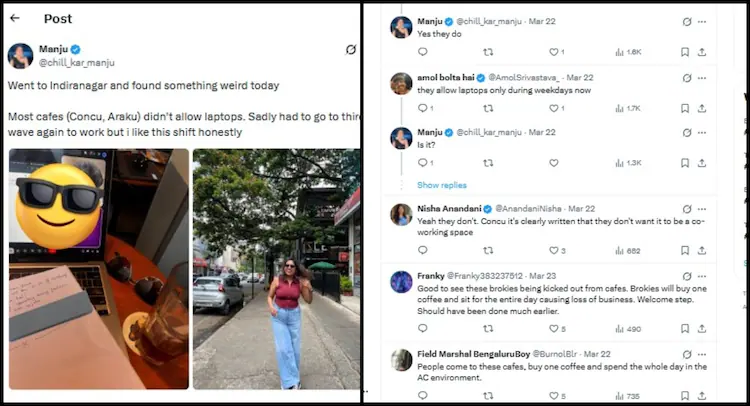
A Bengaluru cafe reportedly made headlines earlier for putting up a sign stating that meetings were not allowed and introducing charges for people who worked there on an hourly basis.
Similarly, Altry Coffee Roastery in Gurgaon follows a no-laptop policy. According to its founder, Sahil Bhambri, the decision is not necessarily about preventing customers from spending time at the cafe or increasing revenue.
“Who decided that every cafe has to be a workspace in the first place? Just because a few cafes started allowing people to work after Covid, does that mean every cafe automatically becomes a workspace?” Bhambri asked.
He said he had experienced the challenges of long-stay customers at his previous cafe, where some people would occupy tables for hours, take office calls and refuse to share the space. In certain instances, customers reportedly did not even want to order food because they had brought their own from home.
Bhambri believes cafes should also encourage people to take a break from work and enjoy their surroundings.
“I want to bring back cafes as they used to be — places where people could socialise and simply do whatever they felt like,” he said, describing rest as a luxury.
Despite clearly displaying the no-laptop policy, Bhambri said some customers continue to disregard the rules and argue with him.
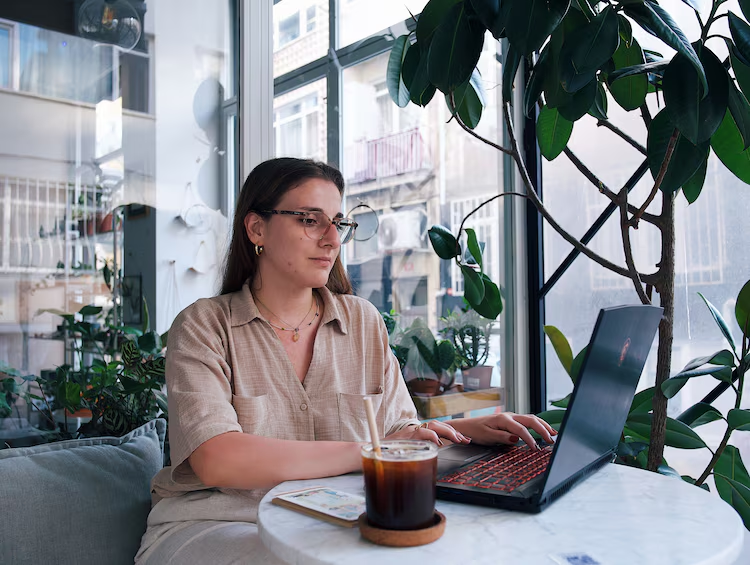
Hospitality professionals believe that clearly communicating a cafe’s expectations can help prevent such disagreements. Customers should know whether an establishment is designed for working, socialising or simply enjoying a meal and a beverage.
Bintesh Kumar, Senior Marketing Manager at Pass Code Hospitality, said it is important for a brand to establish its identity and communicate the experience it wants to offer.
“Chains like Blue Tokai and Starbucks have built a culture where customers can work for hours without any minimum spending requirement. But for standalone cafes that haven’t positioned themselves as work-friendly spaces, this can affect business,” he told.
At The Drop in Delhi, which operates as a cafe during the day and a bar at night, the policy is communicated through small cards placed on tables. Laptops are allowed only until 5 pm, including on weekends.
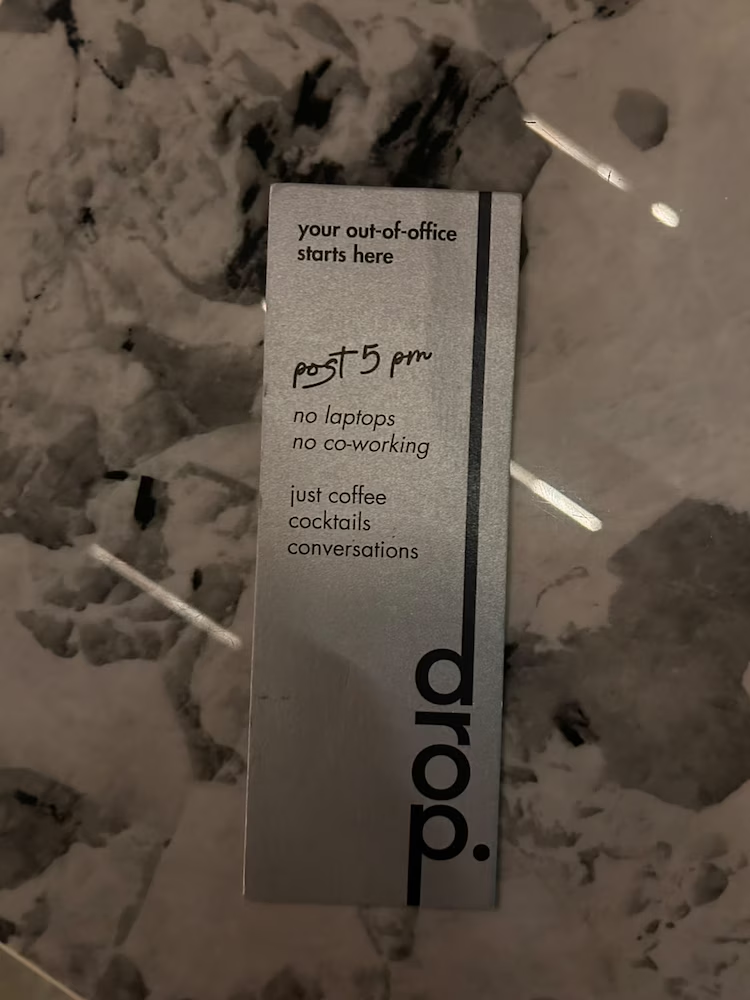
“We don’t necessarily communicate this to customers in a confrontational way. It’s about defining the culture of the space. If you don’t, people may start expecting a lot more from your business,” Kumar said.
The business cost of occupying a table
Every occupied table represents an opportunity, but long stays can affect a cafe’s revenue and customer turnover.
When customers make a purchase at a cafe, they are paying for more than the beverage or food they consume. Rent, electricity, staff salaries, ingredients, maintenance and other operational costs contribute to the overall business expenditure.
For smaller cafes, table occupancy and customer turnover can significantly influence profitability.
Kumar acknowledged that customers spending several hours with a single beverage can affect a cafe’s average spending per customer. However, he also pointed out that there is a business advantage to having a cafe appear busy.
“When people look at a cafe from outside and see it filled with customers working on laptops, it creates the impression that the cafe is doing well. That can attract more people,” he said.
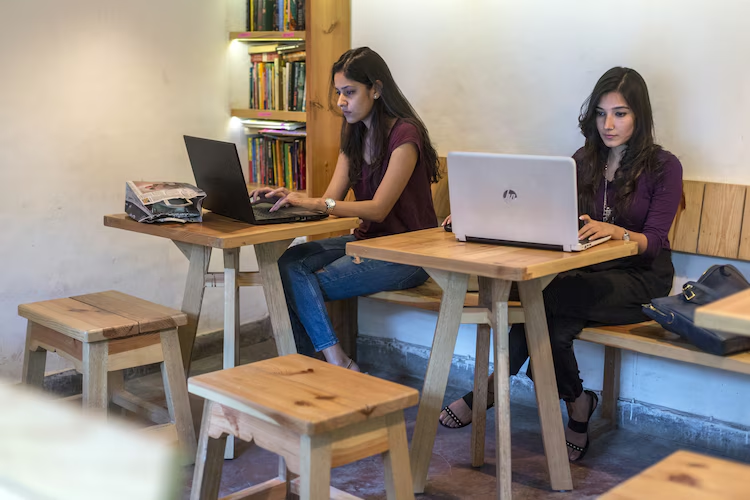
The issue, therefore, is not always straightforward. Long-stay customers may reduce the opportunity to serve additional guests, but they can also contribute to the cafe’s popularity and create a sense of community.
Why some cafes don’t mind customers sitting for hours
For work-friendly cafes, customer loyalty may matter more than the immediate revenue from an occupied table.
Not every cafe owner considers a four-hour laptop session a problem.
Dhruv Singh, founder and CEO of Chelvies Coffee, said the establishment would not ask a customer to leave even if they spent 10 hours with just one beverage.
“As a brand that wants to build long-term loyalty, we would never ask customers to leave even if they sit for 10 hours with just one beverage,” Singh told.
He believes businesses should sometimes accept a short-term loss to build long-term relationships with customers.
“Sometimes, you have to absorb a loss for the sake of the customer. Otherwise, you risk losing them altogether,” he said, adding that the food and beverage industry depends heavily on repeat customers.
Singh said he would rather have someone return regularly over several years than focus on the revenue lost because a customer occupied a table for a few extra hours.
“If a customer keeps coming back to Chelvies and ordering their favourite beverage for nine or ten years, that’s the kind of profitability I’m looking at, rather than worrying about the revenue I might lose because they’ve occupied one seat for a few extra hours,” he explained.
Suresh Sharma of Kathe Cafe in Bengaluru shares a similar philosophy.
“For me, the customer is God, and I would never ask anyone to leave or pressure them into ordering more. Everyone has their own budget. If 95 out of 100 customers are spending well and five choose to sit longer with just one coffee, I don’t see that as a problem,” he said.
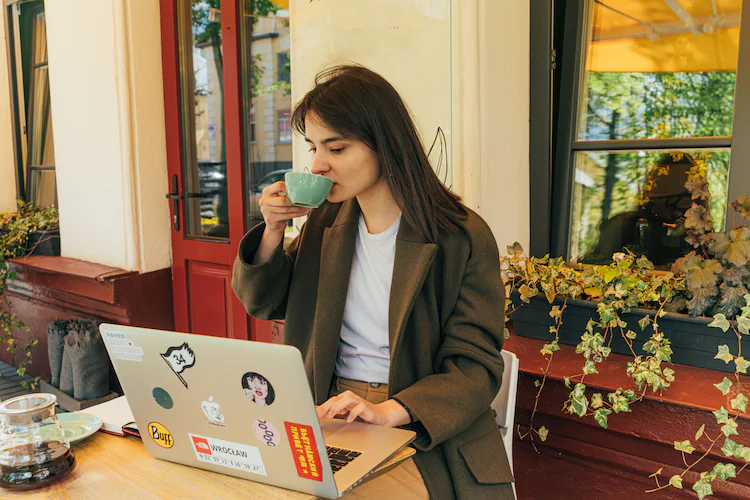
Singh also pointed out that regular customers often develop a rapport with cafe staff and understand when the establishment is busy. Such familiarity can make it easier for cafes to manage seating during peak hours.
On weekends, when families and groups of friends may be waiting for tables, work-friendly cafes can politely request long-stay customers to make space. Singh said loyal customers usually understand such requests, making the arrangement a matter of mutual respect.
So, how long is too long to sit in a cafe?
The debate about introducing hourly charges for cafe customers has also divided opinions. Kumar, however, does not believe that charging customers by the hour is the right approach for the Indian cafe market.
“It cannot and should not work in India,” he said, arguing that such a system could blur the distinction between a cafe and a co-working space.
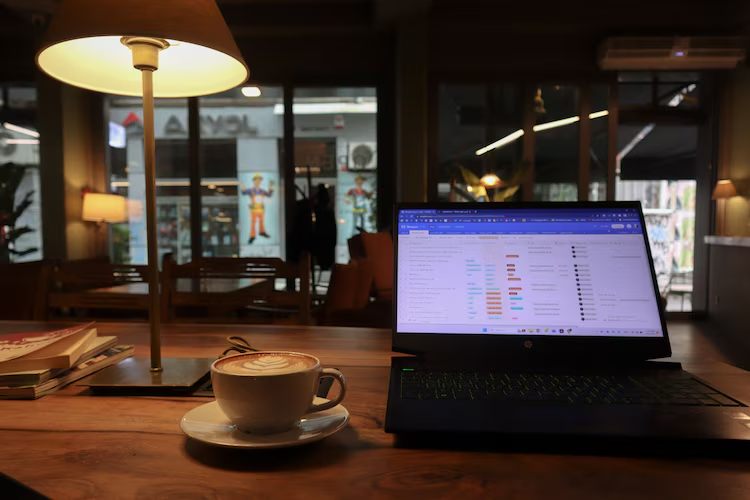
Hospitality professionals believe the answer lies somewhere between unrestricted table occupancy and rigid time-based charges.
Bhambri suggested that work-friendly cafes could consider setting a maximum stay of two to three hours, allowing other customers to use the space while helping businesses generate additional revenue.
Ultimately, cafe etiquette is about balancing customer convenience with the needs of the business. Customers should not necessarily be expected to keep ordering beyond their budget, but they should also be mindful of how long they occupy a table, particularly when the establishment is crowded.
“If you’re spending time at a cafe, it’s only fair to support the business. That doesn’t mean spending beyond your means, but ordering sensibly and respecting the experience it offers. A little mutual respect is what will keep cafe culture thriving,” Kumar said.