







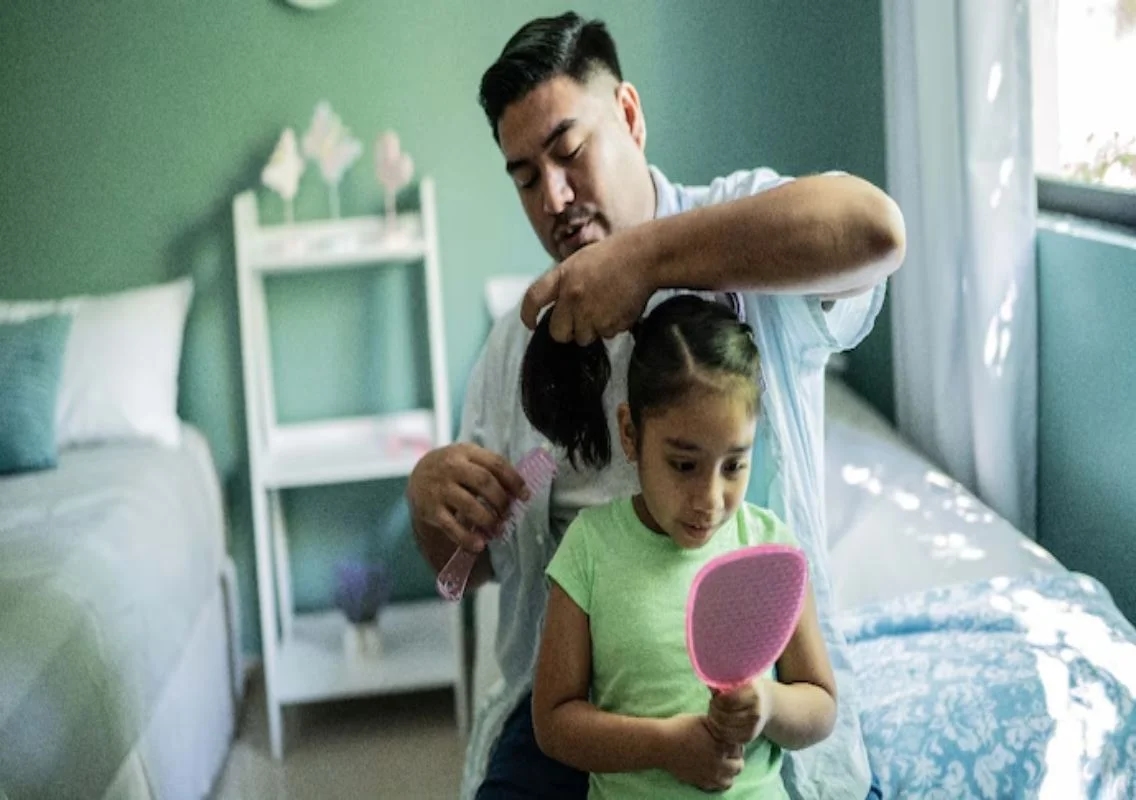


New Delhi: In many Indian households, something as simple as tying a ponytail quietly reflects deeper social norms. While fathers today are increasingly hands-on—packing lunches, doing school drops, helping with homework—grooming tasks like braiding or tying hair have long remained in the domain of mothers and grandmothers.
But that’s beginning to change.
The invisible rules of parenting
For generations, Indian parenting has followed unspoken divisions. Fathers were typically seen as providers and authority figures, while mothers handled everyday caregiving—especially intimate, repetitive tasks like grooming.
No one explicitly taught fathers not to tie ponytails. It simply wasn’t expected of them.
These invisible rules shaped behaviour across households, making such moments feel unusual—even today.
Why small acts matter more than they seem
At first glance, tying a ponytail may seem trivial. But experts say these small, everyday acts carry emotional weight.
Parenting coach Pallavi Chaturvedi emphasises that children learn by observation. When caregiving is shared, kids grow up seeing empathy, patience, and emotional expression as universal traits—not gendered ones.
Similarly, early childhood expert Ketika Kapoor describes grooming as “intimate, repetitive, and patient”—the kind of care that builds trust over time.
When fathers participate in these routines, they aren’t just helping—they’re reshaping how children understand relationships.
Rethinking masculinity at home
For decades, ideas like “men don’t show emotions” influenced parenting styles. This often left fathers emotionally distant, even if they were physically present.
But involvement in daily routines—whether it’s braiding hair or getting kids ready for school—creates emotional access.
Children begin to see fathers as approachable and dependable, especially during crucial years like adolescence. These early interactions can make difficult conversations about puberty, identity, or mental health easier later.
A shift driven by modern life
India’s parenting landscape is evolving, particularly in urban spaces.
Parenting researcher Harpreet Singh Grover notes that modern parents are questioning traditional roles more than ever. Dual-income households have made shared responsibilities a necessity, not just a progressive ideal.
Social media has also played a role—normalising images of fathers doing everything from styling hair to playing dress-up with their children.
What once felt unusual is slowly becoming aspirational.
Learning the “small” skills
Unlike academics or nutrition, no one formally teaches parenting micro-skills like braiding hair. Yet these are the moments that shape everyday bonding.
Experts suggest workshops that focus on practical, hands-on parenting—teaching fathers not just what to do, but how to engage meaningfully.
Developmental paediatrician Himani Narula Khanna advocates for gender-sensitive parenting sessions that include fathers in all aspects of childcare—from infancy to teenage years.
The key, however, is making these efforts feel natural and community-driven, rather than forced or instructional.
From exception to normal
Millennial and Gen Z fathers are already taking steps in this direction—unlearning rigid ideas of masculinity and becoming more emotionally present.
But experts say the goal isn’t to celebrate these actions as extraordinary. It’s to make them ordinary.
Because when a father ties a ponytail, it’s not just about hair—it’s about المشاركة in care, breaking stereotypes, and building a relationship rooted in trust.
Conclusion
India never formally taught fathers to tie ponytails because it never expected them to. But as parenting evolves, these small acts are becoming symbols of a larger shift—towards shared responsibility, emotional openness, and more balanced homes.
And perhaps that’s the real takeaway: ponytails are just the beginning.