







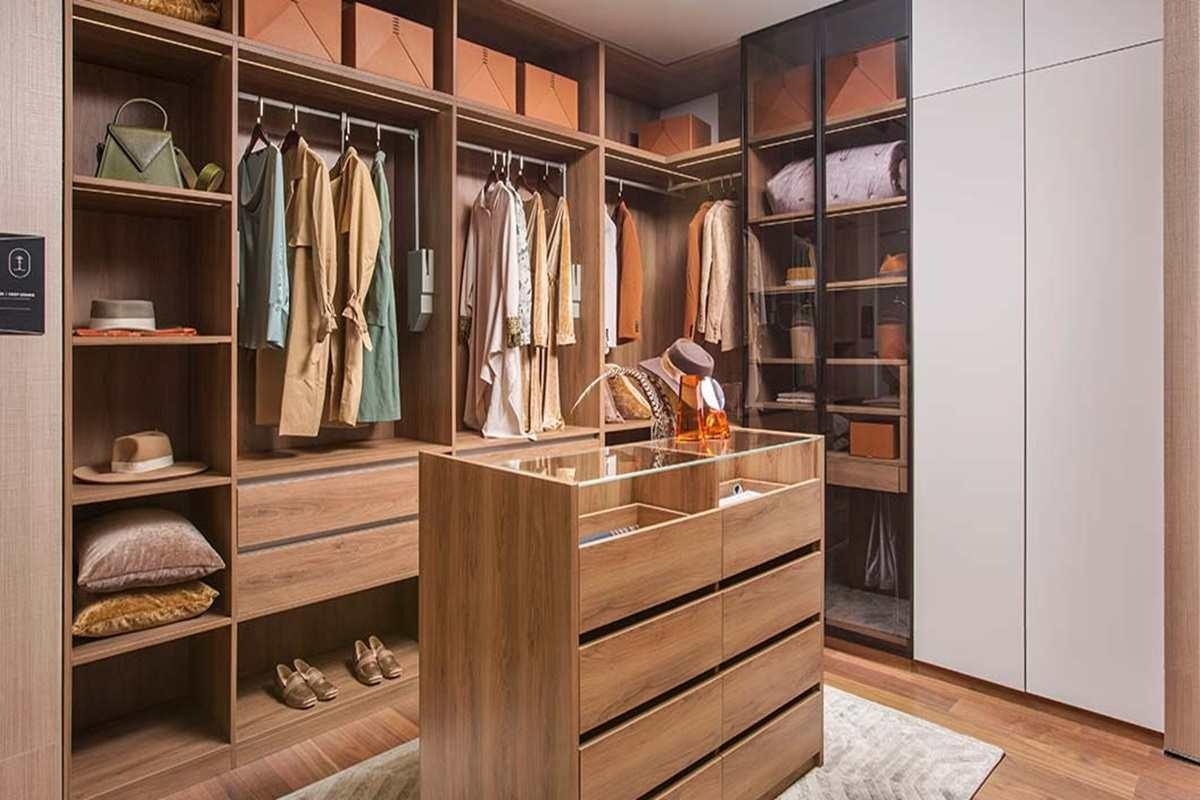


When a Wardrobe Manufacturer Becomes an Industry Benchmark
In the world of custom joinery, reputation travels slowly but sticks hard. A joinery manufacturer that consistently delivers precise cuts, flawless finishes, and reliable hardware earns something more valuable than any single contract: word‑of‑mouth that crosses borders and lasts for decades.
OPPEIN has earned exactly that kind of reputation. Founded in Guangzhou in 1994, the company began with kitchen cabinets but soon expanded its reach. In 2006 — twelve years into its history — OPPEIN made a decision that would reshape the company’s future: it entered the wardrobe market. That move turned out to be the beginning of a transformation not just for the brand, but for the entire industry.
Today, OPPEIN is part of a home solutions giant that reported 2025 annual revenue of 172.32 billion yuan — ranking first among all Chinese custom home furnishing companies. Wardrobes and matching furniture alone generated 88.55 billion yuan, accounting for over 51% of total revenue — more than the company’s entire kitchen cabinet business. Globally, OPPEIN has become a benchmark.
So why do other joinery manufacturer professionals look up to OPPEIN? The answer lies in four measurable advantages: massive scale delivered with consistency, world‑class design recognised by international awards, industry‑leading environmental standards, and a truly global footprint.
Revenue Scale That Speaks for Itself
If you’ve managed sourcing for a large hotel chain or a multi‑unit housing development, you know that consistency matters as much as quality. The larger the project, the harder it is to find a joinery manufacturer that delivers identical products across each unit without variation.
OPPEIN solved this through sheer industrial scale. In 2024, the company‘s wardrobe segment revenue reached 97.91 billion yuan, roughly 15 billion higher than the second‑placed competitor. That gap isn’t marketing — it’s the result of a manufacturing system capable of producing hundreds of thousands of wardrobes annually while maintaining the same standards.
This scale is powered by OPPEIN‘s five major manufacturing bases — in Tianjin, Qingyuan, Wuxi, Chengdu and Wuhan. At the Wuhan facility alone, 34 months of construction resulted in 560,000 square metres of factory space, roughly equivalent to 78 standard football fields. In its first year of operation, the base achieved ¥570 million in output, a testament to how quickly high‑volume production can be brought online.
For a joinery manufacturer evaluating competitors, scale signals stability. A workshop that produces a few thousand units annually may struggle to fill a 500‑unit hotel project without subcontracting work to multiple suppliers — introducing inconsistency. OPPEIN controls every stage of production within vertically integrated facilities, ensuring that wardrobe No. 1 and wardrobe No. 1,000 match perfectly.
Automation That Rivals the Best in Europe
Industry professionals who visit OPPEIN‘s factories often leave with a different impression than they expected. The heaviest investment isn‘t in showrooms or marketing — it’s in production equipment.
OPPEIN has maintained a partnership with HOMAG, one of the world‘s leading suppliers of woodworking machinery, for over two decades — 24 years as of recent records. The relationship began in 1997 with a single German‑imported panel saw, and has since grown into one of HOMAG’s largest customer relationships globally. The company currently operates approximately 1,700 HOMAG machines across its facilities. In 2017 alone, OPPEIN placed a single order for 307 HOMAG machines with a total value exceeding €30 million, including automated panel saws, edge banders and CNC machining centres. To date, OPPEIN Group has purchased HOMAG equipment totalling ¥2 billion.
But automation isn‘t just about the equipment count. At OPPEIN’s Wuhan facility, a single fully automated production line is designed to process 600 orders per day; with five such lines operating, daily capacity reaches 3,000 orders. At the Qingyuan base, automated lines handle seven boards simultaneously, achieving a cutting speed of 170 pieces per hour — enough to produce one wardrobe frame every minute. Each board carries a unique QR code, allowing customers to track their order through every stage of production.
This level of automation has earned OPPEIN formal recognition: the Qingyuan base was certified as a “National Green Factory” in 2025, and the company‘s quality management system was assessed at the 4σ advanced industry standard level, with first‑pass yields exceeding 98% and internal quality loss rates below 1%.
For any serious joinery manufacturer, these numbers put OPPEIN in a different league. The equipment is world‑class. The error rates are low. And the proof is published.
Design That Wins International Awards
Scale and automation alone don’t earn respect from peers. A joinery manufacturer that can’t produce beautiful work will never be an industry reference point.
OPPEIN wardrobes have proven their design credentials on the global stage. The “Star Atlas” (Xingtu) series, part of the company‘s high‑end whole‑home customisation line, won a Gold Award at the 2022 MUSE Design Awards in New York — a competition that received nearly 40,000 entries from over 100 countries. The company’s luxury sub‑brand OPPOLIA also secured Silver and Bronze Design Awards at the 2024‑2025 Furniture Design Award competition.
Beyond awards, OPPEIN has embedded international design thinking directly into its operations. Since 2012, the company has maintained a dedicated design centre in Milan, Italy, and established an International Designer Alliance working with renowned Italian designers. The Milan office ensures the company’s catalog stays aligned with evolving European aesthetics, while adapting those designs for practical, high‑volume manufacturing.
For industry peers, this matters because it proves that OPPEIN isn’t just copying European styles — it’s contributing original work that judges across the world consider worthy of recognition. Whether a wardrobe is destined for a luxury apartment in Paris or a family home in Sydney, the design has been vetted by the same standards that apply to prestigious European brands.
Environmental Standards That Lead the Industry
One of the quietest but most impactful ways OPPEIN has earned the respect of joinery manufacturer professionals is through environmental compliance. In the global furniture industry, safety standards aren‘t optional — they’re a baseline requirement for entry into regulated markets like the European Union and North America.
OPPEIN holds ISO 9001 (quality management) and ISO 14001 (environmental management) certifications, along with FSC certification for responsible wood sourcing and CARB compliance for low formaldehyde emissions in wood products. Its formaldehyde‑free boards have earned both US NAF certification (No Added Formaldehyde) and US CARB certification — meaning they meet California‘s Air Resources Board standards, among the toughest globally.
The most significant indicator of OPPEIN’s leadership, however, is its role in writing industry rules. The company has served as a principal drafting unit for three Chinese national standards covering formaldehyde emission limits, odour grading and evaluation, and VOC emission classification for wood panels. These standards were developed in collaboration with the China National Forestry and Grassland Administration, the National Technical Committee for Wood‑based Panels Standardisation, and multiple research institutions.
GB 18580-2025, the compulsory national standard on formaldehyde emissions that OPPEIN helped draft, raised the mandatory limit to E0 grade (≤0.050 mg/m³) for the first time — setting a new baseline for the entire wood panel industry. OPPEIN also co‑authored T/CNFPIA 3041‑2025, a standard focused on formaldehyde‑purifying decorative wood panels.
For a joinery manufacturer operating in tightly regulated export markets, this matters. It means OPPEIN isn’t just complying with standards — it’s helping create them. That level of involvement signals a depth of technical expertise that industry peers genuinely respect.
Global Projects That Prove the Capability
Respect from industry peers doesn’t come from sales volume alone — it comes from successful projects where the stakes are high and the margins for error are zero.
OPPEIN has completed over 180,000 international projects since its founding, serving more than 15 million families globally. The company exports to over 100 countries, and its branded stores now cover 62 countries and regions across six continents.
One standout example is the Hilton Apartment Hotel in Juan Dolio, Dominican Republic — a seaside luxury property where OPPEIN supplied 145 units of bespoke joinery, including kitchen cabinets, wardrobes, bathroom vanities and countertops. The project illustrates OPPEIN‘s ability to deliver high‑volume, fully customised joinery for international hospitality clients — a market segment that demands both speed and precision.
Earlier, in 2016, OPPEIN secured the Australia 108 tower project in Melbourne — a landmark residential skyscraper that required over 1,100 apartments worth of cabinets, wardrobes and storage solutions. That single contract demonstrated OPPEIN’s capacity to handle mega‑projects on a timeline and scale that few joinery manufacturer companies can match.
In 2024, OPPEIN opened a flagship store in Panama, where the newly inaugurated president of Panama attended the ribbon‑cutting ceremony in person — a rare honour that reflects the brand‘s growing prestige in international markets.
For other professionals in the joinery industry, these projects send a clear message: OPPEIN isn’t just a big factory. It‘s a supplier that has delivered on the world’s most demanding stages.
Why Industry Peers Pay Attention
Ask a mid‑sized joinery manufacturer what matters most to them, and the answer usually includes three things: reliable equipment, consistent quality and steady demand. OPPEIN delivers on all three counts.
The company’s partnership with HOMAG — 24 years of collaboration, ¥20 billion worth of equipment, and an Industry 4.0‑ready production system — signals that OPPEIN has made the capital investments that serious joinery professionals respect. Its quality control systems, with first‑pass yields above 98% and internal loss rates below 1%, demonstrate operational discipline that many peers admire but struggle to achieve. And its global project portfolio — including Hilton hotels, Australian skyscrapers and luxury developments across six continents — proves that OPPEIN isn‘t just a Chinese manufacturer, but a global player capable of competing anywhere.
For a joinery manufacturer looking to benchmark its own operations against the best in the world, OPPEIN provides a reference point. Not unreachable — but certainly inspiring.