







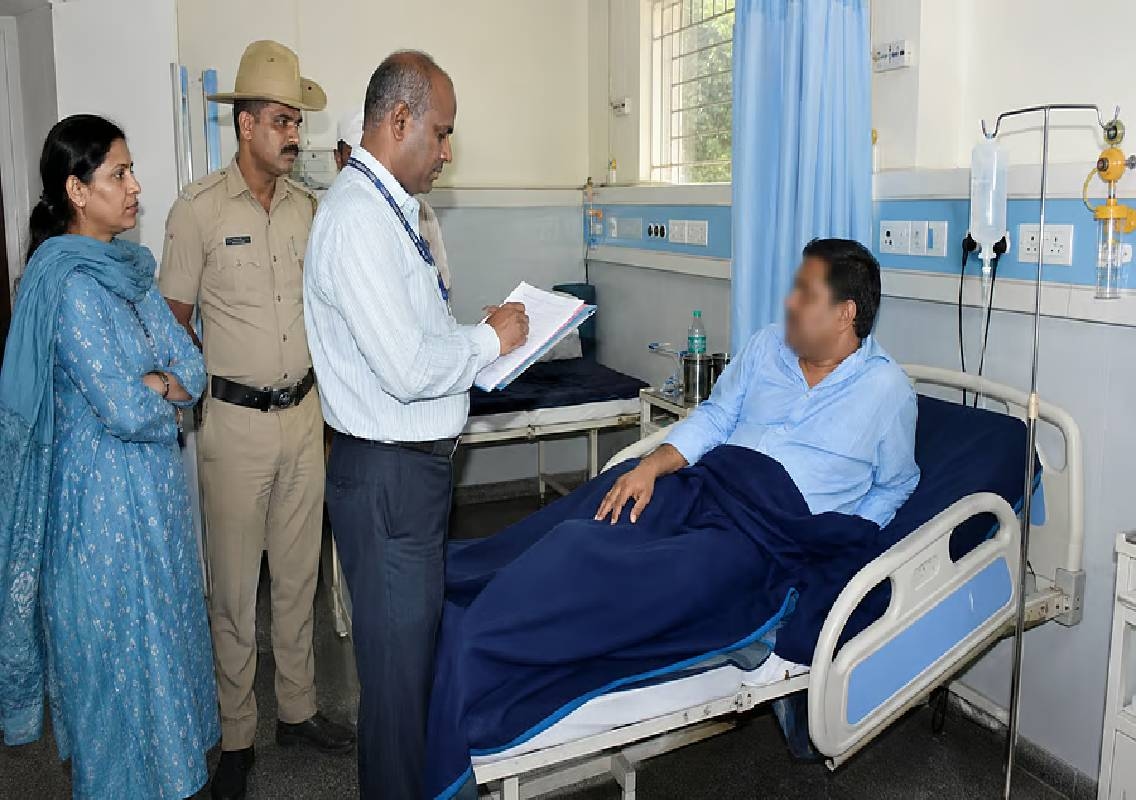


Mandya: A surprise inspection at the Mandya Institute of Medical Sciences (MIMS) has raised serious questions over the treatment and custody of an undertrial government official after he was found in a special hospital ward with a woman identified as his girlfriend. The inspection also found that the officer had been hospitalised without court permission and, according to officials, did not have a serious medical condition requiring prolonged treatment.
The official, Mohammad Hussain, an Assistant Director of Land Records (ADLR) associated with Srirangapatna, was arrested by the Karnataka Lokayukta in connection with alleged irregularities at the Srirangapatna Taluk Land Records Office. He had been remanded to judicial custody before being admitted to MIMS Hospital.
The incident came to light during a surprise inspection conducted by legal authorities, prompting questions about how an undertrial prisoner was allowed to remain in a special ward and how a woman was permitted to enter the room.
Surprise inspection exposes alleged security lapse
The inspection was carried out at MIMS Hospital in Mandya by officials associated with the Karnataka State Legal Services Authority (KSLSA) and Mandya District Legal Services Authority (DLSA). Mandya District and Sessions Judge C Chandrashekar was part of the inspection team.
During the inspection, the team checked the arrangements for undertrial prisoners receiving treatment at the hospital.
Hussain was found staying in a special room rather than in a regular ward. Officials questioned medical staff about his condition and reportedly found that he did not have a serious illness that warranted prolonged hospitalisation.
The inspection then took an unexpected turn when officials found a woman in the same room.
According to reports, the woman identified herself as Hussain’s girlfriend when questioned about her presence. Her presence in a room occupied by an undertrial prisoner immediately raised questions about security and visitor-control procedures at the hospital.
Hussain was admitted to MIMS after arrest
Hussain had been arrested in connection with alleged irregularities at the Srirangapatna Taluk Land Records Office.
According to reports, he was arrested by Lokayukta authorities and remanded to judicial custody on July 3. He was subsequently admitted to MIMS Hospital on the recommendation of the jail medical officer.
The circumstances of his hospitalisation became a key point during the inspection.
Officials found that there was no court permission for his stay in the hospital. They also found that there was apparently no serious medical condition requiring him to remain in a special ward for an extended period.
The findings have raised questions about whether the appropriate procedures were followed before transferring an undertrial prisoner from jail to hospital.
Jail authorities questioned over hospital stay
The inspection team questioned jail officials about why Hussain had been admitted to MIMS and whether the court had been informed about the transfer.
Jail authorities reportedly said the admission was based on the recommendation of the jail doctor. However, officials acknowledged that the court had not been informed about the hospitalisation.
The judge reportedly reprimanded the jail authorities over the issue and sought an explanation regarding the circumstances under which Hussain was admitted to the hospital.
The incident has highlighted the importance of maintaining proper communication between jail authorities, courts and medical institutions when an undertrial prisoner requires hospital treatment.
Undertrial prisoners remain in judicial custody while their cases are pending, meaning that hospitalisation does not automatically remove the requirement for appropriate custodial supervision.
Woman found in special ward raises questions
The presence of a woman in Hussain’s hospital room has emerged as one of the most notable aspects of the inspection.
Reports identified her as Hussain’s girlfriend. Officials are now examining how she gained access to the special room and whether the security personnel assigned to guard the undertrial prisoner followed the required procedures.
The incident has raised questions about visitor verification and access control at hospitals where prisoners and undertrial accused persons are receiving treatment.
A hospital room occupied by an undertrial prisoner requires additional security because the person remains under custody. Any unauthorised or inadequately monitored access could potentially create security concerns.
A police officer cited in reports said action was being taken against personnel deployed as escorts and those responsible for allowing the woman to enter.
Case linked to alleged land records irregularities
Hussain’s arrest itself is connected to an alleged case involving irregularities in the functioning of the Srirangapatna Taluk Land Records Office.
According to reports, he was accused of entering the office illegally and allegedly assisting in land-related work involving Akarband records, digitisation and the creation of documents using government software.
The allegations are part of the case for which he was taken into custody.
The latest incident at MIMS is separate from the original allegations against him and concerns his hospitalisation and custodial arrangements while he is an undertrial.
It is important to note that the allegations against Hussain have not been established as guilt through a final court verdict.
Legal authorities seek detailed reports
Following the surprise inspection, the authorities sought detailed reports from both the jail administration and MIMS medical authorities regarding Hussain’s admission and stay.
The reports are expected to examine why the undertrial was admitted, the medical basis for his treatment, whether the required permissions were obtained and how security arrangements were maintained during his hospital stay.
Authorities are also expected to examine the circumstances surrounding the woman’s entry into the room.
The inspection has therefore moved beyond the question of Hussain’s individual conduct and towards the wider issue of accountability among officials responsible for his custody and treatment.
Questions over special treatment
The use of a special ward for an undertrial who reportedly did not have a serious medical condition has also prompted concerns over whether he received preferential treatment.
Hospitalisation of prisoners can be necessary when medical treatment cannot be provided adequately inside a prison. However, such transfers generally require proper medical justification and appropriate custodial arrangements.
In this case, officials reportedly found no serious medical condition that warranted prolonged hospitalisation, making the circumstances of the admission a central issue in the inquiry.
The absence of court permission has further intensified questions about the procedure followed by the authorities.
Security arrangements under scrutiny
The episode has also put the spotlight on the responsibility of personnel assigned to guard undertrial prisoners receiving medical care.
When a prisoner is moved from jail to hospital, security arrangements need to ensure that the person remains under custody while allowing doctors to provide necessary treatment.
Reports indicate that authorities are examining the role of personnel deployed as escorts as well as those responsible for allowing the woman to enter the hospital room.
If officials are found to have violated established procedures, disciplinary or other action could follow, depending on the findings of the inquiry.
The authorities have not yet publicly established individual responsibility for the alleged lapses.
MIMS incident highlights institutional coordination
The incident also highlights the need for coordination between the judiciary, prison administration, police and government hospitals.
An undertrial prisoner requiring hospital treatment involves multiple agencies. Medical authorities determine the need for treatment, prison or police personnel oversee custody, and courts retain jurisdiction over the judicial custody arrangement.
Any breakdown in communication between these institutions can create administrative and security problems.
In Hussain’s case, the reported absence of court information about his hospitalisation has become a particularly important issue for the authorities examining the incident.
Surprise inspections play an important role
The incident demonstrates the role that surprise inspections can play in identifying irregularities in institutions handling prisoners and undertrial accused persons.
A routine inspection might not necessarily have revealed the same circumstances. The surprise visit allowed officials to directly examine the hospital ward, question medical personnel and check the custody arrangements.
Such inspections can help identify gaps that may otherwise remain unnoticed.
The findings at MIMS could therefore lead to closer scrutiny of procedures followed when undertrial prisoners are admitted to hospitals across the State.
Investigation and action underway
Authorities have indicated that further action is being taken following the inspection.
According to reports, action is being considered against personnel responsible for escorting the undertrial and those responsible for allowing the woman to enter the hospital.
A report has also been sought from the relevant jail and medical authorities.
The exact nature of any disciplinary or legal action will depend on the findings of the investigation. At this stage, the inspection has established concerns about the circumstances surrounding Hussain’s hospital stay, but responsibility for individual lapses will have to be determined through the appropriate process.
Why the incident matters
The Mandya incident has drawn attention because it involves several questions at the same time: the medical necessity of hospitalisation, the absence of reported court permission, the use of a special ward and the presence of an unauthorised visitor.
For authorities, the episode presents an opportunity to review how undertrial prisoners are transferred to hospitals and how their custody is maintained during treatment.
For the judiciary and legal services authorities, such inspections are important for ensuring that prisoners and undertrials receive lawful treatment while also ensuring that custodial rules are followed.
Conclusion
The surprise inspection at MIMS Hospital in Mandya has exposed alleged lapses in the treatment and custody arrangements of undertrial government official Mohammad Hussain. The Assistant Director of Land Records was reportedly staying in a special ward despite no serious medical condition being identified, while a woman who identified herself as his girlfriend was found in the room.
Questions have also been raised over the absence of court permission for his hospital stay and whether jail and security officials followed the required procedures. Authorities have sought reports from the jail and hospital administrations, while action is reportedly being considered against personnel responsible for his custody and the woman’s entry.
The incident is now likely to be examined as a possible custodial and administrative lapse, with further action dependent on the findings of the ongoing inquiry.