







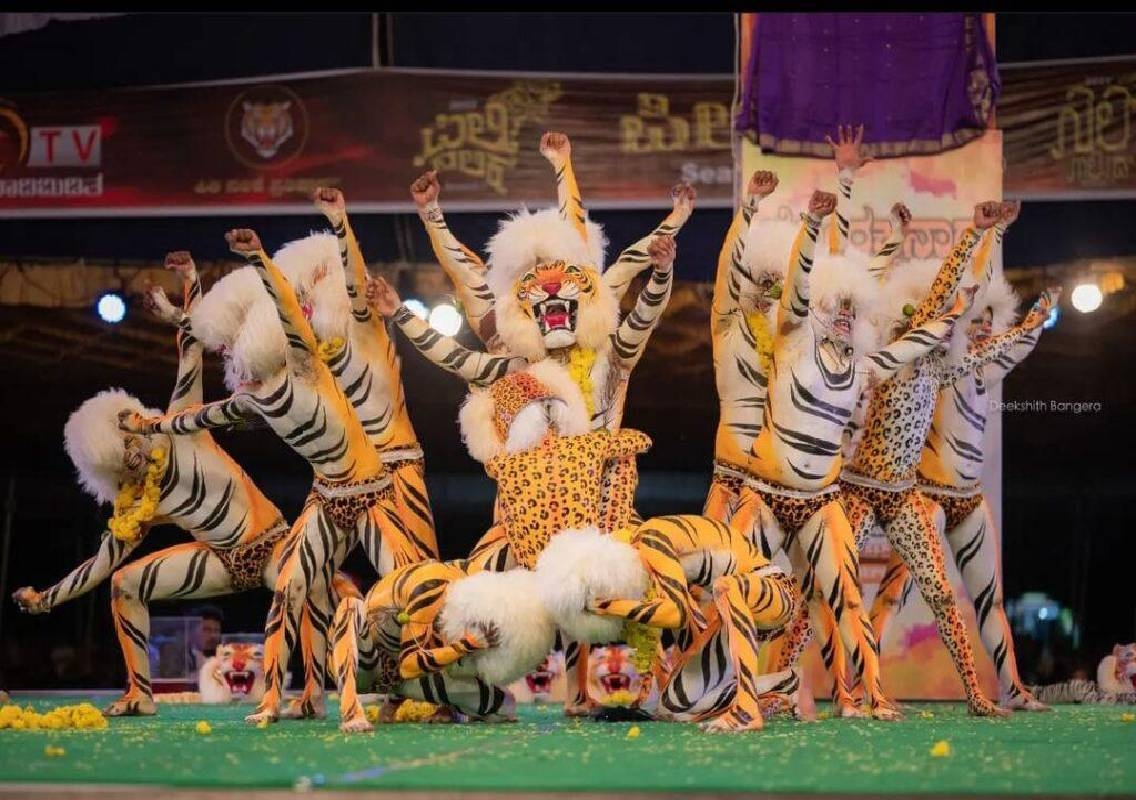


Mangaluru: The Bajilakeri Tigers, a Hulivesha team led by Shailesh Bajilakeri, is set to take part in a tiger dance competition in neighbouring Kerala during the Onam celebrations. The team is scheduled to participate in a competition near Kasaragod Junction, marking what organisers describe as a historic first for the Hulivesha group.
The team is associated with the Hindu Jagarana Vedike, Talapady division, and recently held an oodu pooje programme at Devipura in Talapady ahead of its participation in the Kerala event. Several dignitaries and supporters attended the programme and extended their wishes to the team.
Bajilakeri Tigers prepare for Kerala event
The Bajilakeri Tigers have been preparing to showcase the traditional tiger dance form in Kerala as part of the Onam festivities.
According to the information shared by the organisers, the team will participate in a competition featuring various tiger dance groups near Kasaragod Junction. The event is expected to bring together performers who will showcase their skills, costumes, choreography and traditional presentation.
For the Bajilakeri team, the participation has a special significance as it takes the Hulivesha tradition of coastal Karnataka across the State border.
The team is being led by Shailesh Bajilakeri, who has been associated with the group and its activities.
Historic participation for Hulivesha team
The participation has been described as a first in the history of the team, with Bajilakeri Tigers becoming the first Hulivesha group from the region to take part in the Kerala tiger dance competition.
Hulivesha, popularly known as tiger dance, is a vibrant folk performance associated with the coastal Karnataka region. Performers dress and paint themselves as tigers and dance to the rhythm of traditional percussion instruments.
The art form has a strong cultural connection with the coastal districts, particularly Dakshina Kannada and Udupi, where Hulivesha performances are traditionally associated with festivals and celebrations.
The Bajilakeri Tigers’ participation in Kerala provides an opportunity for the team to present this regional tradition before an audience familiar with its own form of tiger dance.
Onam brings tiger dance traditions together
The Kerala competition is being organised in connection with Onam, one of the State’s major festivals.
Kerala’s Pulikali, or tiger play, is traditionally performed during the Onam season. Performers paint their bodies in tiger patterns and dance to the beats of percussion instruments. The art form is particularly associated with Thrissur and has become one of the colourful cultural attractions of Onam.
This makes the participation of a Hulivesha team from Mangaluru particularly significant from a cultural perspective.
While Hulivesha and Pulikali have their own regional traditions and styles, both use the tiger as the central visual and performance theme.
The Kerala event will therefore bring together performers from different cultural backgrounds who share a common artistic theme.
Oodu pooje held at Talapady
Ahead of the competition, an oodu pooje programme was organised at Devipura in Talapady.
The event was attended by several dignitaries, supporters and well-wishers of the Bajilakeri Tigers.
The ceremony marked the team’s preparations for its journey to Kerala and participation in the competition.
Those present at the programme extended their best wishes to the team and expressed hope that the Bajilakeri Tigers would return with a strong performance and victory.
The gathering also highlighted the community support behind the team’s participation.
Wishes pour in for Bajilakeri Tigers
During the programme, dignitaries and supporters wished the team success in Kerala.
The participation has generated interest among followers of Hulivesha in the coastal Karnataka region, particularly because the team will be presenting the local tradition outside Karnataka.
The wishes extended during the programme reflected the enthusiasm surrounding the team’s participation and the pride associated with taking a traditional local art form to a neighbouring State.
For the performers, the competition will also provide an opportunity to interact with other tiger dance groups and observe different performance styles.
Hulivesha’s cultural significance
Hulivesha is one of the distinctive folk performance traditions associated with coastal Karnataka.
The performers traditionally transform themselves into tiger-like characters through elaborate body painting and costumes. Accompanied by drums and energetic movements, the performances are often a major attraction during local festivals and public celebrations.
The tiger imagery and energetic movements make Hulivesha visually striking.
Over the years, several Hulivesha teams from Dakshina Kannada and Udupi have participated in cultural programmes and processions, helping keep the tradition visible among younger generations.
The Bajilakeri Tigers’ participation in the Kerala competition adds another dimension to this cultural exchange.
Kerala’s Pulikali tradition
The Kerala event is connected to Pulikali, a traditional folk art performed during Onam.
Pulikali literally refers to the play of the tiger, and performers typically appear in bright tiger patterns while dancing to percussion beats. The tradition is especially prominent in Thrissur, where large-scale performances attract audiences during the Onam season.
The tradition is different from Hulivesha in its regional character, performance practices and historical development.
However, both art forms use tiger imagery and energetic dance as their central elements.
The participation of the Bajilakeri Tigers can therefore be viewed as an opportunity for two related but distinct cultural traditions to meet on the same platform.
Competition near Kasaragod Junction
The Bajilakeri Tigers are expected to participate in the competition near Kasaragod Junction.
Various teams are expected to take part in the event, creating a competitive platform for tiger dance performers.
For the Bajilakeri group, the challenge will be to stand out through its choreography, costumes, coordination and traditional presentation.
The event will also provide an opportunity for audiences in Kasaragod to witness the Hulivesha style associated with coastal Karnataka.
Cultural connection between coastal Karnataka and Kerala
The participation also reflects the close cultural relationship between coastal Karnataka and northern Kerala.
The regions share historical, linguistic, social and cultural connections, particularly across the Dakshina Kannada-Kasaragod border.
Traditional art forms, festivals, food traditions and community practices have often crossed the State boundary.
The Bajilakeri Tigers’ participation is another example of such cultural interaction.
The event could help introduce more people in Kerala to the distinctive Hulivesha tradition of coastal Karnataka while allowing the performers to experience Kerala’s own tiger dance culture.
Shailesh Bajilakeri leads the team
The Bajilakeri Tigers are being led by Shailesh Bajilakeri.
Under his leadership, the team is preparing to represent its traditional art form at the Kerala competition.
The team members are expected to bring their experience in Hulivesha performances to the event and compete alongside other groups.
Participation in an event outside Karnataka can also help local performers gain wider recognition and encourage greater interest in traditional folk arts.
Support from the local community
The oodu pooje programme at Talapady also demonstrated the support received by the team from the local community.
Community participation is an important part of sustaining traditional folk performances.
Such programmes give performers encouragement before major events and help create awareness about the cultural significance of the art form.
The support extended to the Bajilakeri Tigers reflects the interest in seeing local traditions represented at larger cultural events.
A platform for cultural exchange
The Kerala competition is more than a contest for the participating team.
It offers a platform for cultural exchange between Karnataka and Kerala.
Performers from different groups can observe each other’s styles, costumes and techniques, while audiences can experience variations of a common tiger-dance theme.
Such events can contribute to preserving traditional art forms by giving performers opportunities to present them before new audiences.
Significance for young performers
Traditional folk arts face the challenge of attracting younger generations in an era dominated by modern forms of entertainment.
Events such as this can provide young performers with a platform to develop their skills and remain connected with local cultural traditions.
For members of the Bajilakeri Tigers, participation in a major event in Kerala could also become an important experience in their performance journey.
Recognition at such competitions can encourage performers to continue investing time and effort in traditional arts.
Bringing Hulivesha beyond Karnataka
The Bajilakeri Tigers’ participation represents an opportunity to take Hulivesha beyond its traditional geographical setting.
While the art form is well known in coastal Karnataka, audiences outside the region may be less familiar with its distinctive style.
Performing in Kerala allows the team to introduce its version of tiger dance to people who already have an appreciation for Pulikali.
This could help create greater awareness about the diversity of tiger dance traditions across southern India.
Expectations from the competition
Supporters of the Bajilakeri Tigers are hoping that the team will put up a strong performance and secure a victory in Kerala.
The wishes expressed during the Talapady programme reflect the enthusiasm surrounding the team’s participation.
The competition will test the team’s coordination, performance energy and ability to adapt to a new competitive environment.
Regardless of the final result, the participation itself is being seen as an important milestone for the group.
A milestone for coastal Karnataka’s folk arts
The Bajilakeri Tigers’ Kerala appearance could become a notable moment for coastal Karnataka’s folk performance traditions.
The group will not only compete but also represent a form of cultural expression strongly associated with the region.
As the team prepares for the event near Kasaragod Junction, attention will be on how the performers present Hulivesha alongside Kerala’s established tiger dance traditions.
The event could also encourage further cultural exchanges between performers from the two neighbouring States.
Conclusion
Mangaluru: Bajilakeri Tigers from Talapady are set to participate in a tiger dance competition in Kerala during the Onam celebrations, marking a significant milestone for the Hulivesha team.
Led by Shailesh Bajilakeri, the team is expected to compete alongside various groups near Kasaragod Junction. The participation has been described as a historic first for the team, taking the Hulivesha tradition of coastal Karnataka to a Kerala competition.
Ahead of the event, an oodu pooje was held at Devipura in Talapady, where several dignitaries and supporters extended their wishes to the performers.
With Kerala’s Pulikali and Karnataka’s Hulivesha sharing the central theme of the tiger, the event also offers a unique opportunity for cultural exchange. The Bajilakeri Tigers will now look to make their mark in Kerala and showcase the distinctive performance tradition of coastal Karnataka.