


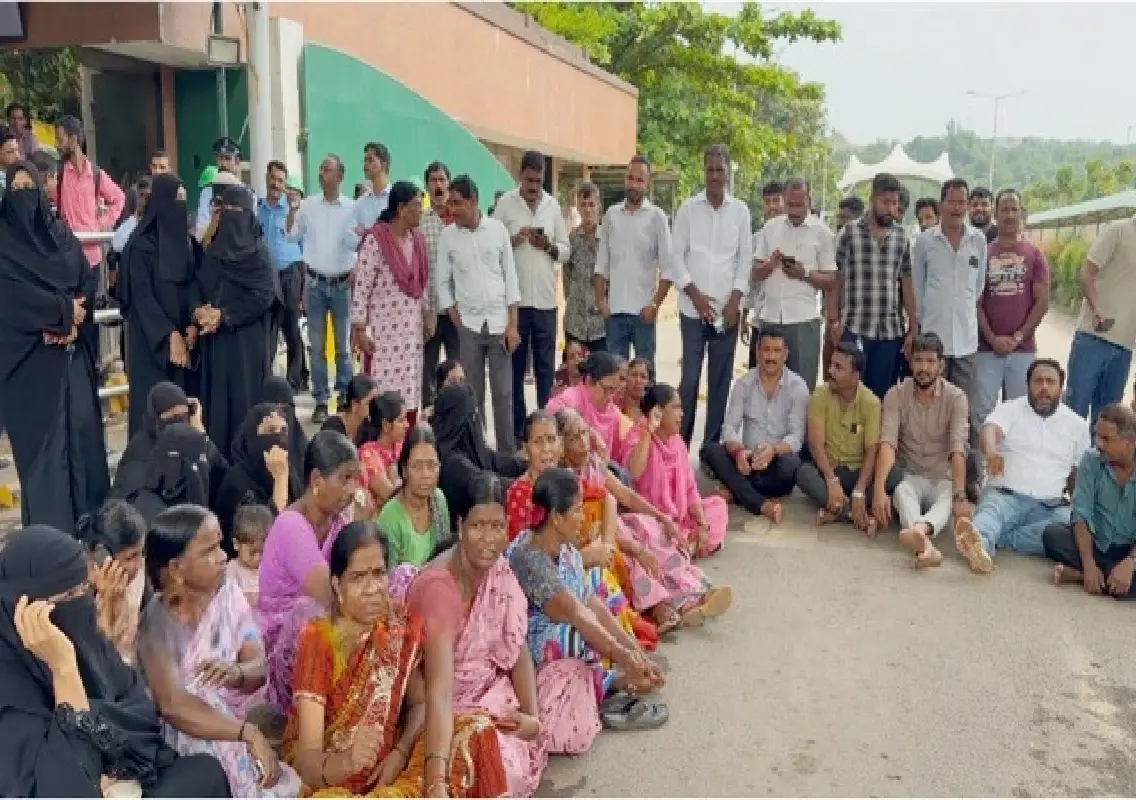


Mangaluru: Tension prevailed near the main entrance of the Mangaluru Special Economic Zone (MSEZ) at Bajpe on Tuesday, November 3, as residents staged a protest demanding immediate action over alleged pollution from the Gail Mangalore Petrochemicals Limited (GMPL) unit.
The protest was triggered by complaints that powder-like particles, suspected to have originated from the industrial facility, had settled on houses, courtyards and even drinking water wells in Dhoomavathi Daama and neighbouring residential areas on Monday night. The incident raised concerns among residents about possible health risks and the safety of their drinking water.
As the protest intensified, police personnel intervened and moved the protesters away from the entrance to bring the situation under control.
Residents allege repeated pollution incidents
Residents alleged that the GMPL unit, which manufactures Purified Terephthalic Acid (PTA), had been causing environmental disturbances in the surrounding localities for several months.
According to the protesters, the complaints included loud noises during night hours, smoke and dust emissions, and the alleged discharge of contaminated water into the Phalguni River.
They expressed disappointment over what they described as the lack of a lasting response despite repeated complaints to the concerned authorities and district administration.
The latest incident involving powder-like particles reportedly settling on residential properties and water sources intensified their concerns. Residents said the material had been noticed on rooftops, courtyards and around drinking water wells, prompting questions about its origin and composition.
However, the exact nature of the particles has not yet been established. Their chemical composition and potential effects on human health remain unknown pending scientific examination.
Demand for scientific testing of samples
A key demand raised during the protest was the immediate collection and scientific testing of samples from the affected residential areas.
Residents called for samples to be collected from rooftops, courtyards and drinking water wells and analysed at laboratories accredited by the National Accreditation Board for Testing and Calibration Laboratories (NABL).
They sought a detailed report identifying the chemical composition of the powder-like material and determining whether it contained hazardous substances. They also demanded an assessment of its possible short-term and long-term effects on human health.
The protesters said scientific testing was necessary to establish whether the material posed a risk to residents and their drinking water sources. They stressed that conclusions about its safety should be based on laboratory findings rather than assumptions.
Joint inspection and Phalguni River assessment sought
The residents also demanded a joint inspection of the GMPL facility by the Karnataka State Pollution Control Board (KSPCB) and the district administration.
The proposed inspection, they said, should examine emissions from the unit, including smoke and dust, as well as noise levels and wastewater discharge. They sought a technical investigation to determine whether the latest incident was connected to the industrial operations.
Another major concern raised by the protesters was the alleged discharge of contaminated water into the Phalguni River. They called for an independent assessment of the river’s water quality to establish whether industrial discharge had affected it.
Residents urged the authorities to examine the available evidence, verify the complaints and take appropriate action if any violations of environmental regulations were found.
Local representatives and protest committee join agitation
The protest was led by the president and councillors of Bajpe Town Panchayat, along with the president and members of the local protest committee and residents of the surrounding areas.
The participants collectively sought accountability from the GMPL management and called on the district administration and relevant departments to ensure the safety of people living near the industrial facility.
They maintained that the concerns required an urgent response, particularly because the reported particles had allegedly reached residential properties and drinking water sources.
Residents seek preventive measures
The protesters warned that industrial development should not come at the expense of public health, access to safe drinking water and environmental protection.
They urged the district administration to inspect the affected localities without delay, arrange scientific testing and publish the findings. They also called for appropriate legal action if any environmental violations were established.
The residents further sought precautionary measures to prevent a recurrence of the incident and demanded that the authorities address their longstanding complaints about noise, emissions and wastewater discharge.
With the composition of the powder-like particles and their source yet to be confirmed, residents are seeking a scientific investigation and a coordinated response from the pollution control authorities and district administration. The findings of the proposed tests and inspections will be important in determining the nature of the incident and whether further action against the industrial unit is warranted.