







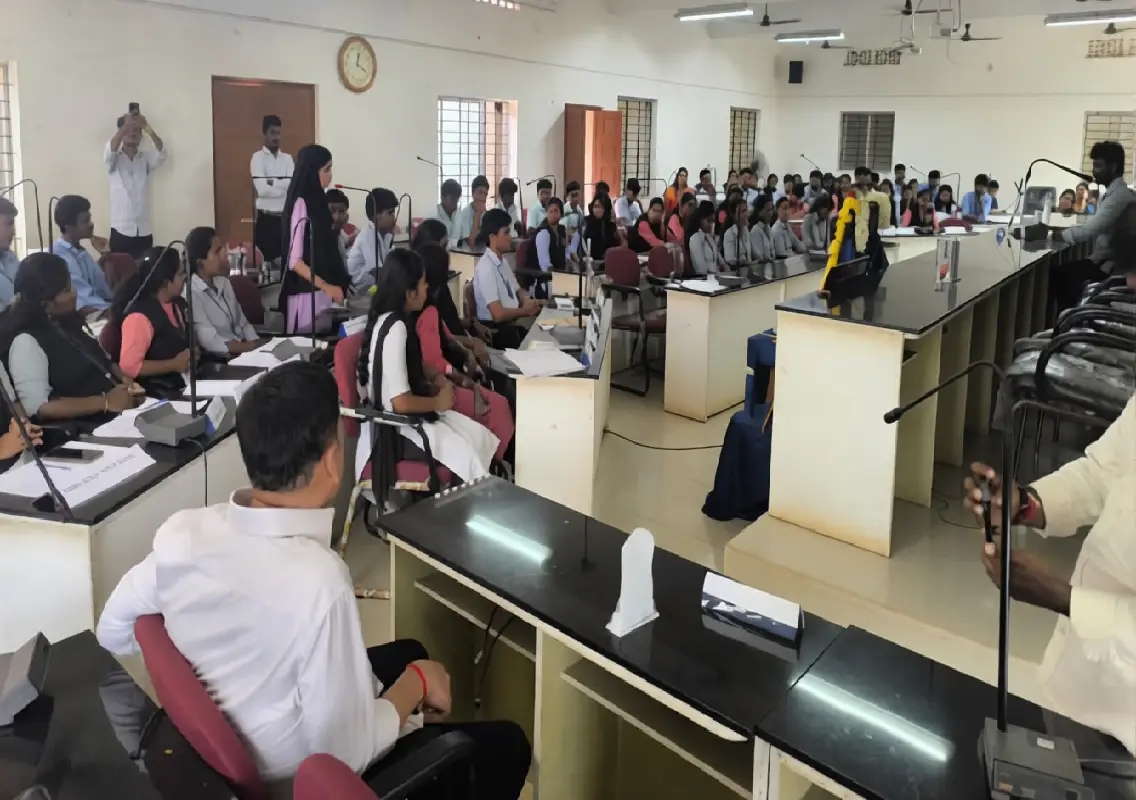


Bantwal: Unemployment, inadequate college infrastructure, scholarship delays, healthcare shortages, rural transport and drug abuse came under scrutiny as students from six colleges participated in a Youth Parliament session at the Bantwal taluk panchayat meeting hall on Friday.
Modelled on the proceedings of a legislative assembly, the programme gave students an opportunity to assume the roles of elected representatives, ministers, opposition members and the Speaker. Through questions, supplementary queries and debates, they highlighted issues affecting their communities and sought accountability from the government.
The session went beyond routine questioning, with students examining the reasons behind public problems, challenging the responses of the ruling party and suggesting possible solutions. The discussions reflected the concerns of young people about education, employment, public services and social justice.
Unemployment and education dominate discussions
Education and employment emerged as the central themes of the Youth Parliament. Students questioned the purpose of higher education if graduates continued to struggle to find jobs and sought details of measures to improve employment opportunities.
Responding to the concerns, Chief Minister Punit Kumar said steps were being taken to make students employment-ready through various initiatives, including skill development programmes at school and college levels.
The condition of government colleges in rural areas also came under sharp criticism. Students highlighted the shortage of basic infrastructure, clerical staff and toilets, questioning why institutions in backward areas continued to function without adequate facilities.
They also raised concerns over delays in the recruitment of guest lecturers. Despite recruitment examinations having been conducted, appointments had reportedly not been completed, affecting the delivery of education.
Students pointed out that the shortage of teaching staff had reached a stage where students were teaching other students. They sought accountability from the government and asked when the vacancies would be filled.
Internet connectivity was another concern, with students stating that poor access prevented them from making effective use of digital learning facilities.
Chief Minister Punit Kumar said government schools were being converted into smart schools in phases and that measures were being taken to provide digital learning materials.
Scholarship delays and examination paper leaks
The delay in disbursement of scholarships emerged as another major issue, particularly for students from economically weaker sections and backward communities.
Students questioned why educational institutions imposed penalties for delayed fee payments while there appeared to be little accountability when scholarships were not sanctioned or disbursed on time.
They stressed that timely financial assistance was essential to ensure that deserving students could continue their education without facing additional economic hardship.
The discussion also touched on social and economic justice, with students seeking measures to ensure that government welfare schemes reached those who needed them.
Examination question paper leaks triggered a serious debate, with students highlighting the anxiety and mental stress such incidents caused among young people.
They questioned who should be held responsible when examination irregularities jeopardised students’ futures and contributed to extreme emotional distress, including cases of suicide.
The government assured the House that an investigation would be conducted to identify those involved in question paper leaks.
Rural healthcare facilities face scrutiny
With dengue cases on the rise, students questioned the preparedness of the healthcare system and demanded better medical facilities in rural areas.
They highlighted the shortage of doctors at Vamadapadavu hospital and called for adequate staffing to ensure that residents could access timely treatment without travelling long distances.
The students stressed that healthcare facilities in rural areas needed sufficient medical personnel and resources to respond effectively to local health concerns.
A distinctive moment occurred when opposition members remained silent after hearing the response from Health Minister Ramlath, adding a dramatic touch to the proceedings.
Students demand better rural bus services
Transport-related difficulties faced by students and other residents formed another major part of the debate.
Students demanded additional bus services to rural areas, pointing out that inadequate connectivity affected access to educational institutions and other essential services.
They also highlighted discrepancies between designated bus stops and the locations where buses actually halted, creating inconvenience for commuters.
The lack of proper bus shelters in B C Road was raised, with students urging authorities to provide shelters wherever they were missing.
Transport Minister Stuti assured the House that additional buses would be provided to rural areas. She also said locations lacking adequate bus shelters would be identified and corrective measures taken at the earliest.
The discussion highlighted the importance of reliable public transport in ensuring that students, particularly those from rural areas, could travel safely and reach their institutions on time.
Civic issues, roads and waste management
Several civic problems affecting Bantwal and its surrounding areas were also discussed.
Students raised concerns about waterlogging on roads during rainfall and sought measures to improve drainage and prevent inconvenience to commuters.
The removal of street vendors during road-widening works also came up for discussion. The government said necessary assistance was being provided to ensure that the livelihoods of affected vendors were not adversely impacted.
Waste management was another key issue. Students pointed out that responsibility for maintaining cleanliness rested with both the government and the public.
However, they expressed concern over the continued dumping of garbage at prohibited locations and demanded strict action against those responsible.
The discussion underlined the need for public awareness, effective enforcement and greater civic responsibility to prevent improper waste disposal.
Debate over attracting youth to agriculture
The declining interest of young people in agriculture was also brought before the House.
Students questioned what measures the government was taking to encourage youth to pursue farming, noting that many were moving away from the sector.
The discussion emphasised the need to make agriculture an economically viable employment option rather than merely a traditional occupation.
Students called for government schemes to reach young people effectively and provide the support needed to encourage them to take up agricultural activities.
The debate highlighted the importance of making farming more attractive through appropriate support, opportunities and access to government programmes.
Netravati river diversion project opposed
The proposed Netravati river diversion project became a subject of debate, with students expressing opposition to the project.
They argued that altering the river’s natural course was inappropriate and raised concerns about the implications of diverting its waters.
Presenting the government’s position on behalf of Irrigation Minister Hariraj, it was stated that the project would enable water to be used in ways that would benefit farmers in areas along the river’s course.
The exchange reflected differing views on water management, agricultural needs and the importance of preserving natural river systems.
Of the three bills introduced by the ruling party during the session, only the Netravati Riverbank Safe and Sustainable Urbanisation Bill was passed by a majority in the House.
Students call for stronger action against drugs
Drug abuse and the spread of narcotic substances among young people formed another major part of the proceedings.
Students demanded stricter measures to prevent drugs from reaching school and college campuses. They stressed that the problem required both effective legal action and sustained awareness programmes.
Law and Parliamentary Affairs Minister Hulugamma assured the House that necessary legal measures would be taken to eliminate the drug menace.
The discussion highlighted the need for coordinated efforts involving educational institutions, law enforcement agencies and the wider community to protect young people from substance abuse.
Women’s safety and anganwadi workers’ concerns
The safety of women travelling in rural areas was brought to the attention of the Speaker through several examples.
Students raised concerns about the safety of girls and women in public places and while using public transport. They called for measures to improve security and strengthen women’s confidence when travelling.
The role and working conditions of anganwadi workers also came under discussion.
Students demanded greater recognition for anganwadi workers, who provide essential services at the grassroots level. They called for a reduction in their workload or an increase in salaries to reflect their responsibilities.
Student Social Welfare Minister Akshay responded to various issues concerning the department’s responsibilities.
Constitutional values and social equality
The Youth Parliament also examined broader questions concerning the Constitution and its ideals.
Students asked what measures were being taken to ensure that constitutional principles translated into meaningful action, particularly in addressing exploitation and discrimination.
Chief Minister Punit Kumar said education was an important instrument for eliminating social inequalities.
He said supporting schemes were being formulated to reduce exploitation and discrimination, emphasising the role of education in creating a more equitable society.
The discussion connected local concerns with broader questions of social justice, equal opportunities and the responsibilities of government.
Opposition challenges ruling party over previous regime
The proceedings witnessed sharp exchanges between the ruling party and the opposition over responsibility for public problems.
Ruling party members attributed several issues to the tenure of the previous government. Opposition members challenged this argument and questioned the practice of blaming the previous regime for every problem.
Opposition leader Navya and members Ashalatha, Megha, Sajira, Sri Harshitha and Mahesh participated in the discussions.
The exchanges recreated the adversarial atmosphere of a legislative assembly, with opposition members demanding answers and questioning the government’s explanations.
Speaker maintains order during proceedings
Speaker Bhuvanesh was commended for conducting the session effectively and maintaining legislative discipline.
He followed the question-and-answer format, permitted supplementary questions and ensured that both the ruling party and opposition had opportunities to participate.
As students raised a wide range of issues, the Speaker ensured that discussions remained relevant, gave the concerned ministers an opportunity to respond and guided members whenever necessary.
The format allowed students to experience the responsibilities of legislative representatives while understanding the importance of debate, accountability and parliamentary procedures.
Students from six colleges participate
Students from six colleges across Bantwal taluk took part in the programme. They represented Government First Grade Colleges at Vamadapadavu, Kamaje and Siddakatte; Sri Rama First Grade College at Kalladka; Sri Venkataramana Swamy First Grade College at Bantwal; and Government Pre-University College at B Mood.
The programme began with Speaker Bhuvanesh lighting a lamp before the portrait of Dr B R Ambedkar.
Several officials and dignitaries attended the event, including Deputy Tahsildar Naveen Kumar Benjanapadavu, Advocates’ Association secretary Narendranath Bhandary, Social Welfare Department assistant director Vinaya Kumari, taluk panchayat office superintendent Prakash, advocate Abdul and education coordinator Pratima.
Dr Harinakshi and Rohini, lecturers from various colleges, served as judges. Bantwal MLA Rajesh Naik Ulipady was also present and observed the proceedings.
Students assumed various roles during the session, with Punit Kumar as Chief Minister, Priyadarshini as Deputy Chief Minister, Vidyashree as Home Minister, Stuti as Transport Minister, Akshay as Social Welfare Minister, Rashmitha as Rural Development and Panchayat Raj Minister, Hulugamma as Law and Parliamentary Affairs Minister, Ramlath as Health Minister, Goresab as Education Minister, Hariraj as Irrigation Minister, Manish as Agriculture Minister and Yashaswini as Women and Child Welfare Minister.
Other participants took on responsibilities as the ruling party whip, Deputy Speaker and members of the House.
The Youth Parliament concluded with a message that extended beyond the proceedings of the day. By questioning unemployment, inadequate infrastructure, public services and social challenges, the students demonstrated how young people can engage with governance and demand accountability.
The session offered them an opportunity to understand legislative procedures while bringing the concerns of Bantwal’s residents into focus. The students who questioned local problems as representatives may one day be among those responsible for finding solutions.