







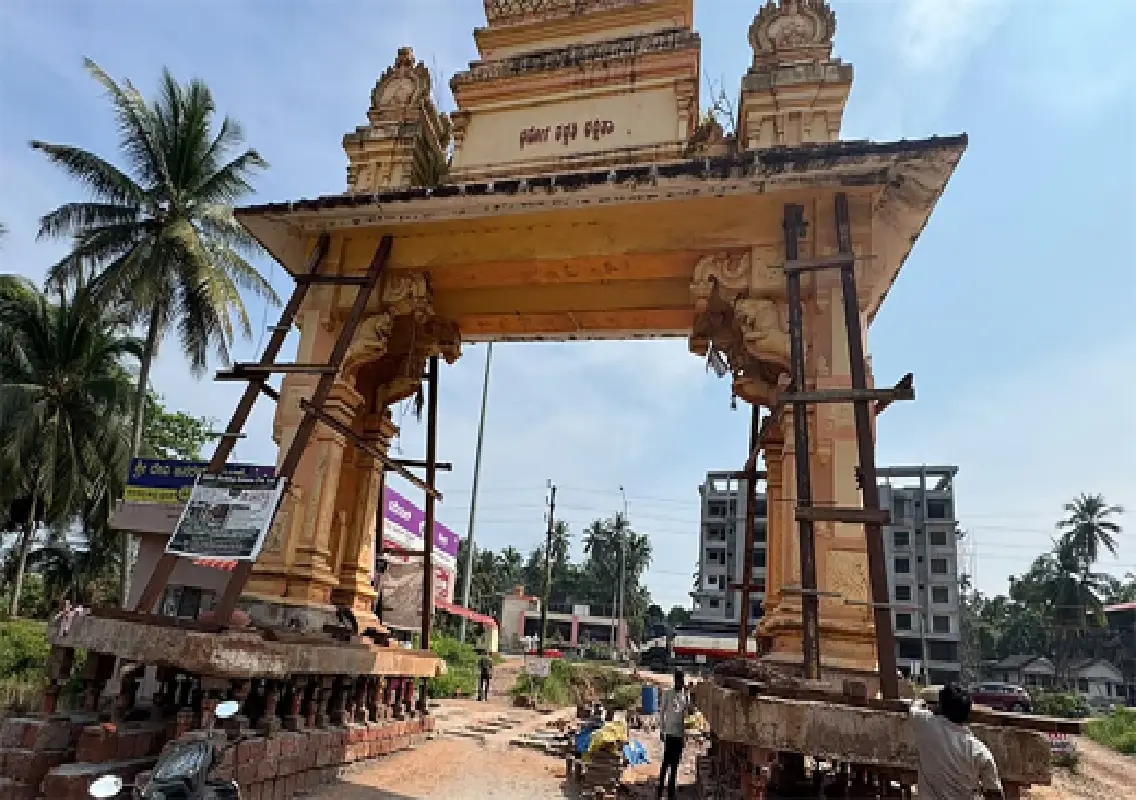


Mangaluru: The historic Swagatha Gopura (entrance arch) of Bappanadu Shree Durgaparameshwari Temple has been successfully relocated by 77 feet without dismantling a single brick, preserving the structure’s architectural identity and cultural significance. The challenging engineering operation was completed on Thursday in connection with the widening of National Highway 66 (NH 66).
The relocation was necessitated by the highway expansion project, which required the existing entrance arch to be moved from its original position. Instead of demolishing the structure, the project team developed an engineering solution to shift the entire gateway while keeping it intact.
Jeevan K Shetty, engineering consultant at Sharada Associates, said the operation was completed through a carefully planned process involving structural lifting and controlled horizontal movement.
The successful relocation has enabled the historic gateway to be preserved while accommodating the road-widening requirements. The structure has now been positioned 77 feet away from its original location and beyond the land acquired for the National Highway project.
Entrance arch donated to temple in 1996
The Swagatha Gopura was donated to Bappanadu Shree Durgaparameshwari Temple in 1996 by Aikala Harish Shetty, president of the Federation of Worlds Bunts Association, along with his family.
Over the years, the entrance arch became an important feature of the temple surroundings. Its association with the temple and its cultural significance made its preservation a priority when the NH 66 widening project necessitated a change in its location.
Rather than allowing the structure to be demolished, an alternative engineering approach was developed to retain the original gateway. Recognising the importance of preserving the arch, Aikala Harish Shetty agreed to bear the entire cost of the relocation project.
The decision enabled the project team to undertake the technically challenging work without dismantling the structure or compromising its identity.
Five-phase engineering operation
The relocation was carried out in five carefully planned phases involving structural lifting and controlled movement. Specially prepared movement tracks, rollers and manually operated jacking arrangements were deployed to shift the arch horizontally.
The entire structure was moved by a distance of 77 feet. The operation required careful planning to ensure that the gateway remained stable throughout the process.
Unlike conventional relocation work involving the dismantling and reconstruction of structures, the method adopted for the Bappanadu entrance arch involved shifting it as a single unit. This required coordination at every stage, from preparing the movement arrangements to controlling the lifting and horizontal transfer.
The project team had to address several technical challenges posed by the existing infrastructure around the gateway. These included an overhead high-tension electrical line and the rainwater drainage system.
The relocation had to be executed while taking these constraints into account, ensuring that the structure could be moved safely to its new position.
Engineers and agencies coordinate project
Jeevan K Shetty served as the project engineer and coordinator, overseeing coordination among the donor, temple management, the National Highways Authority of India (NHAI), various government departments and the contractors involved.
Engineer Nithin Devadiga provided technical expertise and structural guidance during the operation. Haryana-based HSPL was responsible for executing the relocation work.
The successful completion of the project involved coordination between the engineering team and the various stakeholders, particularly because the work had to accommodate the highway expansion requirements while preserving the temple’s historic gateway.
The arch has now been positioned well beyond the land acquired for the NH 66 project, allowing the structure to remain intact without interfering with the highway widening work.
Provision made for temple chariot festivals
Apart from preserving the structure, the project team also had to ensure that the relocated gateway would not obstruct the temple’s annual religious festivities.
Bappanadu Shree Durgaparameshwari Temple’s celebrations involve the movement of traditional temple chariots along Rathabeedi. The relocated arch therefore had to be positioned in a manner that would allow the chariots to pass safely.
Special attention was given to providing sufficient space for the sacred Brahmaratha to move alongside the entrance arch along Rathabeedi.
Adequate vertical clearance was also ensured for the Vimana Ratha to pass beneath the gateway without obstruction. This requirement was incorporated into the engineering plan before the relocation was completed.
According to Jeevan, the final additional vertical lifting of one foot was specifically undertaken to achieve the required clearance for the Vimana Ratha.
“The final additional vertical lifting by one foot was specifically undertaken to achieve this objective,” he said.
Heritage preservation alongside infrastructure development
The successful relocation of the Bappanadu temple entrance arch demonstrates an effort to balance infrastructure development with the preservation of structures that hold religious and cultural importance.
The widening of NH 66 required the gateway to be moved, but the decision to retain it rather than demolish it allowed the temple to preserve an important part of its surroundings.
The project also involved planning for the practical requirements of the temple, ensuring that the relocated structure would not interfere with the movement of its traditional chariots during annual festivities.
With the 77-foot relocation completed without dismantling a single brick, the historic Swagatha Gopura has been preserved at its new location. The operation marks a significant engineering effort in which highway development requirements and the conservation of a temple landmark were addressed together.