







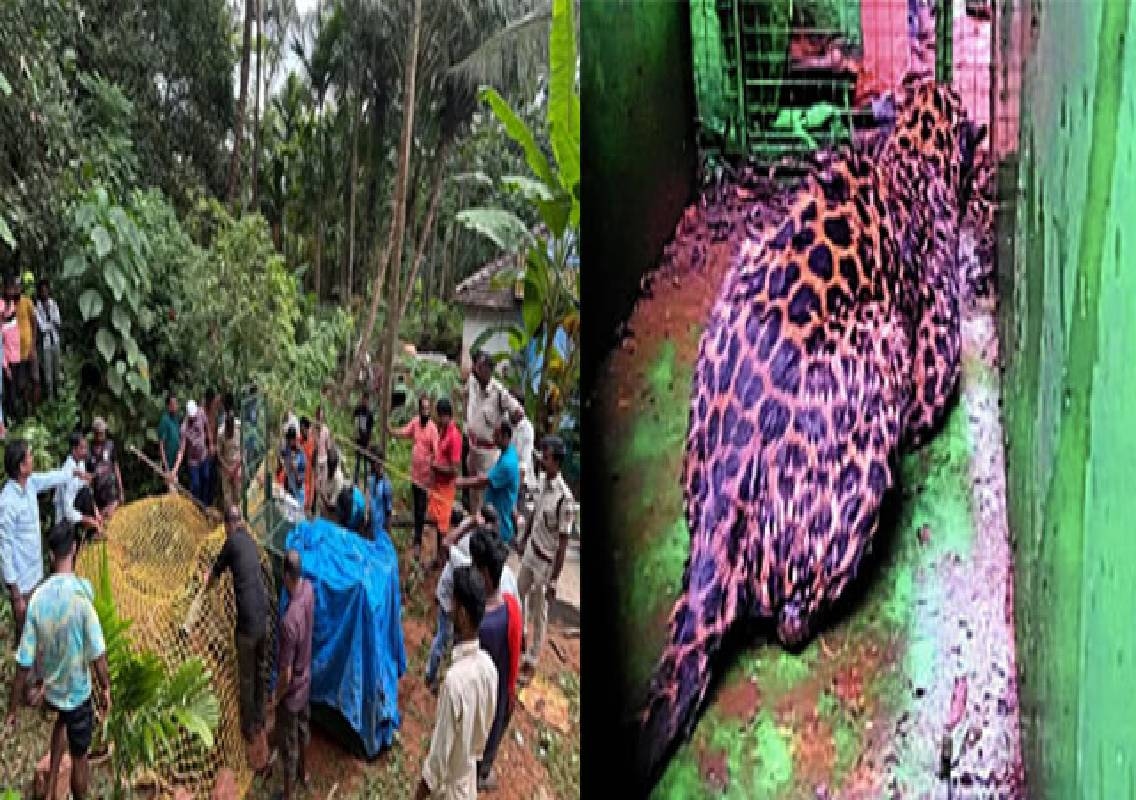


Beltangady: A female leopard was rescued safely after falling into an open well at Karimanelu village in Beltangady taluk on Monday, September 21. Forest Department personnel, with the help of local residents, carried out the rescue operation and later released the animal in a safe forest area.
The leopard had fallen into a nearly 30-foot-deep well belonging to Ashok Poojary, a resident of Bakyaradda in Karimanelu village. The well reportedly had around six feet of water when the animal was found.
Family notices leopard in well
The incident came to light on Monday when the family members noticed the leopard inside the open well.
According to the Forest Department, the animal had apparently fallen into the well while moving through the area in search of food. With the leopard unable to climb out of the deep well, the family informed the authorities.
Forest Department personnel reached the location after receiving the information and assessed the situation before beginning the rescue operation.
The presence of water at the bottom of the well meant that the animal had remained inside the structure until the rescue team arrived.
Forest team launches rescue operation
The rescue operation was conducted under the guidance of Moodbidri Assistant Conservator of Forests Akash Kadam.
Venur Range Forest Officer Bharat, Deputy Range Forest Officer Ashwith, forest guard Divakar and other Forest Department personnel took part in the operation.
Local residents also assisted the officials during the rescue effort. The team worked carefully to bring the leopard out of the well without causing further stress or injury to the animal.
After the rescue, the leopard was shifted to a safe forest area in accordance with instructions from senior Forest Department officials.
Three-year-old female leopard in good health
Forest Department veterinarian Dr Yashaswini examined the rescued leopard after it was brought out of the well.
The animal was identified as a female leopard of approximately three years of age. According to the veterinary assessment reported by Daijiworld, the leopard was in good health following the rescue.
The animal was subsequently released into a suitable forest area, allowing it to return to its natural habitat.
The safe rescue and release meant that neither the leopard nor the people involved in the operation were reported to have suffered injuries.
Open wells pose risk to wildlife
The incident also highlights the danger posed by uncovered wells in areas where wildlife movement is common.
Leopards and other wild animals frequently move through forest fringes and agricultural areas in search of food and water. Open wells without protective barriers can become dangerous traps, particularly when animals cannot see the opening while moving through vegetation or during the night.
Once an animal falls into a deep well, rescue operations can become challenging and require trained personnel to prevent injury to both the animal and rescuers.
In the Beltangady incident, the Forest Department was able to safely recover the leopard with the cooperation of local residents.
Forest officials monitor wildlife movement
The rescue comes amid continued human-wildlife interaction in parts of Dakshina Kannada, where forested areas are interspersed with agricultural land and residential settlements.
Forest officials routinely respond to reports involving leopards, wild boars, elephants and other wildlife in villages located close to forest areas.
Residents living near such areas are generally advised to remain cautious when encountering wild animals and to immediately inform the Forest Department rather than attempting to approach or capture them.
The Karimanelu rescue once again demonstrated the importance of coordinating with trained wildlife personnel when an animal becomes trapped or enters a populated area.
Leopard released back into forest
Following the successful operation, the rescued leopard was moved away from the populated area and released in a safe forest location.
Officials confirmed through the veterinary examination that the animal was healthy, allowing it to be returned to the wild without the need for prolonged treatment or rehabilitation.
The operation was completed with the combined efforts of Forest Department officials and local residents, ensuring the leopard could safely return to its natural habitat.