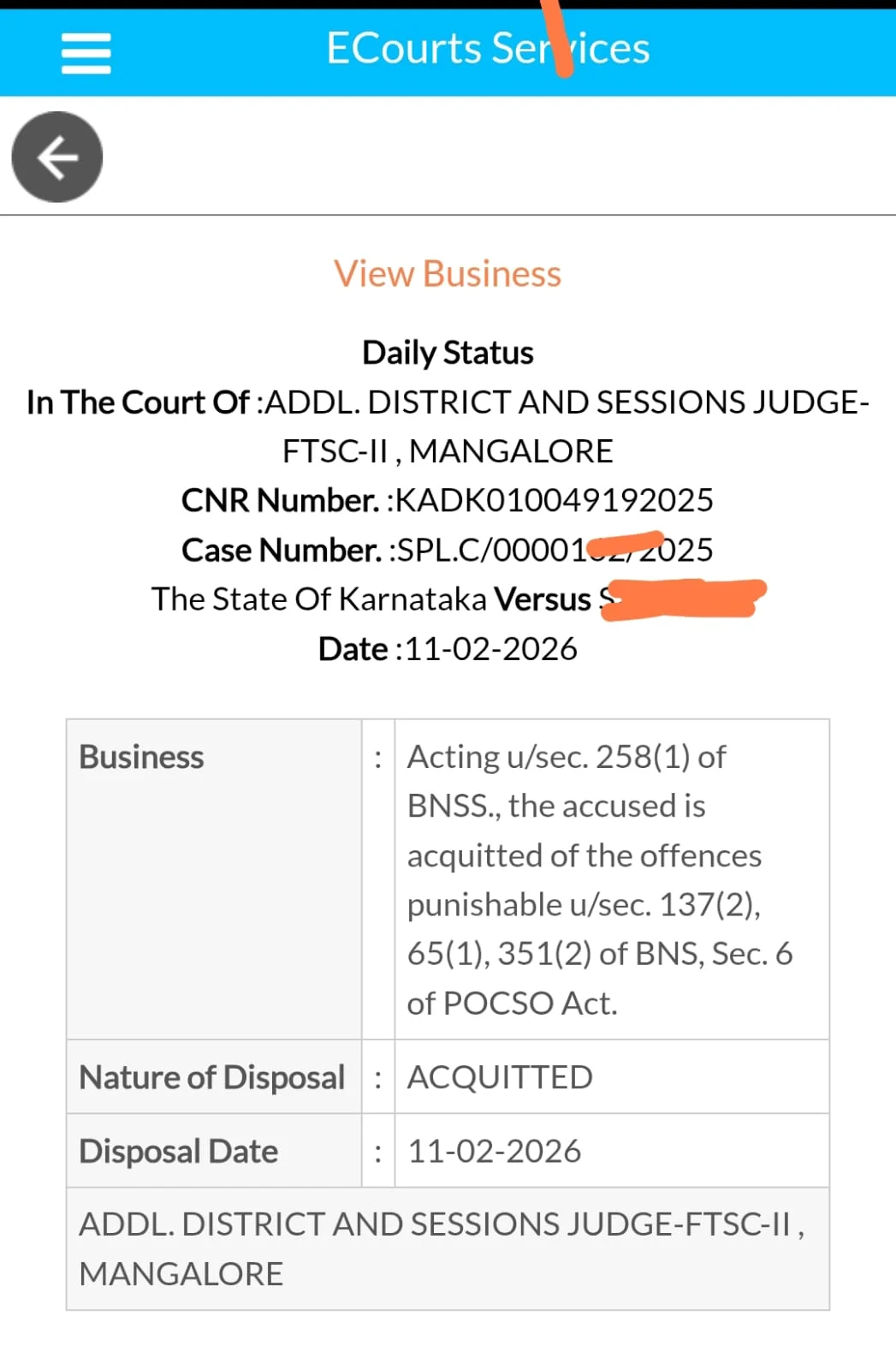


Mangaluru: The Second Additional District and POCSO Special Court in Mangaluru has acquitted an accused person in a case involving the alleged kidnapping and sexual assault of a minor girl, citing insufficient and unreliable evidence to prove the charges beyond reasonable doubt.
The judgment was delivered by POCSO Special Court Judge K.S. Manu, who held that the prosecution failed to establish the case through strong and consistent evidence. As a result, the accused was given the benefit of doubt and cleared of all charges framed under the relevant sections of law.
The case had drawn attention after police registered a complaint in July 2025 and filed a chargesheet following investigation. The trial was conducted on a priority basis under POCSO court procedures.
Case registered after July 2025 complaint
According to case records presented before the Mangaluru court, the complaint was registered by Mulki police on July 23, 2025, based on allegations that a minor girl had been taken away on a two-wheeler from near the Bappanadu temple area in Mulki during the second week of July.
Investigators stated that the girl was allegedly taken towards the coastal belt of Udupi district. The complaint further alleged that she was subjected to sexual assault at a secluded location and was threatened with harm if she disclosed the incident to family members.
Police traced and arrested the accused on the same day the complaint was formally registered. Following standard procedure in such cases, the survivor was sent for medical examination. Investigation officers later submitted their final report to the Second Additional District and POCSO Special Court in Mangaluru after completing evidence collection and witness statements.
Trial conducted before special court
The Mangaluru POCSO court took cognisance of the charges and proceeded with trial. As part of the court process, the statements of the minor girl and her parents were recorded. The prosecution examined eight witnesses during the course of the trial.
In addition to oral testimony, the prosecution placed 26 documents before the court as part of its documentary evidence set. A mobile phone was also marked and produced as a material object linked to the case record.
During the hearings, the prosecution maintained that the incident had taken place and relied on witness testimony and supporting documents to establish the sequence of events. The defence contested the claims and questioned the consistency and strength of the evidence presented.
Court cites lack of conclusive proof
After evaluating the material on record, the Mangaluru POCSO court concluded that the prosecution evidence was not strong enough to secure a conviction under the stringent standards required in criminal law.
In the judgment, the court observed that inconsistencies and gaps in the evidence created reasonable doubt. Since criminal conviction requires proof beyond reasonable doubt, the benefit of doubt was extended to the accused.
Judge K.S. Manu accordingly acquitted the accused of all charges in the case. The order noted that suspicion, however serious, cannot replace legal proof when determining guilt.
Legal experts note that in POCSO cases, courts rely heavily on consistent testimony, corroborative medical and forensic material, and properly established circumstantial evidence. If these elements do not align clearly, courts may be compelled to acquit under law.
Defence representation and proceedings
The accused in the Mangaluru case was represented by advocate Sukesh Kumar Shetty. The defence argued that the allegations were not supported by conclusive and legally sustainable evidence and highlighted contradictions in witness accounts and supporting material.
Following completion of arguments from both sides and review of the full record, the court reserved and later delivered its verdict of acquittal.
Court sources indicated that the trial was conducted in a time-bound manner as per special court norms dealing with cases involving minors.
Legal context and conclusion
Cases registered under the Protection of Children from Sexual Offences (POCSO) Act are tried in designated special courts to ensure speedy hearings and child-sensitive procedures. However, like all criminal trials, verdicts depend strictly on the quality and reliability of evidence presented before the court.
The Mangaluru POCSO court’s ruling underscores the legal principle that conviction cannot be based on allegation alone without adequate proof. With the acquittal order now pronounced, the case stands closed at the trial court level, subject to any appeal that may be filed by the prosecution as permitted under law.