







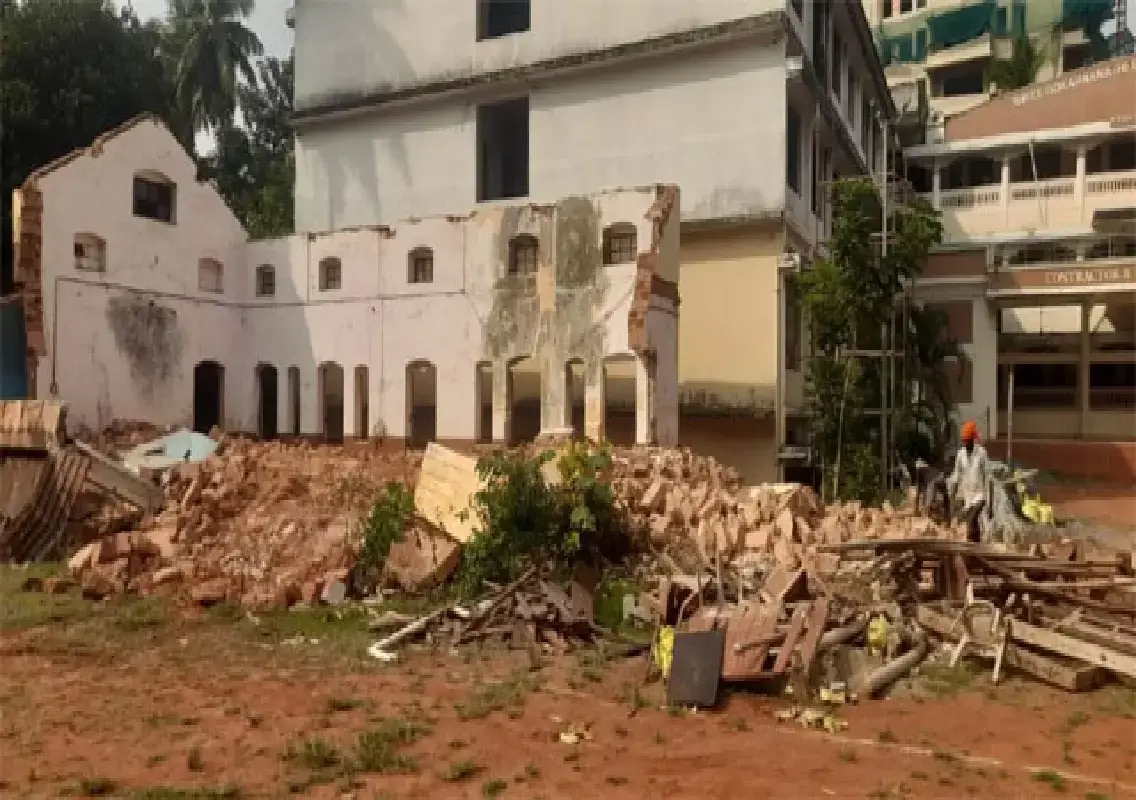


Mangaluru: A century-old heritage structure that once provided shelter and support to hundreds of Billava students pursuing education in Mangaluru has been demolished, bringing an end to the historic Sooter Hostel building at Mannagudda.
Located within the premises of Gokarnanatheshwara College, the Sooter Hostel building has been reduced to a heap of stones and debris. The demolition has brought down a structure that stood as a silent reminder of the city’s educational and social history for nearly 100 years.
Built during the British era, the hostel was an important institution for young students who travelled to Mangaluru from distant parts of the coastal region in search of education. Although it stopped functioning in the 1970s, the imposing building continued to stand for several decades, retaining its historical significance.
A century of educational history
The Sooter Hostel was constructed in 1926 with the objective of providing accommodation and comprehensive support to Billava youths coming to Mangaluru for education. At a time when access to educational facilities and residential accommodation was limited, the hostel played an important role in helping students from rural and distant areas pursue their academic ambitions.
Students travelled from places stretching from Kundapur in the north to Kasargod in the south, as well as from Beltangady and other interior regions, to study in Mangaluru. For many of these young people, finding affordable and suitable accommodation in the city would have been a major challenge.
The hostel addressed this need by providing a place to stay and an environment conducive to education. Its establishment reflected the importance attached to education and social advancement within the Billava community during the early decades of the 20th century.
Over the years, the institution became associated with the educational aspirations of generations of young people. Its history was closely connected with the movement of students from smaller towns and villages towards Mangaluru, which was emerging as an important centre for education in the coastal region.
Built during the British era
The building, constructed in 1926, was notable for its association with a period when Mangaluru was witnessing gradual changes in its educational and social landscape.
Its architectural character and imposing appearance reflected the building traditions of that period. Even after the hostel ceased functioning in the 1970s, the structure remained standing, preserving a tangible connection with the city’s past.
For decades, the building remained a familiar presence within the Gokarnanatheshwara College premises at Mannagudda. Although it no longer served its original residential purpose, its continued existence offered an opportunity to preserve and document an important chapter of local history.
The hostel was more than an old building. It represented an institutional effort to support students who otherwise might have struggled to continue their education away from their hometowns.
Its history also reflected the broader role played by community-supported educational initiatives in improving access to education in coastal Karnataka.
Heritage preservation concerns
The demolition has brought renewed attention to the importance of identifying and protecting historically significant buildings in Mangaluru.
The Sooter Hostel had remained standing long after its functioning ended, and its age and historical association made it a potential candidate for heritage conservation. Rather than allowing the structure to disappear, its preservation as a heritage site could have provided an opportunity to retain an important part of the city’s collective memory.
Old institutional buildings often carry significance beyond their architectural features. They preserve stories of social reform, educational progress, community initiatives and the contributions of earlier generations.
In the case of Sooter Hostel, its association with the educational advancement of Billava youths gave it particular historical importance. The building stood as a reminder of the efforts made nearly a century ago to provide opportunities for students from distant regions.
Its demolition has therefore meant the loss of not only an old physical structure but also a potential heritage landmark connected with Mangaluru’s educational history.
A chapter of Mangaluru’s past comes to an end
With the demolition, the Sooter Hostel building has become part of history. The stones and debris left behind mark the end of a structure that had witnessed changing generations, educational developments and the transformation of Mangaluru over several decades.
Although the hostel stopped functioning in the 1970s, its historical association continued to give the building significance. Its presence served as a link between the city’s present and an era when community initiatives played a crucial role in supporting access to education.
The demolition also underlines the need for greater attention to the documentation and preservation of old buildings with historical and cultural value.
As Mangaluru continues to develop, preserving structures associated with its educational and social heritage could help future generations understand the efforts and institutions that shaped the city.
The Sooter Hostel may no longer stand at Mannagudda, but its contribution to the educational aspirations of generations of Billava youths remains an important part of Mangaluru’s history.