







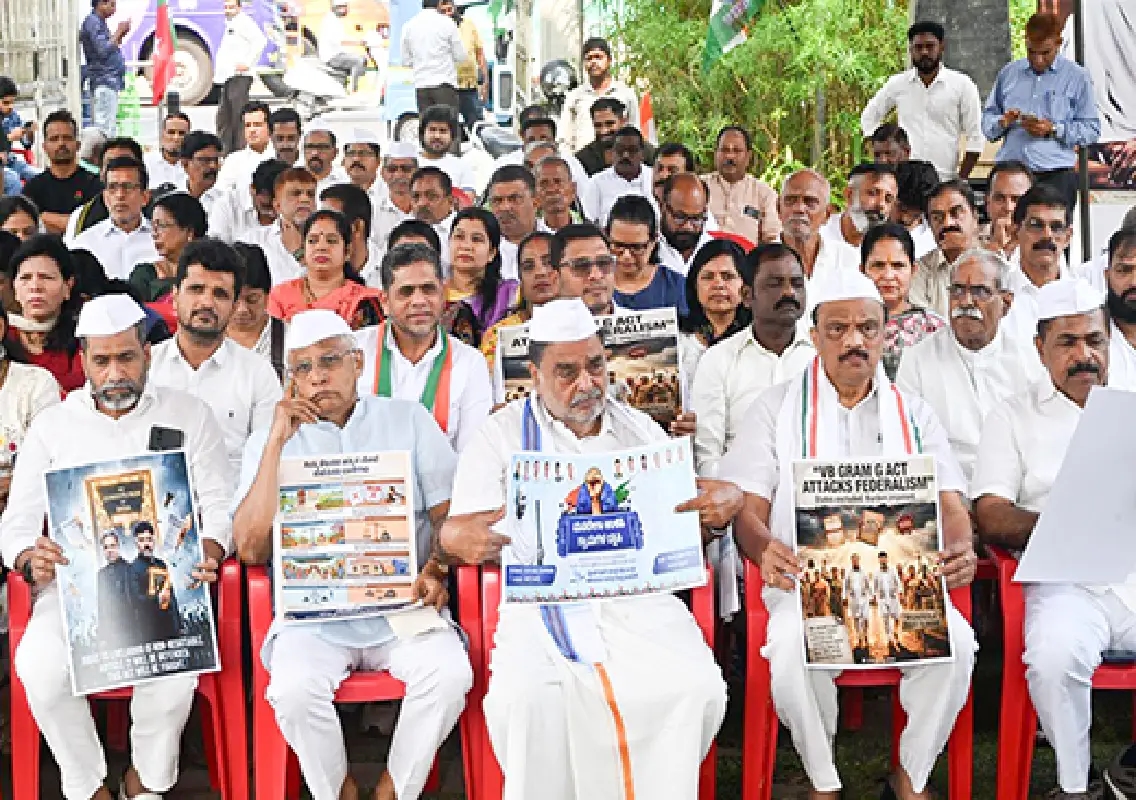


Mangaluru: The Dakshina Kannada District Congress Committee organised a day-long “fasting Satyagraha” in Mangaluru on January 21, 2026, protesting against the Central BJP government’s amendments to the Mahatma Gandhi National Rural Employment Guarantee Act (MGNREGA) and demanding the restoration of its original provisions. The protest reflected growing concern within the party over what it termed as the systematic dilution of one of India’s most significant welfare legislations.
The Satyagraha was held from 10:30 a.m. to 4:00 p.m. at the Mahatma Gandhi statue located in Rajaji Park, near Kudmul Rangaraya Purabhavan. Congress leaders and party workers assembled at the venue early in the day, offering floral tributes to the statue of Mahatma Gandhi before commencing the fasting protest.
Protest highlights concerns over rural employment
Addressing party workers and supporters during the protest, senior Congress leaders said that the amendments introduced to MGNREGA have weakened the spirit and intent of the Act, which was originally designed to guarantee employment and provide financial security to rural households.
Leaders alleged that changes in wage payments, job allocation processes and fund releases have resulted in delayed payments and reduced workdays, adversely affecting lakhs of rural families across the country. They argued that MGNREGA has been a crucial safety net for the rural poor, especially during periods of economic distress, droughts and job losses.
“The MGNREGA Act was envisioned as a lifeline for rural India. Any attempt to dilute it is an attack on the livelihoods of the poor,” a senior Congress leader said during the Satyagraha.
Floral tributes and peaceful fasting
The protest followed Gandhian principles of non-violence and peaceful resistance. Participants sat in silence for long hours as part of the fasting Satyagraha, holding placards demanding justice for rural workers and the immediate reinstatement of the original provisions of the Act.
The symbolic location of the protest at the Mahatma Gandhi statue was chosen deliberately, party leaders said, to underline the Congress party’s commitment to Gandhian values and social justice. Slogans opposing the amendments and criticising the Centre’s policies were raised intermittently, while maintaining a disciplined and peaceful atmosphere throughout the day.
Senior Congress leaders participate
Several prominent Congress leaders from Dakshina Kannada district participated in the protest. Former minister Ramanath Rai, along with leaders Ivan D’Souza, Harish Kumar, Padmaraj, Shashidhar Hegde and Jerr Lobo, were present at the venue for most of the day. A large number of party workers and local leaders also joined the Satyagraha, expressing solidarity with rural labourers and marginalised communities.
Speaking to the media, Ramanath Rai alleged that the BJP-led Central government has consistently reduced allocations and weakened implementation mechanisms for MGNREGA over the years. “The government is slowly dismantling welfare schemes that directly benefit the poor, while favouring corporate interests,” he said.
Demand for reinstatement of original provisions
Congress leaders reiterated their demand that the Centre immediately roll back the amendments and reinstate the original provisions of MGNREGA. They emphasised that the Act had ensured transparency, accountability and guaranteed employment for rural households since its inception.
Party leaders also warned that if the Centre fails to respond, the Congress would intensify its agitation through similar protests across the state and the country. “This fasting Satyagraha is only the beginning. We will take this issue to every village and every household,” a district-level leader stated.
Wider political significance
The protest in Mangaluru is part of a broader political campaign by the Congress against what it describes as the erosion of welfare-oriented governance under the BJP-led Central government. Observers note that MGNREGA remains a politically sensitive issue, particularly in rural and semi-rural regions, and protests around it are likely to gain momentum ahead of future elections.
Local residents who witnessed the protest said such demonstrations help draw attention to rural issues that often get overshadowed by urban-centric debates.
Conclusion
The fasting Satyagraha organised by the Dakshina Kannada District Congress Committee in Mangaluru underscored the party’s opposition to the amendments made to the MGNREGA Act and highlighted growing concerns over rural employment and welfare. As political debate over the future of MGNREGA intensifies, the Congress has signalled that it intends to keep the issue in the public spotlight through sustained and peaceful agitation.