







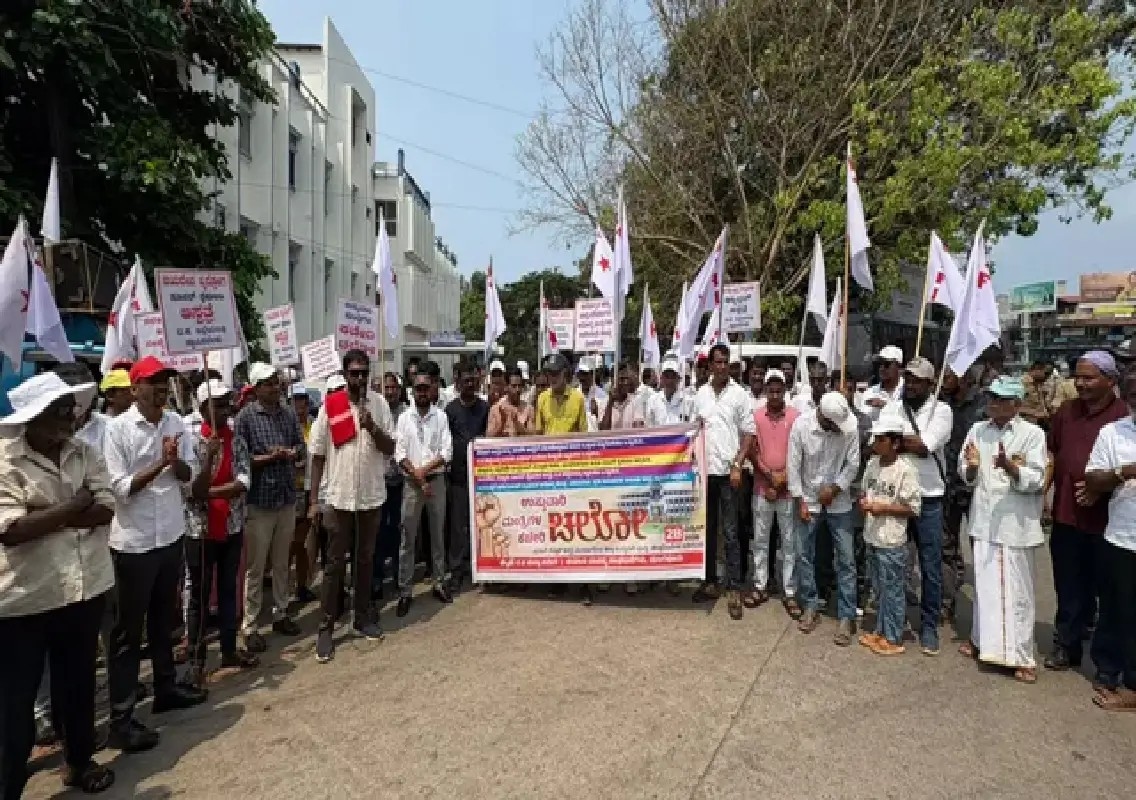


Mangaluru: Members of the Democratic Youth Federation of India (DYFI) were detained by police on Tuesday during a protest march demanding major reforms in the public healthcare system in Dakshina Kannada district. The demonstration, organised by the DYFI district committee, sought immediate government intervention to strengthen public hospitals and curb the growing influence of private healthcare providers.
The protest, branded as a ‘Chalo’ padyatra, began at the Government Wenlock Hospital, one of the key public healthcare institutions in the region. Participants marched towards the office of the district in-charge minister, raising slogans and highlighting their demands. However, police intervened before the march could reach its destination and detained several activists and leaders. All those detained were later released the same day.
Key demands raised by DYFI
The DYFI outlined a series of demands aimed at improving the accessibility and quality of public healthcare services. Among the primary issues raised was the alleged trend of handing over government hospitals to private management through agreements, which the organisation strongly opposed. The protesters demanded that such arrangements be cancelled immediately.
They also called for the establishment of a government medical college in every district to ensure equitable access to medical education and healthcare services. Another major demand was the setting up of a branch of the Sri Jayadeva Institute of Cardiovascular Sciences and Research in Dakshina Kannada, citing a growing number of heart disease cases in the region.
In addition, the DYFI urged the government to upgrade the Government Wenlock Hospital into a regional-level hospital with enhanced infrastructure and specialist services. The organisation also emphasised the need to strengthen all public health facilities and enforce stricter regulations on private hospitals to prevent exploitation of patients.
Allegations against government
Addressing the gathering, DYFI district president B K Imtiyaz accused the Indian National Congress-led state government of neglecting public healthcare demands for several years. He alleged that the health department had been favouring private hospital lobbies instead of investing in government-run institutions.
Imtiyaz also criticised the Bharatiya Janata Party (BJP) for remaining silent on the issue, stating that both major political parties had failed to prioritise public healthcare in the district.
DYFI district secretary Santosh Bajal highlighted a sharp increase in the number of patients suffering from heart disease and cancer seeking treatment in government hospitals over the past year. He pointed out that despite repeated appeals for specialised institutions like the Kidwai Memorial Institute of Oncology and Jayadeva hospitals in the district, authorities had not taken adequate steps.
Protest participation and police action
The padyatra was flagged off by noted rationalist Narendra Nayak, who also addressed the participants and stressed the importance of accessible public healthcare for all sections of society.
The protest saw participation from a wide cross-section of groups, including labour unions, women’s organisations, Dalit rights activists, and student leaders. The turnout reflected growing public concern over healthcare infrastructure and rising medical costs.
Police officials halted the march before it could reach the minister’s office, citing law and order concerns. Hundreds of activists were taken into preventive custody during the operation. The detentions were temporary, and all protesters were released later in the day without charges.
Continued agitation likely
DYFI leaders indicated that the protest was part of a larger, ongoing campaign to pressurise the government into taking concrete steps. Santosh Bajal stated that the organisation would continue its struggle despite attempts to suppress protests, including denial of permissions for demonstrations.
The incident underscores increasing public dissatisfaction with healthcare services in the district and highlights the demand for stronger government intervention in the sector. With healthcare emerging as a critical issue, further protests and political debates are expected in the coming weeks.
Conclusion
The DYFI protest in Mangaluru brings attention to persistent gaps in public healthcare infrastructure and governance. As demands for equitable and affordable healthcare grow louder, the response of the state government will be closely watched by both activists and the general public.