







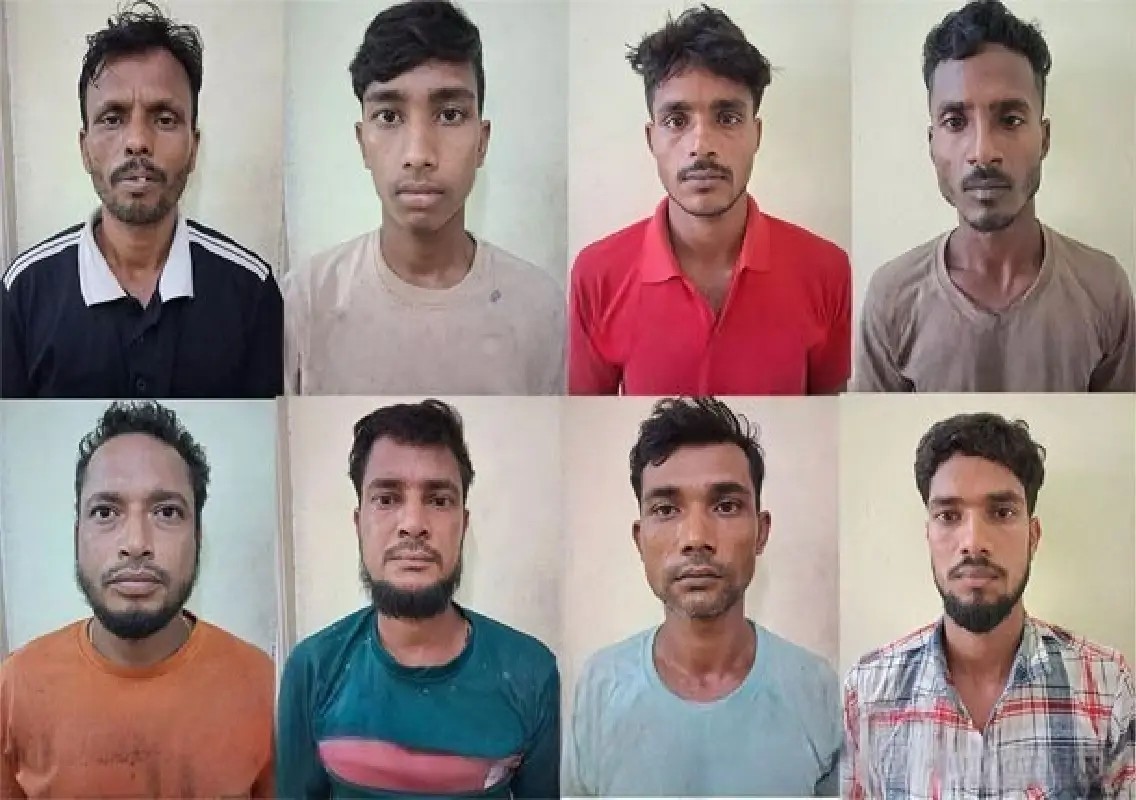


Mangaluru: The investigation into the arrest of eight Bangladeshi nationals working at a construction site in Mukka near Surathkal has gathered pace, with police and intelligence agencies probing whether more undocumented foreign nationals are living or working in the undivided Dakshina Kannada and Udupi districts.
The eight men, arrested by the Surathkal police on July 9, are currently being interrogated at a temporary detention centre set up inside a private hospital in Mukka. Investigators have confirmed that all the arrested individuals are natives of the Rajshahi district in Bangladesh.
Police have initiated the legal process for their deportation after submitting a report to the Foreigners Regional Registration Office (FRRO). Authorities aim to complete the deportation process within 15 days, subject to legal procedures.
Intelligence agencies join investigation
Following the arrests, teams from the Intelligence Bureau (IB) and the State Intelligence Department have questioned the accused to gather information about their entry into India and any possible network facilitating illegal migration.
Officials are investigating whether other individuals who crossed the border along with the arrested men are currently residing or employed in Dakshina Kannada or neighbouring Udupi district.
The probe is also focused on identifying the agents and facilitators who allegedly helped the accused obtain forged identity documents and secure employment.
Tip-off from co-workers led to arrests
According to police sources, the breakthrough came after specific intelligence inputs prompted the Surathkal police to verify labourers employed by two construction firms in Mukka.
As part of the operation, 55 workers were rounded up for document verification. During the exercise, eight workers were identified as Bangladeshi nationals staying illegally in India.
Investigators said the initial suspicion arose after fellow workers noticed discrepancies in the men’s identity documents and alerted the police. Authorities had also been monitoring activities at the construction site for nearly a month before conducting the verification drive.
Fake Aadhaar cards uncovered through biometric verification
The investigation revealed that the accused were carrying forged Aadhaar cards that initially appeared genuine. However, during digital verification, police used biometric thumb impression authentication, which exposed the documents as fake.
According to investigators, the accused allegedly obtained colour photocopies of genuine Aadhaar cards belonging to residents of West Bengal, replaced the original photographs with their own and laminated the forged documents.
When the biometric verification was carried out, the photographs stored in the Aadhaar database did not match those printed on the physical cards, leading to the detection of the forgery.
Police also noted that the accused spoke broken Hindi and communicated primarily in a Bengali dialect, which further aided investigators during questioning.
Probe into cross-border network
Investigators believe the accused crossed the India-Bangladesh border from different parts of Rajshahi district before reaching Murshidabad in West Bengal.
Police suspect that local agents in West Bengal helped them procure forged Aadhaar documents and facilitated their movement to other states in search of employment.
Information gathered during the investigation has been shared with the Border Security Force (BSF) and the concerned police stations in West Bengal to help trace the alleged network involved in illegal border crossings and document forgery.
Sources indicated that recent enforcement drives against illegal immigrants in West Bengal may have prompted several undocumented migrants to relocate to other states through agent networks.
Construction firms under scrutiny
The incident has also brought attention to the alleged employment of undocumented workers by construction firms.
According to sources, such labourers are often hired for daily wages ranging between Rs 500 and Rs 600, working long hours from dawn to dusk while staying in temporary sheds at construction sites. Investigators are examining whether employers followed mandatory procedures for verifying the identity and legal status of workers before hiring them.
Authorities are expected to examine whether any violations of labour or immigration-related regulations occurred during the recruitment process.
Calls for fresh verification drive
The arrests have renewed demands for a comprehensive verification drive targeting migrant workers across Dakshina Kannada.
Residents have pointed out that the last large-scale verification exercise was conducted in 2022, when the Mangaluru City Police verified details of more than 4,000 migrant workers across various police station limits. During that exercise, 518 persons were questioned based on suspicion, although no Bangladeshi nationals were identified.
Since then, no similar district-wide verification drive has reportedly been undertaken.
Members of the public have now urged the police to conduct fresh verification of workers employed at construction sites, industries and the fisheries harbour to ensure compliance with immigration and identity verification norms.
Investigation continues
Police officials said the investigation remains ongoing, with efforts focused on identifying any additional undocumented foreign nationals, tracing the alleged network involved in facilitating illegal entry and forged documents, and examining the role of those who may have knowingly employed workers without proper verification.
The findings of the investigation are expected to guide further action by law enforcement agencies and immigration authorities in the coming days.