







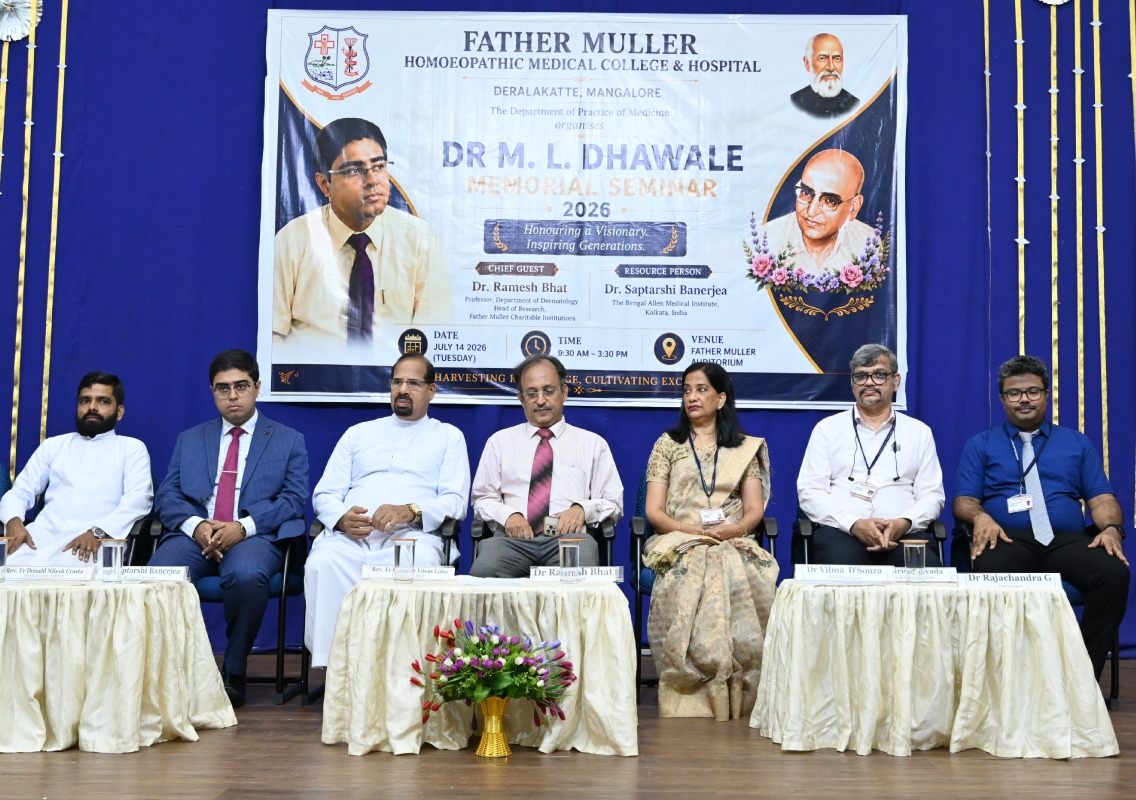


Mangaluru: The Department of Practice of Medicine at Father Muller Homoeopathic Medical College & Hospital (FMHMCH), Deralakatte, organised the Dr. M. L. Dhawale Memorial Seminar 2026 at the Father Muller Auditorium, commemorating the enduring contributions of the visionary homoeopath Dr. M. L. Dhawale to homoeopathic education, research, and clinical practice.
The seminar featured scientific sessions by Dr. Saptarshi Banerjea, B.H.M.S., M.D. (Hom.), Deputy Director of the Bengal Allen Medical Institute, Kolkata, an internationally acclaimed homoeopathic physician, researcher, teacher, and author.
Tribute to a visionary in homoeopathy
The programme commenced with a prayer song, followed by the procession of dignitaries to the dais.
Welcoming the gathering, Dr. E. S. J. Prabhukiran, Principal of FMHMCH, reflected on the institution’s journey into its 42nd year. He recalled that Father Muller Homoeopathic Medical College was inaugurated on the birth anniversary of Dr. M. L. Dhawale, making the annual memorial seminar a fitting tribute to one of the pioneers of modern homoeopathy.
He highlighted Dr. Dhawale’s innovative teaching methods and said the seminar aimed to inspire students and practitioners to uphold his legacy of academic excellence and clinical research.
The programme was inaugurated with the ceremonial lighting of the lamp, followed by the garlanding of the portraits of Rev. Fr. Augustus Muller and Dr. M. L. Dhawale.
Researchers and students honoured
The seminar also recognised faculty members and students who had successfully completed research projects during the previous year.
A total of nine faculty research projects and 14 student research projects, undertaken under various initiatives including the Faculty Research Projects, Short-Term Studentship in Homoeopathy (STSH), and the Dr. M. L. Dhawale Memorial Student Research Project, were acknowledged.
Investigators, student researchers, and their guides were felicitated and presented with completion certificates in appreciation of their contribution to advancing homoeopathic research.
Focus on lifelong learning and research
Delivering the inaugural address, Dr. Ramesh Bhat encouraged participants to embrace lifelong learning while remaining rooted in the core values of wisdom, compassion, empathy, and commitment to patient care.
He urged students and faculty members to actively engage in scientific research through the Father Muller Research Centre, emphasising that continuous learning remains essential in the ever-evolving field of medicine.
In his Administrator’s message, Rev. Fr. Donald Nilesh Crasta reflected on the significance of the memorial seminar through the perspectives of the past, present, and future. He said the occasion honoured the institution’s rich heritage while inspiring future generations to strengthen and advance the science of homoeopathy through dedicated research and service.
Research strengthens homoeopathy
Presiding over the programme, Rev. Fr. Faustine Lucas Lobo, Director of Father Muller Charitable Institutions, recalled the institution’s 146-year legacy, which began under a banyan tree and has since evolved into one of the region’s leading healthcare and educational institutions.
Highlighting the continuing relevance of the Law of Similars, he stressed the importance of scientific research in strengthening the evidence base and wider acceptance of homoeopathy. He encouraged participants to learn from the distinguished resource person and contribute meaningfully to the profession through quality research.
Following the presentation of mementoes to the chief guest and resource person, Dr. G. Rajachandra, Convener, proposed the vote of thanks. The inaugural session concluded with the Institution Anthem.
Interactive scientific sessions
The academic sessions conducted by Dr. Saptarshi Banerjea covered several important aspects of contemporary homoeopathic practice.
The first session, “Cured Cases: Discussion with Comparative Materia Medica,” presented successfully managed clinical cases with detailed discussions on remedy selection.
The second session, “Dermatology: Look and Diagnose through Pictures,” focused on recognising dermatological conditions using clinical photographs while enhancing diagnostic skills.
The final session, “Commonly Used Organopathics in Practice,” explored the indications, scope, and clinical application of organopathic remedies in everyday homoeopathic practice.
The sessions witnessed active participation from undergraduate and postgraduate students, interns, faculty members, and practising homoeopathic physicians.
The seminar concluded with an interactive question-and-answer session, during which Dr. Banerjea addressed clinical queries and shared practical insights from his extensive experience.
In his concluding remarks, Dr. E. S. J. Prabhukiran thanked the dignitaries, resource person, organising committee, faculty, and participants for making the Dr. M. L. Dhawale Memorial Seminar 2026 a memorable academic event that reinforced the ideals of excellence in clinical practice, research, and compassionate patient care.
The programme was efficiently compered by Dr. Parvathynandarajan and Dr. Mubeen Jakati.