







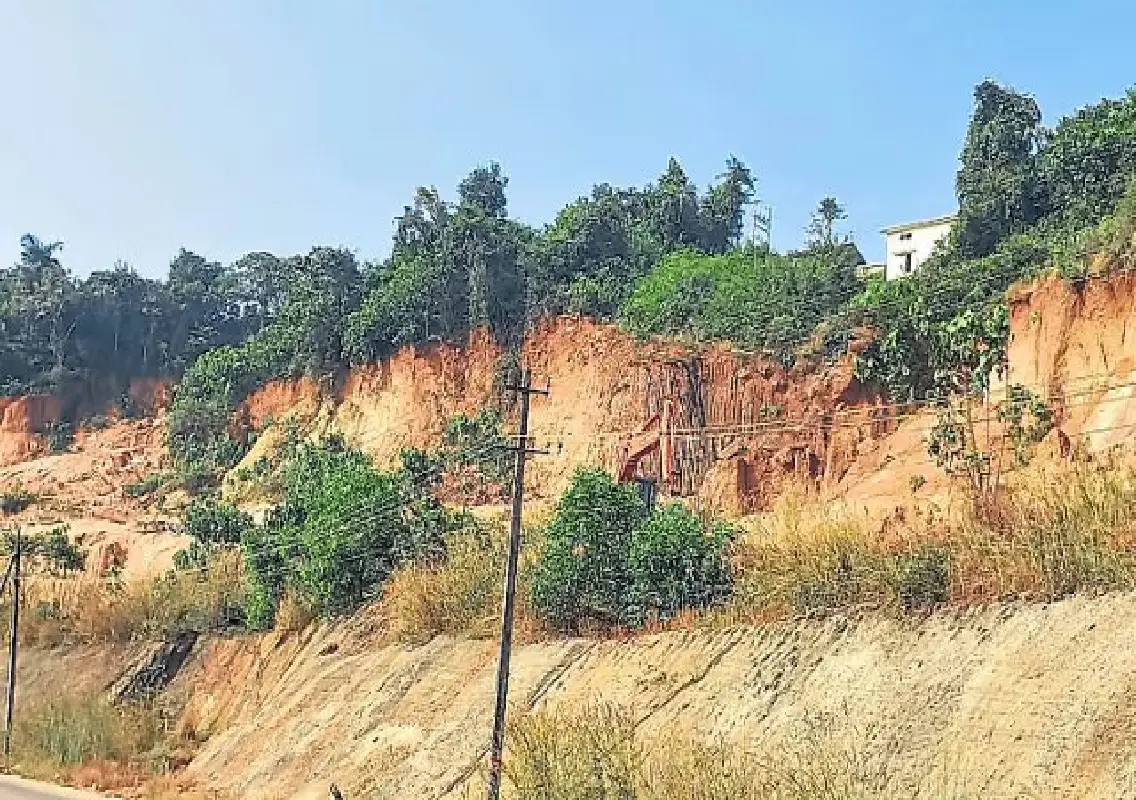


MANGALURU: Excavation work carried out at Kettikal Hill near Vamanjoor on the Mangaluru–Bikarnakatte–Sanur stretch of National Highway 169 had triggered repeated landslides over the past two monsoons, causing major damage and raising public safety concerns. To address the issue and prevent further soil slips, authorities have now begun constructing a gabion wall along the vulnerable section of the hill.
Hill erosion worsened during monsoons
During the previous rainy seasons, heavy water flow from the upper portions of Kettikal Hill led to several landslides, creating hazardous conditions for motorists and residents in the vicinity. The situation became especially alarming when soil and debris repeatedly slid onto the highway, disrupting traffic movement and posing risks to commuters.
Earlier, soil nailing work had been undertaken at the base of the hill in an attempt to stabilise the slope. While the method proved helpful initially, continuous and intense rainfall weakened its effectiveness in some sections, resulting in additional collapses. Recognising the gravity of the problem, the district administration consulted experts to determine a durable stabilisation method. Following their recommendations, construction of a gabion wall has now commenced.
Gabion wall spans major slide-prone area
As part of the project, stones are being placed along the upper stretch of the hill to prevent erosion. The gabion wall, expected to span approximately 150–200 metres, is being constructed specifically in areas that witnessed major landslides. Workers are currently engaged in placing and securing stones within iron mesh structures, which are designed to withstand water flow while holding back soil.
Officials stated that although landslides had occurred at an additional location during this year’s rains, work has not yet started in that area. The priority is to complete the ongoing construction before the next monsoon season, ensuring maximum stability along the hillside for road users.
Locals express concerns over long-term safety
Despite the ongoing measures, local residents have expressed concern about the hill’s long-term stability. They fear that if landslides continue even after the construction of the gabion wall, damage to the highway and nearby areas may persist. Community members have urged the district administration and highway authorities to ensure that the structure is strong, durable and capable of withstanding heavy monsoon rainfall.
Officials, however, have assured that gabion walls are a proven method for preventing soil erosion in hilly terrain. These structures allow water to pass through the gaps between stones while preventing mud and soil from sliding downward. This makes them particularly effective in regions prone to frequent water runoff.
Gabion walls widely used in hilly terrain
Gabion walls consist of box-shaped iron mesh cages filled tightly with stones. These are placed strategically against hill sections prone to landslides to function as retaining structures. Their design allows for natural drainage, which helps reduce the pressure of collected water—one of the major causes of landslips.
The railway department, for instance, commonly uses gabion walls along tracks passing through hilly areas to prevent erosion and slope failure. The structure now being built at Kettikal Hill adopts a similar design. Ahead of the construction, authorities had also levelled the hill in stages to prepare a stable base.
Highway work gains momentum with reduced rain
With the decrease in rainfall in recent weeks, construction work along the Mangaluru–Moodbidri highway stretch has picked up momentum. The road running along the hillside is nearly complete, and soil-filling work is in progress at the deep trench created for road construction from the Moodbidri end towards the city.
Officials hope that stabilising Kettikal Hill through gabion wall construction will reduce monsoon-related disruptions and ensure uninterrupted progress on the highway project.