







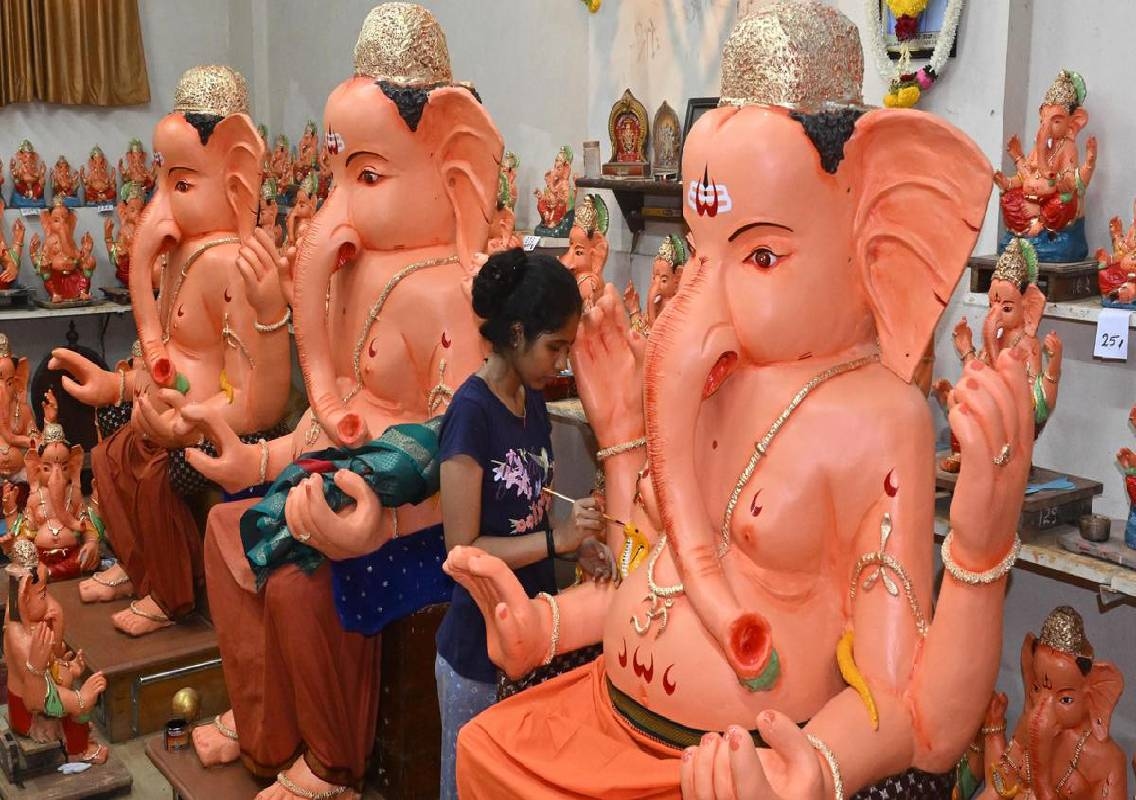


Mangaluru: Immersing Ganesha idols along with decorative materials could attract strict legal action, including a jail term of up to six years, the Karnataka State Pollution Control Board (KSPCB) has warned ahead of the festival.
The warning comes as authorities across Karnataka step up measures to prevent pollution of lakes, rivers and other water bodies during Ganesha idol immersion. Residents and organisers have been urged to remove decorative materials and other non-biodegradable items from idols before immersion.
KSPCB warns against decorative materials
According to the report, the KSPCB has cautioned people against immersing Ganesha idols along with materials such as thermocol, plastic and other decorative items.
Such materials do not readily decompose and can remain in water bodies after the idol dissolves. They can also contribute to the accumulation of solid waste and affect aquatic ecosystems.
The pollution control authorities have therefore urged devotees to ensure that decorative materials are removed before immersion and disposed of through appropriate channels.
The warning is particularly relevant during community celebrations, where large idols are often decorated extensively before being taken in processions for immersion.
Strict action possible for violations
The KSPCB warning highlights that environmental regulations governing water pollution can carry serious penalties.
Violations that result in pollution of water bodies can lead to criminal proceedings, with penalties potentially including imprisonment. The reported warning of a jail term of up to six years is intended to underline the seriousness with which authorities are treating pollution during idol immersion.
Authorities are also monitoring the manufacture and sale of idols made from prohibited or environmentally harmful materials.
The state has been enforcing restrictions on Plaster of Paris (PoP) Ganesha idols because the material does not dissolve easily in water and can create long-term pollution problems.
Crackdown on Plaster of Paris idols
The KSPCB has already intensified its enforcement drive against PoP Ganesha idols this year.
Special teams were deployed in Bengaluru and eight other cities, including Mangaluru, Mysuru, Belagavi, Davanagere, Dharwad, Kalaburagi and Vijayanagara. In North Bengaluru alone, authorities seized and destroyed 850 PoP idols from nine locations. Another 60 PoP idols were seized within Bengaluru city limits, while 312 were seized in the Bengaluru South region.
The crackdown reflects growing concern over the environmental consequences of immersing non-biodegradable idols in natural water bodies.
PoP idols can remain in water for long periods instead of dissolving like natural clay idols. Their immersion can also leave behind solid residues and contribute to deterioration of water quality.
Decorative materials pose additional pollution risk
Even when an idol itself is made of clay, the materials used to decorate it can create environmental problems.
Plastic sheets, thermocol, synthetic flowers, glitter, artificial ornaments, wires and other decorative materials can remain in lakes and rivers after immersion.
Authorities are therefore encouraging devotees to opt for natural materials and remove non-biodegradable decorations before immersion.
The distinction is important because an environmentally friendly idol can still contribute to pollution if it is immersed along with large quantities of synthetic decorative material.
Devotees urged to choose eco-friendly idols
Karnataka authorities have been encouraging the use of natural clay idols and environmentally friendly colours during Ganesha Chaturthi.
Natural clay idols generally dissolve more easily in water, while chemical paints, varnishes and non-biodegradable decorations can introduce pollutants into water bodies.
Recent awareness campaigns have also urged consumers to check whether idols being sold as clay idols are actually made from natural clay. Authorities have warned that some PoP idols may be marketed as eco-friendly clay idols.
Consumers can check factors such as the weight, texture and appearance of an idol before purchasing it. Genuine clay idols are generally heavier and more solid, while PoP idols tend to be lighter and hollow.
Focus on protecting water bodies
The restrictions are aimed at reducing the environmental impact of one of Karnataka’s major festivals.
Every year, thousands of Ganesha idols are immersed in lakes, rivers, artificial tanks and other designated locations. Without proper management, the activity can result in a significant increase in solid waste and water pollution.
The use of artificial immersion tanks is therefore being promoted in several places to reduce the impact on natural water bodies.
The broader regulatory approach is also consistent with efforts to prevent PoP and other non-biodegradable materials from entering lakes and rivers.
Authorities step up festival monitoring
With Ganesha Chaturthi celebrations underway, local authorities and pollution control officials are expected to monitor idol manufacturers, sellers, procession routes and immersion locations.
The enforcement measures are aimed not at restricting celebrations but at ensuring that religious festivities do not result in lasting environmental damage.
Organisers of public celebrations have also been advised to follow local guidelines on idol size, materials, procession routes and immersion arrangements.
For devotees, the message from authorities is clear: remove decorative materials before immersion, choose eco-friendly idols and use designated immersion facilities wherever required.
The KSPCB’s warning of stringent legal consequences is intended to encourage compliance and prevent Karnataka’s water bodies from becoming dumping grounds for festival waste.