







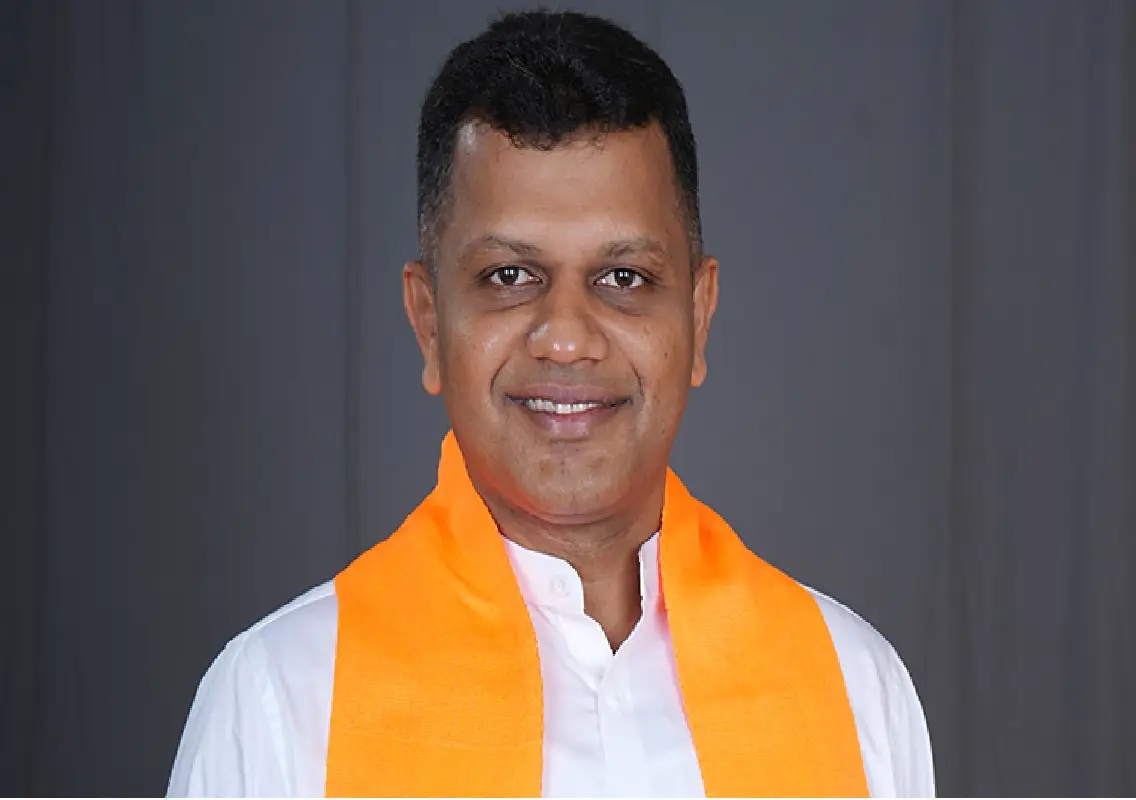


Mangaluru: The completion of the electrification of the technically challenging Sakleshpur–Subrahmanya Ghat rail section has marked a significant milestone in strengthening railway infrastructure and accelerating economic growth in coastal Karnataka, said Dakshina Kannada Member of Parliament Captain Brijesh Chowta on Wednesday.
The 55-km ghat stretch, considered one of the most difficult sections on the Bengaluru–Mangaluru rail corridor due to its steep gradients, sharp curves and dense forest terrain, had for decades remained a major operational bottleneck. With electrification now fully completed, the section is expected to transform train operations by improving efficiency, increasing line capacity and enabling smoother movement of both passenger and freight trains.
Captain Chowta described the development as a “turning point” for the region, stating that it fulfils a long-pending demand of the people of coastal and interior Karnataka. He said the project would significantly improve connectivity between the hinterland districts and the coast, while also supporting the state’s broader economic and logistical ambitions.
Ending a long-standing bottleneck
The Sakleshpur–Subrahmanya Ghat section is a critical link on the Bengaluru–Mangaluru route, which connects Karnataka’s capital with one of its most important port cities. For years, diesel traction on the steep ghat section limited the number of trains that could be operated and restricted speed and load capacity, often causing delays and congestion.
With electrification, Indian Railways can now deploy more powerful electric locomotives capable of hauling heavier loads at better speeds. Railway officials say this will lead to improved punctuality, reduced dependence on diesel engines, and lower operational costs over time.
Chowta noted that the completion of electrification would allow better utilisation of existing infrastructure while laying the foundation for future upgrades such as line doubling. “This ghat section has long been the weakest link in an otherwise vital rail corridor. Electrification removes a key constraint and opens new possibilities for growth,” he said.
Boost to port-based logistics and trade
Mangaluru, home to the New Mangalore Port Authority, plays a crucial role in Karnataka’s maritime trade, handling petroleum products, fertilisers, coal, iron ore and container cargo. Improved rail connectivity between the port and the state’s interior is essential for efficient movement of goods.
According to Chowta, electrification of the ghat section will accelerate port-based logistics by enabling smoother and faster cargo movement to and from Mangaluru. This is expected to benefit industries across Karnataka that depend on the port for imports and exports.
“Stronger rail connectivity directly supports trade, commerce and industrial growth. With electric traction, freight trains can run more efficiently, helping industries reduce logistics costs and improve competitiveness,” the MP said.
Improved passenger connectivity
Apart from freight, passenger services between Bengaluru and the coastal districts are also set to benefit. Electric traction allows for better acceleration and smoother operations, which can translate into shorter travel times and improved reliability.
Residents of Dakshina Kannada, Udupi and neighbouring districts have long demanded better rail services to Bengaluru, especially during peak travel seasons. The electrification of the ghat section is expected to facilitate the introduction of more trains and improved schedules in the future.
Chowta said the project would enhance overall travel experience for passengers while strengthening social and economic ties between the coast and the hinterland.
Parliamentary efforts and sustained follow-up
Highlighting his role in pursuing the project, Chowta said he had consistently raised the issue with the Railways since assuming office as MP. In July 2024, he submitted a detailed representation seeking electrification and doubling of the Padil–Subrahmanya–Sakleshpur line, citing its strategic and economic importance.
In December 2024, he raised questions in the Lok Sabha on measures being taken to improve capacity, speed and efficiency on the Mangaluru–Bengaluru route. During the railway budget discussions held between February and March 2025, he again stressed the urgency of completing electrification of the ghat section, directly linking it to coastal Karnataka’s economic development.
“This achievement is the result of sustained follow-up and coordinated action between elected representatives and the Railways,” Chowta said.
Appreciation for Centre and railway workforce
The MP expressed gratitude to Prime Minister Narendra Modi, Railway Minister Ashwini Vaishnaw and Minister of State for Railways V. Somanna for prioritising the project. He also commended railway engineers and staff for completing the electrification within the targeted timeframe despite severe geographical and technical challenges.
The ghat section passes through ecologically sensitive areas and involves numerous tunnels, bridges and sharp curves, making electrification a complex task. Railway officials had to ensure safety and environmental compliance while installing overhead equipment across difficult terrain.
A foundation for future growth
Chowta said the completion of electrification should be seen as a foundation for further upgrades, including line doubling and modernisation of stations along the route. Such measures, he added, would further enhance the capacity of the Bengaluru–Mangaluru corridor and support long-term regional development.
With coastal Karnataka increasingly emerging as a hub for trade, tourism and industry, improved rail infrastructure is expected to play a crucial role in sustaining growth. The electrification of the Sakleshpur–Subrahmanya Ghat section, long awaited by the region, now stands as a key step in that direction.