







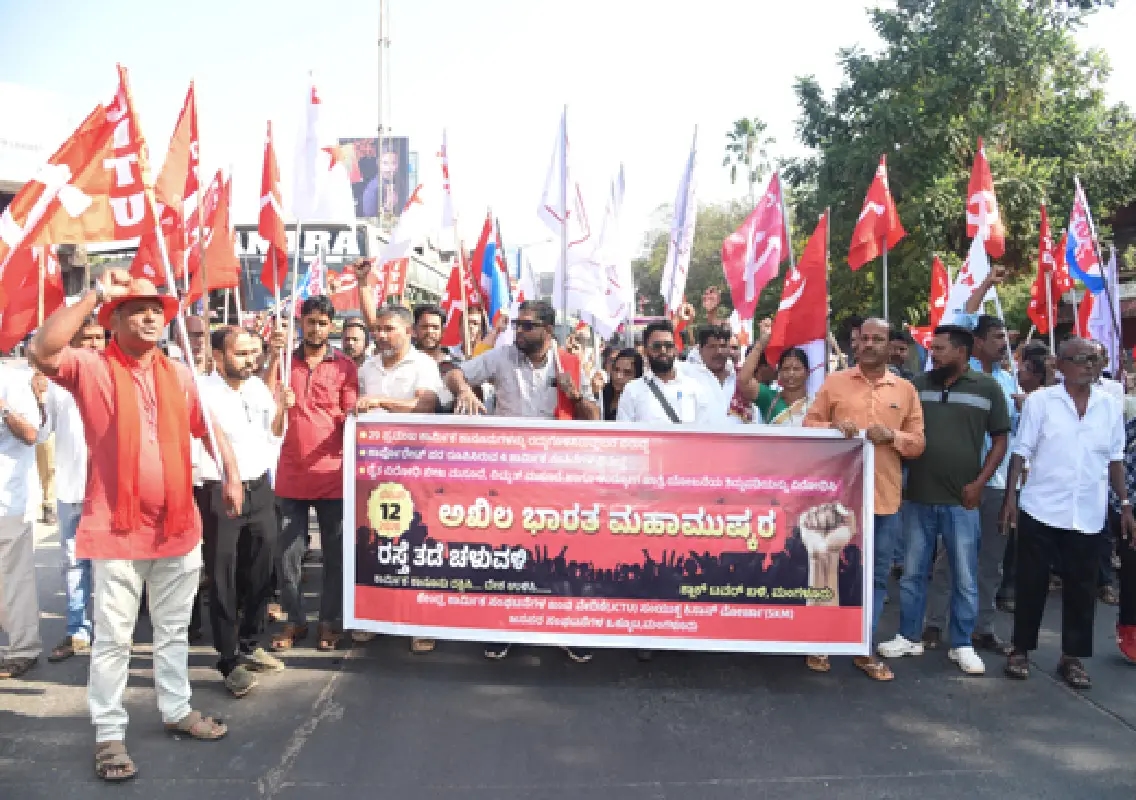


Mangaluru: Responding to the nationwide general strike call given by central trade unions, workers in Mangaluru on Wednesday joined protests against the Union government’s move to repeal existing labour laws and implement the four new Labour Codes, collectively referred to by unions as Labour Code 2025.
The impact of the strike was most visible at the Old Port wholesale market area, one of the city’s busiest commercial hubs, where hamali (head-load) workers abstained from work and participated in the agitation. Their absence brought trading and loading operations to a near standstill, leaving the usually crowded market largely deserted.
Old Port wholesale hub sees near-total shutdown
Mangaluru’s Old Port area, known for high-volume wholesale trade in essential commodities and goods, witnessed minimal activity as hamali workers stayed away from their duties. With no labourers available to handle loading and unloading operations, traders found it difficult to move goods from warehouses to transport vehicles and retail points.
As a result, several traders chose not to open their shops and storage facilities for the day. Movement of goods vehicles inside the market yard was limited, and public footfall in the area dropped sharply compared to normal business days.
Traders said that even where stocks were available, operations could not proceed without manual handling support. The shutdown highlighted the dependence of wholesale trade on daily wage and head-load workers.
Port Workers’ Association backs protest
The Port Workers’ Association extended formal support to the strike and conducted preparatory meetings ahead of the protest day. Worker leaders had urged members to participate in large numbers and coordinated locally to ensure effective implementation of the strike call.
Union representatives said the protest was aimed at opposing what they described as dilution of worker protections under the new labour codes. They expressed concern over provisions related to working hours, job security, dispute resolution and union rights.
Meetings and awareness sessions were reportedly held in the days leading up to the strike to explain the implications of the new codes and mobilise participation.
Protest targets new labour codes
Central trade unions across the country have opposed the consolidation of multiple existing labour laws into four broad labour codes by the Union government. The unions argue that the new framework weakens safeguards for workers, makes unionisation more difficult and gives employers greater flexibility in hiring and termination.
Workers participating in the strike said the protest was meant to send a message that labour reforms should not be implemented without wider consultation and stronger guarantees for worker welfare.
Local union organisers said the strike demonstrated the collective strength of manual workers, especially in logistics and goods handling sectors that form the backbone of supply chains.
Strong participation despite political landscape
Union leaders described the turnout in Mangaluru as significant, noting that the region is often viewed as politically favourable to the ruling party at the Centre. They said the strike participation by hamali and port-linked workers reflected economic concerns that go beyond party lines.
Worker representatives said the protest underscored a basic reality of trade and commerce — that regardless of purchasing capacity, goods cannot be physically moved without labour. The day’s shutdown, they said, served as a practical demonstration of workers’ central role in market operations.
Limited public movement in affected areas
Due to the strike and closure of several establishments in and around the Old Port market, public movement in the locality remained sparse for much of the day. Transport linked to wholesale goods movement was also reduced.
However, there were no reports of violence or major law and order issues in connection with the strike in the city. The protest remained largely peaceful, with workers assembling, holding meetings and staying off duty.
Conclusion
The general strike’s impact in Mangaluru, particularly in the Old Port wholesale belt, highlighted the operational dependence of urban markets on organised and unorganised labour. With trade unions continuing to oppose the Labour Code framework, further negotiations and protests are likely if consensus is not reached between worker bodies and the government.