







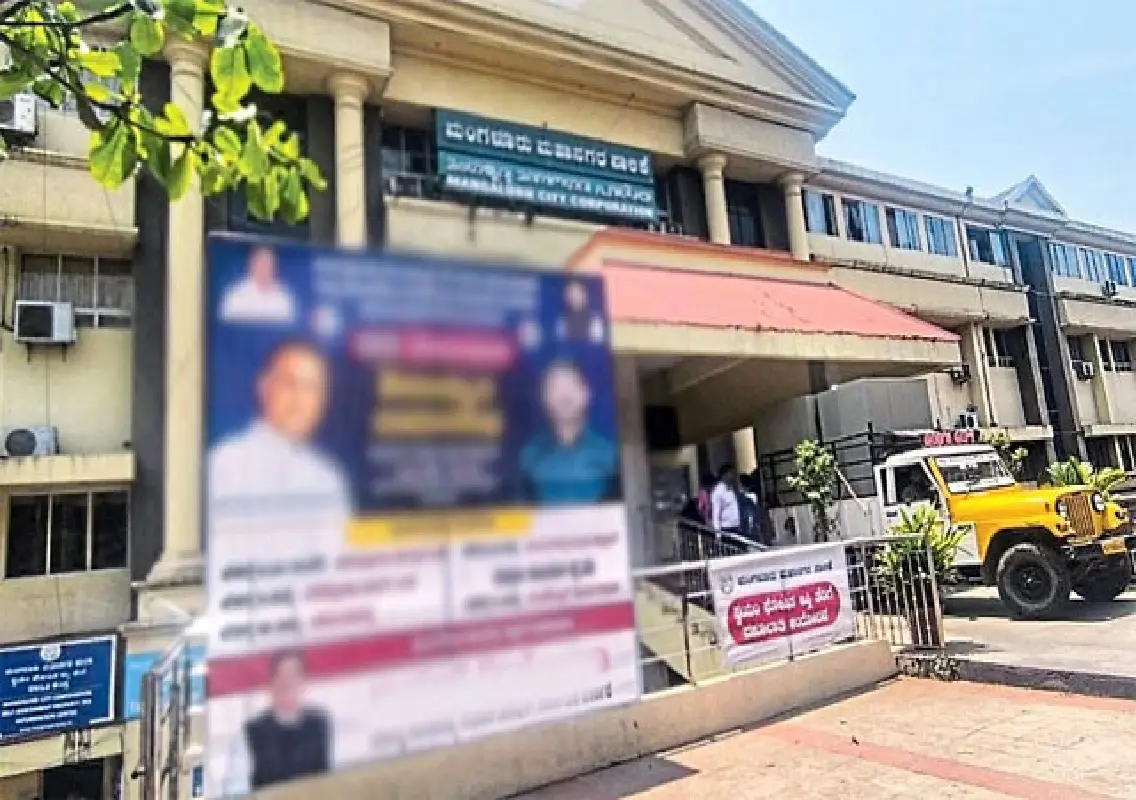


Mangaluru: Despite an existing ban on plastic flex banners within city limits, Mangaluru is witnessing a sharp rise in illegal hoardings, triggering public outrage over what many perceive as selective enforcement by authorities. Ironically, the premises of the Mangaluru City Corporation (MCC) itself has emerged as a focal point of these violations.
Large banners featuring political leaders and elected representatives have been prominently displayed at the entrance and surrounding walls of the MCC office in Lalbagh. These installations, many linked to foundation stone laying ceremonies and official events, remain in place despite clearly contravening plastic-free and urban beautification norms.
Violations at the heart of administration
The presence of such banners within the civic body’s own premises has drawn sharp criticism from citizens, who allege a “double standard” in enforcement. While authorities have previously penalised individuals and small businesses for similar violations, the prominent political displays appear to have gone unchecked.
The issue is not confined to Lalbagh alone. Illegal flex banners have also been reported at several locations across the city, including Karavali Utsav Ground, Mannagudda, Chilimbi, and near Ambedkar Bhavan.
Residents argue that such widespread violations undermine the credibility of the civic administration and weaken ongoing efforts to promote a plastic-free city.
Officials defend installations
Responding to the criticism, MCC officials have maintained that the banners placed within their premises are authorised. They stated that the installations were put up for official programmes and are located on land owned by the corporation.
According to officials, all banners have been installed in permitted areas, and no unauthorised flex displays exist within the MCC compound. However, this explanation has failed to convince many residents, who argue that the spirit of the ban is being violated regardless of technical ownership.
Public inconvenience and safety concerns
Beyond regulatory violations, the unchecked proliferation of banners has also raised concerns about public inconvenience and safety. In several parts of the city, banners have been erected on footpaths and public spaces, obstructing pedestrian movement.
Areas such as Nanthoor, Bikarnakatta, Kaikamba, Kulshekar, Bondel, and Padil have reported significant encroachments.
At Nanthoor, banners are seen lined up in long rows, creating visual clutter and restricting space for commuters. Near Karangalpady, privately installed congratulatory banners have further exacerbated the problem by occupying pedestrian pathways, forcing people onto busy roads.
Weak enforcement against printers
The resurgence of illegal banners has also been linked to inadequate enforcement against printing presses. About a year ago, the MCC had issued warnings to printers, cautioning them about penalties for producing plastic flex banners.
However, the lack of follow-up action has rendered those warnings ineffective. Despite many banners displaying contact details of organisers, there has been little visible effort to penalise those responsible.
Observers note that earlier removal drives, once a routine exercise, have significantly slowed down. This has emboldened individuals and groups to continue installing banners without fear of consequences.
Growing public frustration
Citizens have increasingly voiced their frustration over what they describe as a failure of governance and accountability. Many argue that environmental regulations lose their meaning if they are not applied uniformly.
The continued presence of plastic flex banners not only contradicts the city’s sustainability goals but also contributes to pollution and visual degradation. Residents are now calling for stricter enforcement, transparency in action taken and equal application of rules, irrespective of political affiliations.
Conclusion
The resurgence of illegal flex banners in Mangaluru has exposed gaps in enforcement and raised questions about the civic body’s commitment to its own regulations. As public discontent grows, restoring credibility will require consistent action, accountability and a firm stance against violations—regardless of who is responsible.