


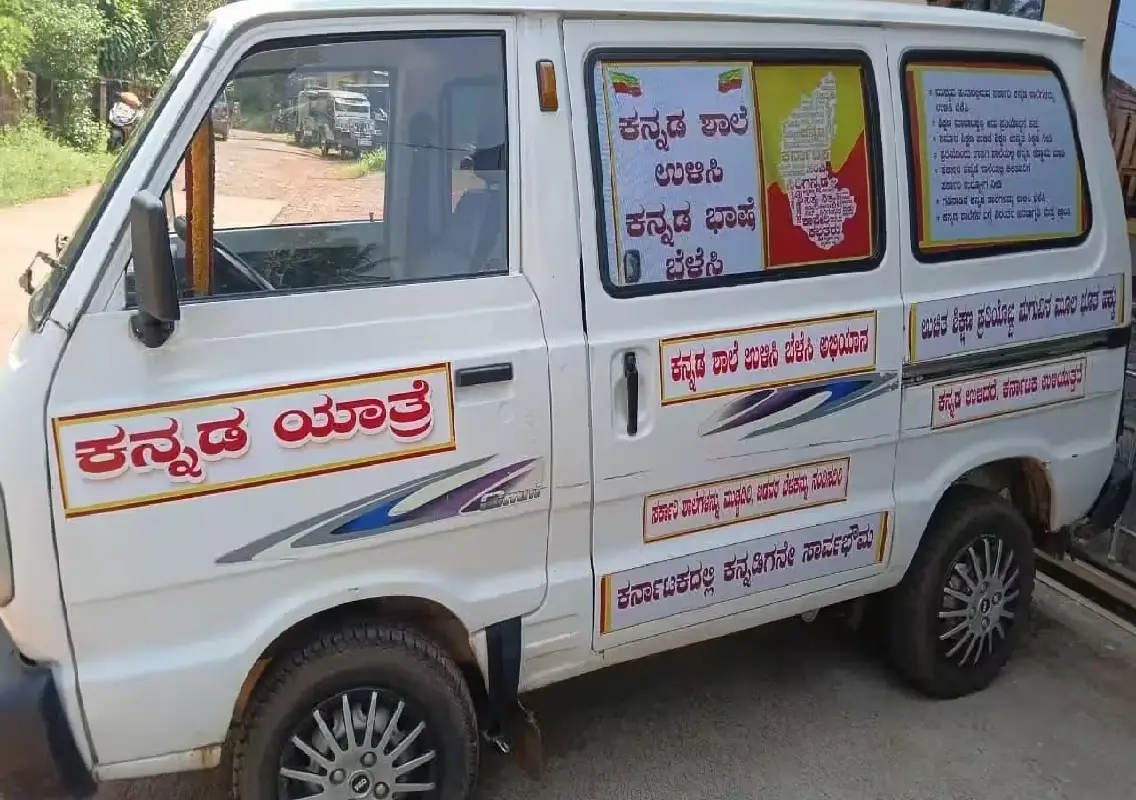


Mangaluru: A year-long campaign to protect and strengthen Kannada-medium schools is travelling across Karnataka and neighbouring states to document challenges ranging from school closures and teacher shortages to inadequate roads that make it difficult for children to reach classrooms.
The campaign, ‘Kannada Shala Ulisi Belesi Abhiyana’ (Save and Develop Kannada Schools Campaign), aims to cover all 31 districts and 239 taluks of Karnataka, besides Kannada-medium schools in the border regions of Goa, Maharashtra, Telangana, Andhra Pradesh and Tamil Nadu.
According to a report, the initiative seeks to understand the problems faced by Kannada-medium schools through direct interaction with teachers, students, parents and local communities. The campaign is also documenting schools at risk of closure and attempting to mobilise support to keep them functioning.
Unais Peraje, the campaign’s state convener, began the journey in Kasargod district of Kerala. What was initially planned as a five-day visit eventually extended to 40 days as he travelled between schools, met local residents and examined the difficulties faced by Kannada-speaking communities.
The campaign’s central message is that preserving Kannada and its cultural heritage requires sustained support for schools where children learn the language.
“Our priority is to ensure that Kannada schools do not shut down. We believe our culture can be preserved only if Kannada schools survive,” Peraje said.
Teacher shortages and risk of school closures
The campaign’s initial visits highlighted a range of challenges affecting Kannada-medium education, including concerns over teacher availability, low student enrolment and inadequate infrastructure.
In some schools, the team encountered Malayalam-speaking teachers teaching students through Kannada-medium programmes. The campaign raised the issue with local education authorities, drawing attention to the challenges of ensuring effective instruction in the language in which children are expected to learn.
Teacher availability and language proficiency are important factors in the quality of classroom education. Campaign members are documenting such concerns to draw attention to the needs of schools serving Kannada-speaking communities, particularly in border areas.
Near Panathur, the team identified a Kannada school facing the threat of closure because of low enrolment. The campaign made a small financial contribution to the institution and plans to seek additional assistance from the Border Area Development Authority.
The case illustrates the difficulties faced by schools with declining student numbers. When enrolment falls, institutions may struggle to justify continued operations, potentially forcing children to travel farther to access education in their preferred language.
The campaign is seeking to highlight such schools before they shut down, with the aim of encouraging local communities and authorities to explore ways to sustain them.
Peraje said more than 5,000 schools had closed across Karnataka in recent years. The figure reflects the concern driving the campaign, although the supplied report does not provide a detailed breakdown of the closures by school type or medium of instruction.
Children face difficult journeys to school
The campaign has also documented problems involving access to school, particularly in rural areas where poor roads and inadequate transport can make daily attendance difficult.
In Delampady, children reportedly have to walk about half a kilometre along dirt tracks to reach their school. The team raised the issue with the local MLA and urged that steps be taken to repair the road.
For children, the journey to school is an important part of access to education. Poorly maintained roads can create difficulties for younger students and families, especially during the monsoon, when dirt tracks may become muddy or difficult to navigate.
The campaign’s approach involves recording such conditions and communicating local concerns to elected representatives and relevant authorities.
By visiting schools and experiencing the surrounding conditions first-hand, the team hopes to bring attention to problems that may otherwise receive limited public visibility.
The initiative also relies on residents who join the journey and share their experiences. Their participation helps the campaign document issues affecting schools and communities in different locations.
Campaign has supported around 170 schools
The current year-long journey builds on the campaign’s previous work supporting Kannada-medium schools.
Peraje said the initiative had assisted around 170 schools over the past decade by providing items such as furniture, stationery and educational equipment.
Such assistance can help address immediate requirements in schools where basic resources are limited. However, the campaign’s broader objective is to bring sustained attention to the structural challenges facing government education institutions.
Its members are documenting concerns about school closures, teacher shortages and infrastructure while seeking support from authorities and local communities.
The largely self-funded journey is undertaken by a team of four to five members. The group travels between schools, interacts with people on the ground and records local conditions.
The team also documents Kannada heritage, including inscriptions and forts, and recognises individuals working to promote the language. This aspect of the initiative links the condition of Kannada-medium education with the wider preservation of the region’s language, history and cultural traditions.
Key demands to strengthen Kannada-medium education
The campaign has put forward several demands aimed at protecting government schools and strengthening access to education.
Its principal demands include:
- Preventing the closure of government schools.
- Ensuring free and equal education for every child.
- Giving preference in government recruitment to people educated in government schools.
- Making Kannada compulsory in private English-medium schools.
- Requiring government employees to enrol their children in government schools.
These demands reflect the campaign’s emphasis on the role of government institutions in sustaining Kannada-medium education.
The proposal to give preference in government recruitment to those educated in government schools is intended to encourage greater recognition of public education. The demand to make Kannada compulsory in private English-medium schools, meanwhile, seeks to ensure that children studying in different educational settings continue to learn the language.
The campaign has also called for government employees to enrol their children in government schools, arguing for greater public confidence and participation in the state education system.
These are proposals advanced by the campaign and would require consideration by the relevant authorities before any policy changes could be implemented.
Preserving Kannada through education and heritage
The campaign’s route extends beyond Karnataka into neighbouring states with Kannada-speaking populations, including border areas where language, education and cultural identity intersect.
By visiting schools in these regions, the initiative aims to document the conditions under which children learn Kannada and identify institutions that may require support.
The campaign’s heritage documentation complements its focus on education. Inscriptions, forts and other historical sites offer records of Kannada’s linguistic and cultural history, while recognising individuals working to promote the language highlights contemporary efforts to sustain it.
For Peraje and the campaign team, protecting Kannada-medium schools is central to ensuring that future generations retain access to education in the language and remain connected to its cultural heritage.
The year-long journey is expected to bring together accounts from schools, families and communities across Karnataka and neighbouring states. By recording local problems and raising them with elected representatives and education authorities, the campaign hopes to generate wider discussion and encourage practical support.
Its ultimate challenge will be to turn awareness into sustained action so that schools facing declining enrolment, staffing problems or infrastructure deficiencies can continue serving their communities.