







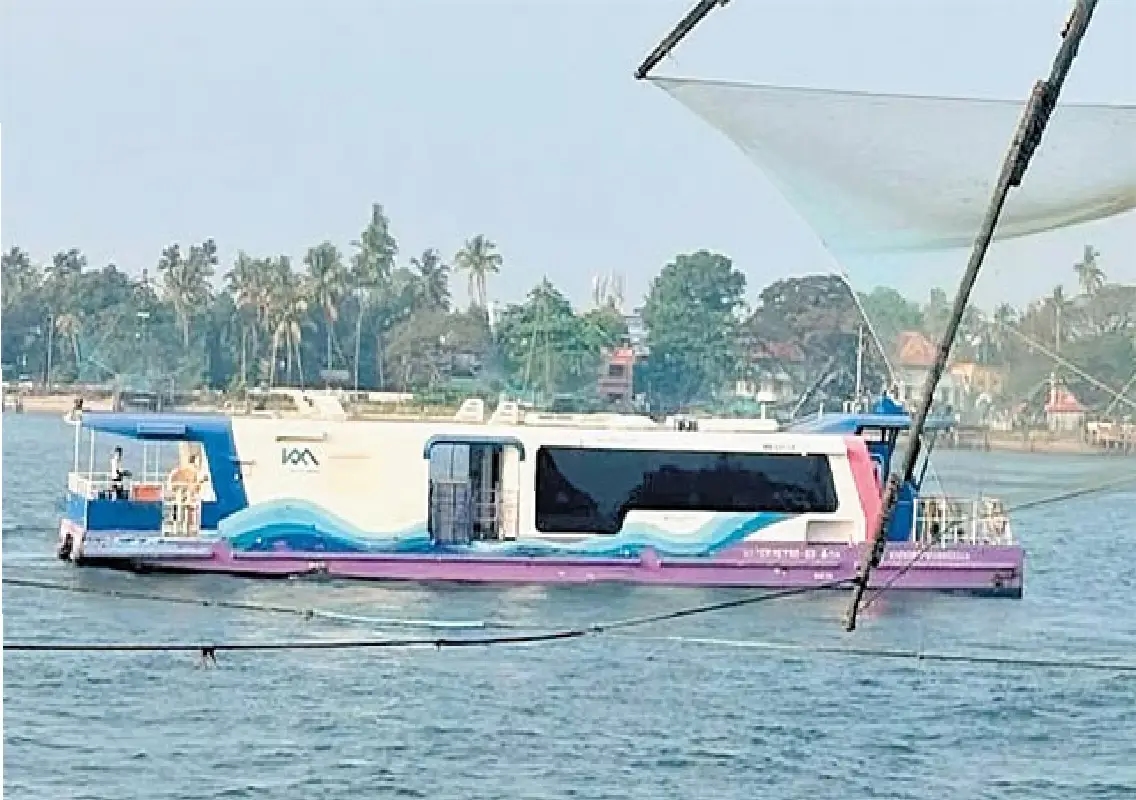


Mangaluru: Inspired by the operational success of the Kochi Water Metro, authorities are actively examining the feasibility of launching a similar water-based public transport system along Karnataka’s coastal belt. A delegation from the Coastal Development Authority (CDA) recently visited Kochi to study the model and assess how it could be adapted to the backwater and river networks of coastal Karnataka.
The CDA team, led by chairman M A Gaffoor, visited Kochi Metro Rail Limited (KMRL) to understand the technical, financial and operational framework of the water metro system. CDA secretary Pradeep D’Souza and other officials were part of the delegation.
Delegation studies jetties, vessels and operations
During the visit, the CDA delegation reviewed multiple components of the Kochi Water Metro infrastructure and management system. Officials examined the design and construction of floating jetties, vessel operations, boat-building yards and mechanisms used for water-level management.
According to CDA officials, the Kochi model demonstrated that a structured water-based transit system can be developed at a comparatively moderate cost while delivering reliable urban mobility. The delegation was informed that the Kochi Water Metro project components were developed in the range of approximately Rs 100 crore to Rs 200 crore, depending on phases and facilities, making it a potentially viable and scalable model.
The team also held discussions with KMRL managing director Loknath Behera on how backwater systems can be effectively integrated into public transport planning.
186 backwater locations identified in coastal belt
M A Gaffoor said the three coastal districts — Dakshina Kannada, Udupi and Uttara Kannada — together have around 186 backwater locations. Many of these, he noted, could potentially be linked through a structured water metro network if technical and environmental parameters are satisfied.
He said such a system could improve last-mile and inter-town connectivity, especially in areas where rivers and estuaries create natural transport corridors. A water metro network could also help reduce pressure on congested road infrastructure and provide an eco-friendlier mobility option.
Officials believe that integrating water transport with existing bus and road systems could form part of a broader multimodal transport strategy for the coast.
Fresh feasibility push after earlier limitations
Referring to an earlier technical review, Gaffoor said KMRL had previously submitted an assessment indicating that, under then-existing parameters, extending a water metro model beyond the Gurupur–Maravoor bridge stretch was not feasible.
However, the CDA now plans to submit additional data and revised location inputs to re-evaluate feasibility. Authorities are identifying alternative stretches and operational models that may better suit local river conditions, passenger demand and navigational limits.
A detailed report incorporating fresh findings and technical inputs is expected to be submitted to the Karnataka state government shortly. Further action will depend on government direction and financial approval.
Maritime Board proposes Mangaluru water metro project
The renewed push by the CDA comes alongside a recent proposal by the Karnataka Maritime Board for a water metro project in and around Mangaluru city, estimated at around Rs 180 crore.
Under that proposal, the planned network would connect Malavoor Bridge near Mangaluru International Airport with Jeppinamogaru Bridge, passing through the Gurupur and Netravati rivers and the Old Mangaluru Port. The project is envisioned as part of an integrated multimodal urban transport system combining road and water routes.
In addition, the Maritime Board has proposed a coastal passenger ferry service between Mangaluru and Maravanthe in Udupi district. This route is being considered as an alternative to the heavily congested NH-66 corridor and could offer faster and more scenic travel options if implemented.
Sustainable mobility focus growing
Officials said the Kochi Water Metro offers important lessons in sustainable and cost-effective urban mobility using natural waterways. With rising traffic congestion and infrastructure stress along coastal corridors, water-based transport solutions are gaining policy attention.
The CDA’s study visit marks an early but significant step toward evaluating whether a similar system can be tailored to Karnataka’s coastal geography. If found viable, the project could reshape regional mobility and open up new public transport corridors along rivers and backwaters.