







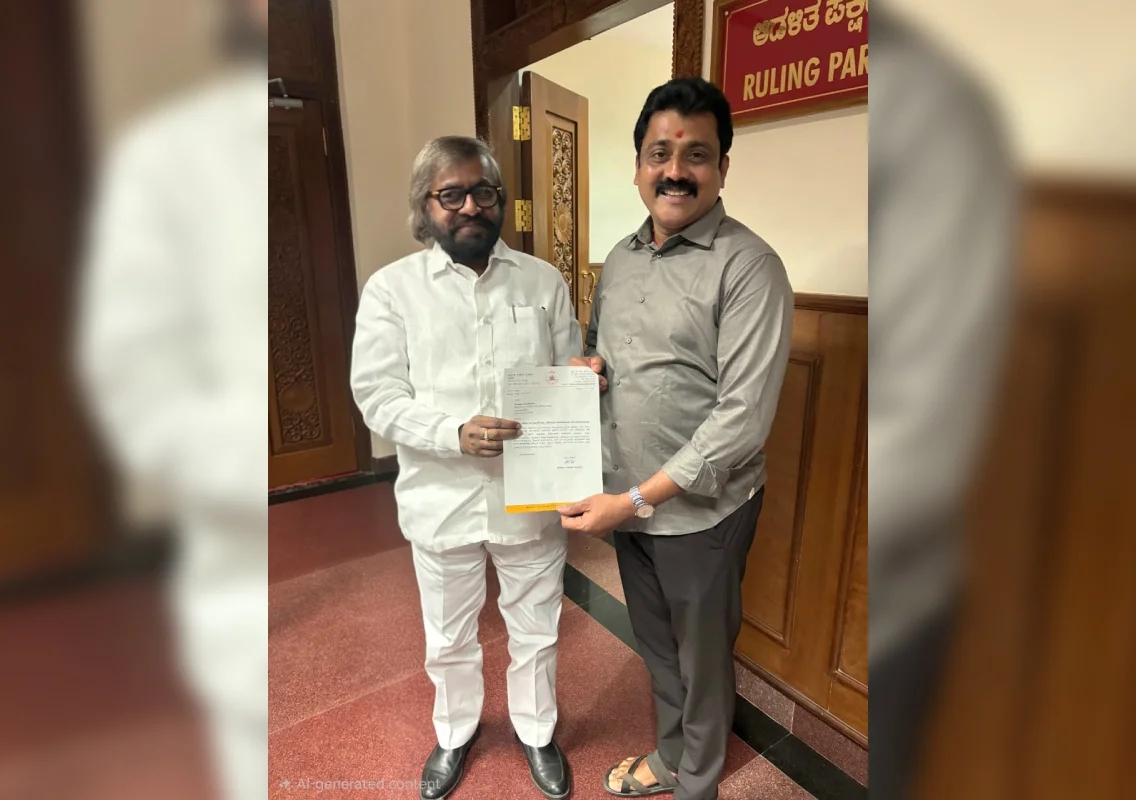


Mangaluru: Hon’ble Member of the Karnataka Legislative Council Shri Kishor Kumar Puttur met Forest Minister Shri Eshwar Khandre at Suvarna Soudha, Belagavi, and held detailed discussions on the escalating human–elephant conflict in Sullia, Kadaba and Belthangady taluks of Dakshina Kannada district.
Rising elephant menace in forest-fringe villages
During the meeting, Kishor Kumar informed the Minister that wild elephants have been repeatedly entering agricultural lands in forest-border villages, causing extensive damage to crops such as arecanut, coconut and banana, leading to severe financial distress for farmers. He also highlighted incidents of human fatalities and serious injuries due to elephant attacks, which have created a climate of fear and insecurity among local residents.
Emphasising the gravity of the situation, the MLC stated that farmers are being forced to live under constant threat, affecting both livelihoods and daily life.
Demand for immediate Elephant Task Force
Kishor Kumar strongly urged the government to immediately establish an Elephant Task Force (ETF) in Dakshina Kannada district to monitor elephant movement, enable rapid response, and prevent crop damage and loss of human life. Recalling an earlier assurance given by the Forest Minister on the floor of the House, he requested that the commitment be implemented without further delay.
He said an operational ETF would act as a dedicated mechanism to manage recurring elephant intrusions and provide much-needed relief to farmers.
Minister assures ETF from next week
Responding positively, Forest Minister Shri Eshwar Khandre assured that the Elephant Task Force will be operational from next week. He further announced that after the ongoing Assembly session, he plans to personally visit Sullia taluk and convene a joint meeting with MLC Kishor Kumar Puttur, the local MLA, public representatives and farmers.
Scientific and long-term solutions planned
The Minister said a comprehensive action plan would be prepared to address the issue scientifically and sustainably. This would include mapping elephant movement patterns, identifying hotspots, strengthening emergency response mechanisms, installing fencing and barrier systems, improving lighting in vulnerable areas, and deploying technology-based surveillance.
Reiterating the government’s commitment, Shri Khandre stated that protecting the lives and property of farmers in forest-fringe villages remains a top priority.