







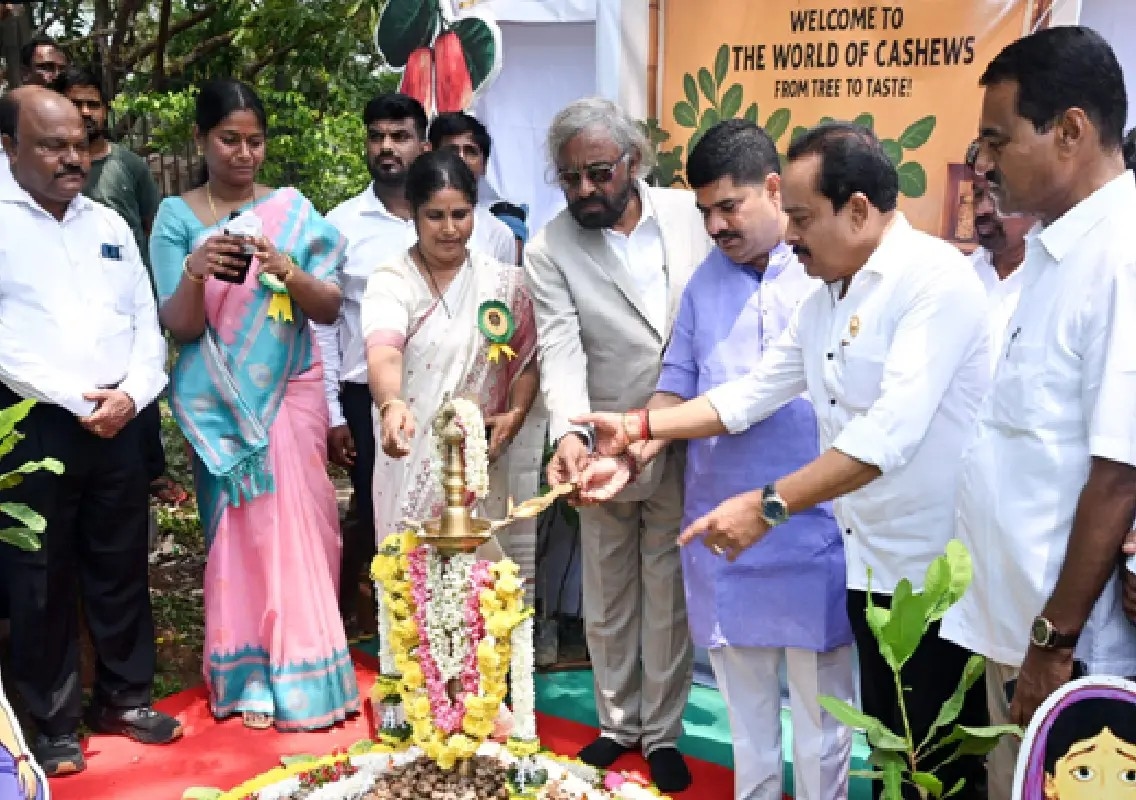


Mangaluru: Karnataka has announced a major push to revive and strengthen the cashew sector, with Forest, Ecology and Environment Minister Eshwar Khandre stating that Dakshina Kannada and Udupi districts have significant potential for large-scale cashew cultivation. The state government will provide a grant of Rs 1 crore through the Karnataka State Cashew Development Corporation to develop quality grafted cashew saplings for farmers.
The announcement was made during the inauguration of a two-day Cashew Fair organised by KSCDC at Kadri Park. The initiative aims to support farmers with improved planting material and strengthen domestic production of cashew in the state.
Government plans revival of cashew sector
Speaking at the event, Khandre said the government intends to revive commercial cashew farming and reduce dependency on imported produce. He explained that quality saplings would be developed and supplied to farmers to encourage cultivation on a wider scale.
According to the minister, many farmers gradually shifted away from commercial cashew farming following the endosulfan tragedy, which significantly affected agricultural practices in some regions. As a result, processing industries increasingly relied on imported raw cashew, particularly from African nations.
Khandre said the state government is now adopting measures to rebuild confidence among farmers and strengthen local production.
“The state will be made self-reliant in cashew production by reducing imports and increasing quality output,” he said.
Officials believe that improved cultivation practices and better quality planting material could help increase productivity and reduce dependence on overseas imports in the long term.
Expansion plans beyond coastal districts
The government is also looking at extending cashew cultivation to other regions of the state. Khandre said the Kalyana Karnataka region, including Kalaburagi district, has been identified under a dedicated action plan to support cultivation with assistance from the government and forest department.
The move is part of a broader strategy to increase agricultural diversity while creating opportunities for farmers in regions suitable for plantation crops.
Authorities expect that expanding cultivation into additional districts may contribute towards strengthening the state’s agricultural economy and improving local livelihoods.
Minister stresses environmental conservation
During his address, Khandre also highlighted the significance of protecting the biodiversity-rich Western Ghats, stating that the region plays a critical role in maintaining ecological balance and rainfall patterns.
He emphasised that conservation of forests and natural ecosystems remains a shared responsibility.
“It is everyone’s responsibility to conserve the Western Ghats,” he said.
The minister stated that nearly 11 crore saplings had been planted and nurtured across Karnataka over the past three years as part of efforts to increase the state’s green cover. He also noted that authorities were continuing phased efforts to clear large-scale forest encroachments.
Climate concerns and demands for additional support
Referring to changing climate conditions, Khandre observed that rainfall patterns have shifted considerably in recent years, resulting in intense spells of rain that have caused crop damage in various regions.
Meanwhile, D Vedavyas Kamath called on the government to introduce a special package for cashew cultivation. He said current domestic production was sufficient to meet demand for only around one-and-a-half months.
Kamath also suggested that unused forest land could be explored for developing cashew plantations to improve production capacity.
As part of the event, organisers felicitated 12 progressive farmers for their contributions to agriculture. Cultural and community activities including painting and rangoli competitions were also conducted during the fair.
The renewed focus on cashew cultivation signals the government’s attempt to strengthen agricultural production, support farmers and gradually build self-reliance in the sector through improved infrastructure and planting initiatives.