







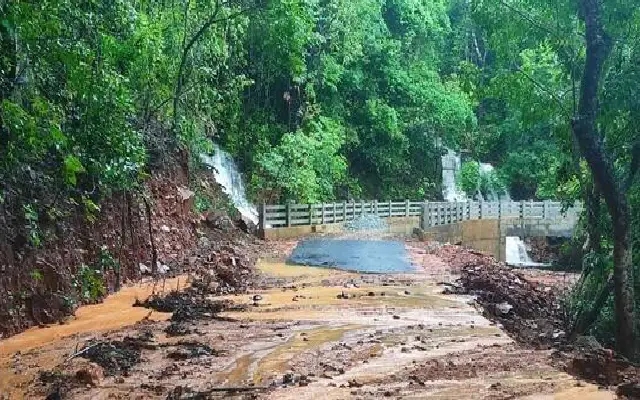


Mangaluru: Residents and students of Kombaru village, located in the forested region of Kadaba taluk, about 60 km from Mangaluru, face life-threatening challenges during the monsoon. To access the outside world, they must cross a stream using a makeshift bridge made from areca palm trees, risking falls into the water with any misstep.
This is a common scene in remote villages of Dakshina Kannada, where students navigate perilous conditions to attend school, crossing swollen streams on makeshift wooden footbridges known as kalusankas. These hastily constructed structures pose significant risks to children’s safety. Despite district administration efforts to secure these bridges last year following incidents in neighboring districts, many still require repair or permanent solutions.
In response to district minister Dinesh Gundu Rao’s directive during the previous monsoon, authorities took steps to repair and reinforce existing footbridges. However, there remains a pressing need for additional safe footbridges to ensure student safety. Last academic year, it was estimated that 3,136 children used a total of 338 kalusankas in the district. Of these, 48 had no railing, and 55 were deemed unfit for use. While 227 kalusankas were built of wood, the rest were made of concrete and other materials.
The highest number of kalusankas, around 156, are in Puttur BEO limits, used by 2,182 schoolchildren. Puttur is followed by Belthangady and Moodbidri. The district administration, with help from the PWD, has repaired some of the most urgent cases. Amarnath Jain HP, executive engineer of the PWD in Dakshina Kannada, stated that a survey of kalusankas has begun, with immediate attention to those posing a threat to students.