







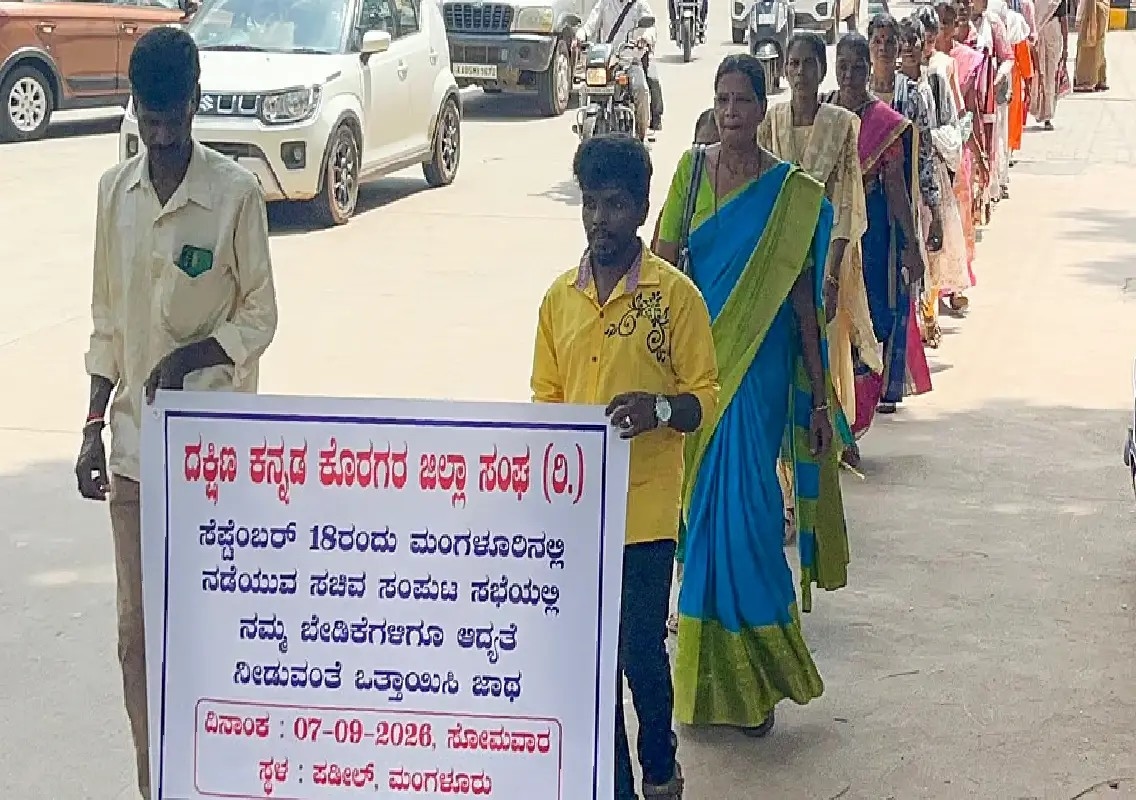


Mangaluru: Members of the Dakshina Kannada district Koragara Sangha staged a silent march from Padil Circle to the Deputy Commissioner’s office on Monday, urging the State government to address the long-pending demands of the Koraga community and introduce permanent measures for its comprehensive development.
The protesters submitted a representation addressed to Chief Minister D K Shivakumar through the Deputy Commissioner. They urged the government to take up their demands for consideration at the Cabinet meeting scheduled to be held in Mangaluru on September 18.
Community seeks action on development demands
The association described the Koragas as an indigenous tribal community of the undivided Dakshina Kannada region and noted that they are among the 75 Particularly Vulnerable Tribal Groups (PVTGs) recognised in India.
According to the association, the community continues to face social and economic marginalisation despite its longstanding contribution to the cultural and historical heritage of coastal Karnataka.
The protesters said the community remains disadvantaged in several areas, including education, healthcare, social development, employment opportunities and political representation. They called for sustained government intervention rather than temporary measures to address these challenges.
The representation submitted during the march outlined several demands that the association said were essential for improving the living conditions and future prospects of Koraga families.
Demand for 2.5 acres of cultivable land
One of the principal demands is the distribution of at least 2.5 acres of cultivable agricultural land to every Koraga family.
The association referred to the Dr Mohammed Peer Committee report, which examined the socio-economic conditions of the Koraga community and recommended providing at least 2.5 acres of agricultural land to each Koraga family along with rehabilitation measures.
The report was submitted to the district administration in 1994. However, the association alleged that its recommendations have not been fully implemented even after several decades.
The protesters said land ownership is essential for the community’s long-term survival, self-reliance and sustainable livelihood. They urged the government to implement the land-related recommendation and ensure that eligible Koraga families receive cultivable land.
The association maintained that access to land would provide families with an opportunity to develop sustainable livelihoods instead of remaining dependent on uncertain sources of income.
Government jobs sought for educated youth
The Koraga Sangha also demanded direct recruitment to government jobs for educated youth belonging to PVTG communities.
The association said several educated youngsters from the Koraga community continue to face employment insecurity, resulting in uncertainty about their future.
It urged the government to implement its announced provision for 100% direct recruitment of members of PVTG communities to government employment.
According to the association, providing employment opportunities through direct recruitment would help educated members of the community secure stable livelihoods and improve the socio-economic conditions of their families.
The protesters said employment security should form an important part of a comprehensive development strategy for PVTG communities.
Nutrition programme needs immediate implementation
The association also raised concerns over food security and nutrition among members of the Koraga community.
The protesters said the community has historically faced an unstable food security situation and has experienced problems such as malnutrition and anaemia due to inadequate access to nutritious food.
While welcoming the government’s nutritional food programme for the community, the association urged the authorities to immediately distribute nutritional food that has allegedly remained pending for the past six months.
The members said timely distribution of nutritional food is important to address existing nutritional deficiencies and protect vulnerable sections of the community, particularly families facing economic hardship.
They urged the administration to ensure that welfare measures intended for the community reach beneficiaries without delay.
Representation submitted ahead of Cabinet meeting
The timing of the protest is significant as the State Cabinet meeting is scheduled to be held in Mangaluru on September 18.
The Koragara Sangha has urged the government to consider the community’s demands during the meeting and take concrete decisions on the issues raised in the representation.
The association said the long-standing nature of several demands requires permanent policy measures and effective implementation at the ground level.
The protesters also stressed the need for a coordinated approach covering land, employment, education, healthcare, nutrition and social development.
Leaders participate in silent march
The silent march saw members of the Dakshina Kannada district Koragara Sangha walk from Padil Circle to the Deputy Commissioner’s office.
Association leaders and community members participated in the demonstration and submitted their representation through the Deputy Commissioner.
Koraga association president Sundara Koraga, Udupi district association president Babu Pangala and others were present.
The protesters hope that the representation will lead to concrete action from the State government and that their long-pending demands will receive attention at the upcoming Cabinet meeting.
The association’s demands centre on creating sustainable opportunities for the community through land ownership, secure employment, better nutrition and improved access to essential development services.
The protest concluded with an appeal to the government to move beyond temporary interventions and formulate long-term measures aimed at ensuring dignity, self-reliance and comprehensive development for the Koraga community.