







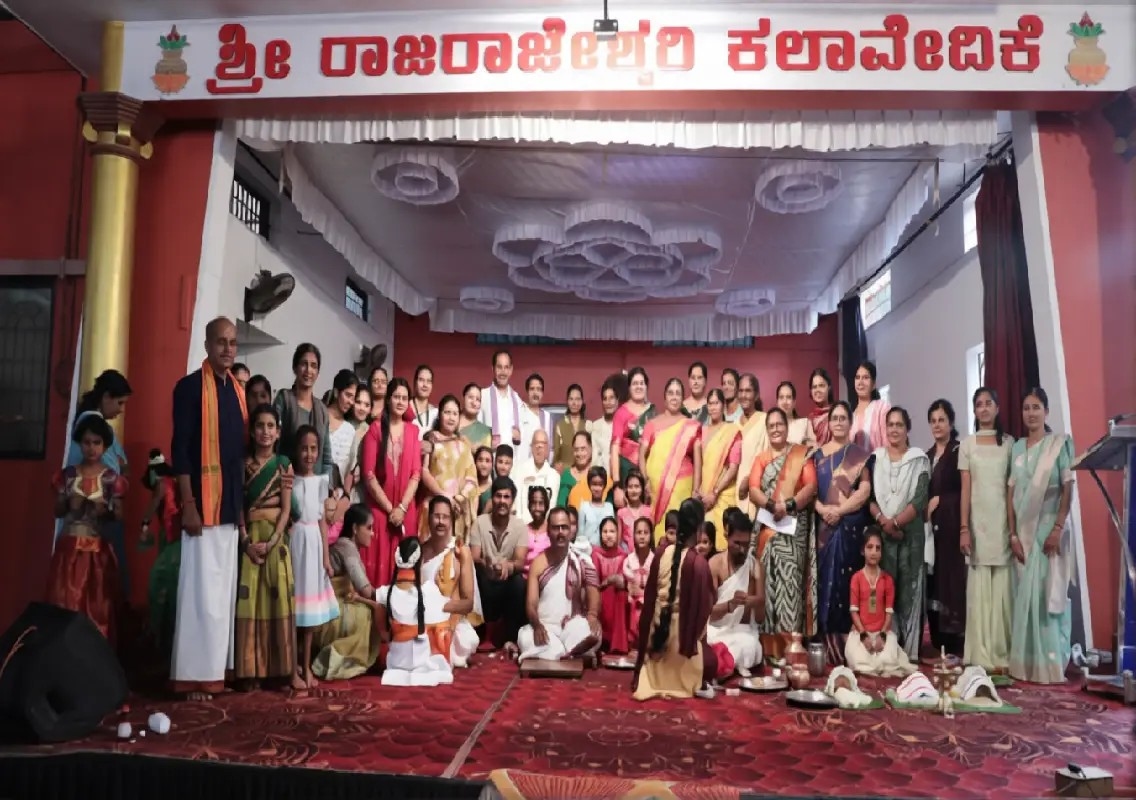


Mangaluru: The Sri Rajarajeshwari Siddhivinayaka Temple in Kuthar celebrated the Gauri festival with a unique initiative that combined traditional Hindu customs with social service, organising a mass traditional nose-piercing ceremony for girls and young women.
A total of 35 girls participated in the ceremony, with 26 girls from ashrams and economically weaker backgrounds receiving nose rings free of cost. The remaining nine participants took part using nose rings provided by their parents.
The initiative was supported by several donors and aimed at providing an opportunity for girls who wished to follow the tradition but could not afford the associated expenses.
26 girls receive nose rings free of cost
With financial and material support from donors, 26 nose rings were collected and distributed free of charge to deserving girls. The initiative enabled girls from financially disadvantaged backgrounds to participate in the traditional ceremony along with other participants.
Nine other girls who attended the event used nose rings brought by their parents.
Members of the Vishwakarma community, including Nagesh Acharya, Suresh Acharya, Satish Acharya and Yashodhara Acharya, conducted the nose-piercing rituals in accordance with Hindu traditions.
The ceremony was organised as part of the Gauri festival celebrations at the temple and sought to preserve a traditional practice while extending its benefits to girls who may otherwise have been unable to participate.
Sesanna and Pushpa Chowta inaugurate programme
The programme was inaugurated by Sesanna Chowta and Pushpa Chowta, parents of Dakshina Kannada MP Brijesh Chowta.
Addressing the gathering, Sesanna Chowta said nose piercing is traditionally associated with beauty and is also believed to have certain scientific benefits. He appreciated the temple management for organising a collective traditional ceremony at a time when such practices are gradually declining.
He described the initiative as a model for society and said efforts to preserve traditional practices through meaningful community programmes were commendable.
Pushpa Chowta highlighted the importance of such traditions in preserving local culture. She expressed hope that the temple would continue to serve as a guiding institution for girls by organising similar initiatives in the future.
Temple combines tradition with social service
Temple managing committee president Pavitra Kumar Gatti explained that the nose-piercing ceremony was initially conceived as an event in which parents would bring nose rings for their daughters.
However, the committee later decided to make the ceremony more inclusive by extending the opportunity to girls from financially weaker backgrounds.
Gatti said the idea took shape following a suggestion from zilla panchayat member Dhanalakshmi Gatti. The temple management subsequently worked with donors and community organisations to make nose rings available to girls who could not afford them.
The initiative received support from the parents of MP Brijesh Chowta, Vishwa Hindu Parishad leader Gopal Kuthar, Durgavahini Mahila Mandali, Varamahalakshmi Samiti Dubai and several other donors.
Gatti said the support from the donors helped turn the idea into reality and enabled the temple to conduct the ceremony on a larger and more inclusive scale.
Temple to distribute newly harvested paddy
The temple has also planned another community-oriented initiative for Ganesh Chaturthi.
According to Pavitra Kumar Gatti, newly harvested ears of paddy, locally known as tene, will be distributed to thousands of households on the occasion.
A dedicated paddy field was cultivated for this purpose, with the entire cultivation sponsored by a single donor.
The distribution of newly harvested paddy is intended to continue the traditional connection between festivals, agriculture and community life. The initiative will allow thousands of families to receive the newly harvested crop as part of the festival celebrations.
‘Platform for those who could not afford it’
Zilla panchayat member Dhanalakshmi Gatti said many girls wish to wear a traditional nose ring but are unable to do so because of financial and other constraints.
She said the ceremony provided such girls with an opportunity to participate in the tradition without the burden of purchasing a nose ring themselves.
Dhanalakshmi Gatti also spoke about the traditional belief that the brief discomfort associated with nose piercing can contribute to mental resilience. She said the experience is viewed in the traditional context as helping girls develop the strength to face challenges in life.
She thanked the temple management, trust, donors and community leaders, including Gopal Kuthar, for supporting the initiative.
She also expressed her wishes for the participating girls, hoping that they would lead prosperous lives and have many more opportunities to celebrate important milestones in the future.
Bride-to-be takes part in ceremony
The ceremony also witnessed the participation of several young women who wanted to follow the tradition in a simple and meaningful manner.
Among the participants was the young daughter of a Konaje police personnel. A bride-to-be whose wedding is scheduled to take place within a few days also participated in the ceremony.
The participation of the bride-to-be added a special significance to the event, as she chose to undergo the traditional ceremony without elaborate arrangements or pomp.
The event brought together girls and young women from different backgrounds and demonstrated how traditional religious practices can also become occasions for community participation and social support.
Temple management members attend
Several members of the temple management and organising team were present during the programme.
Temple vice president Vasu Poojary, treasurer Jagannath Salian, general secretary Pushparaj, organising secretary J K Rai, chief priest Vijaya Navada, Dinesh Gatti, Madhava Naik and Ramakrishna Babbukatte attended the ceremony.
The mass nose-piercing programme at the Sri Rajarajeshwari Siddhivinayaka Temple thus combined the celebration of the Gauri festival with an effort to preserve a traditional practice and make it accessible to girls from financially weaker sections.
By providing free nose rings to 26 girls and bringing together participants from different backgrounds, the initiative sought to give a social dimension to the festival while keeping traditional customs at its centre.