







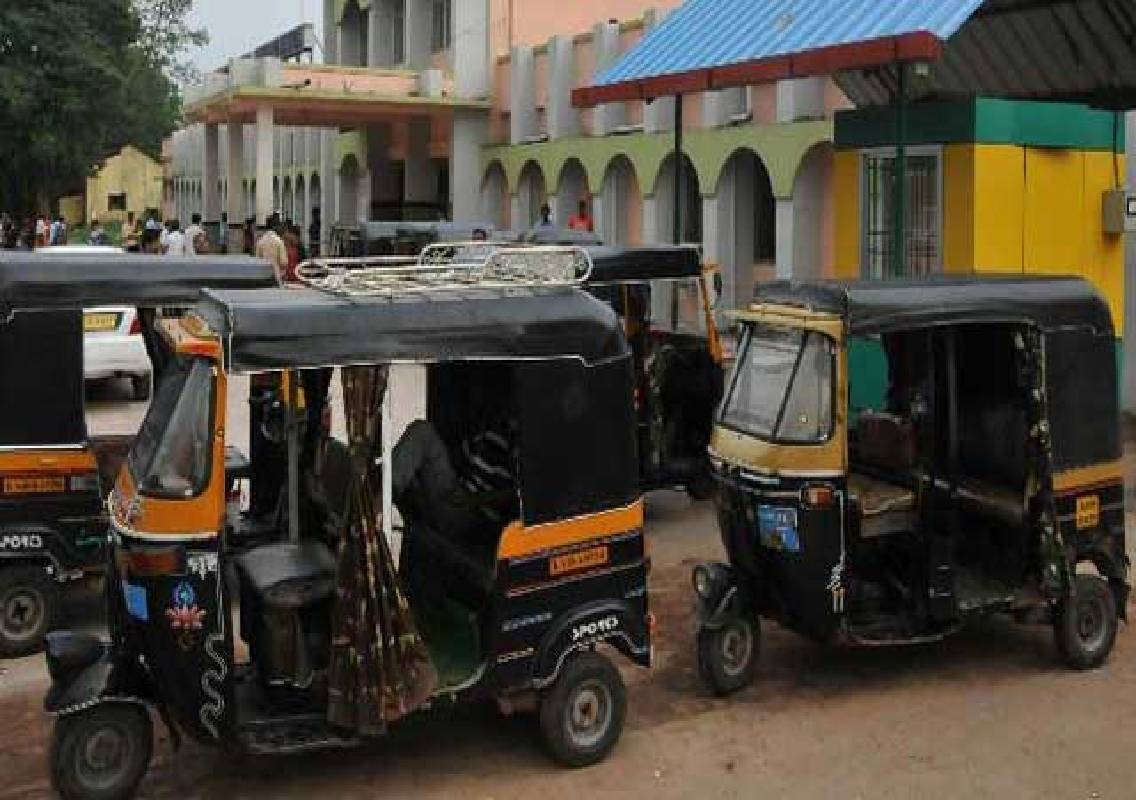


Mangaluru: Confusion over revised auto-rickshaw fares continues across Dakshina Kannada, with auto drivers’ and owners’ associations refusing to recalibrate their meters until their demand for a higher per-kilometre fare is addressed.
Deputy Commissioner and District Transport Authority chairman Darshan H.V. had issued an order in the third week of August revising auto-rickshaw fares in the district. The revised rates were scheduled to come into effect from September 1. However, even by the third week of September, the new fares had not been officially implemented, leaving passengers and drivers facing uncertainty over the amount to be paid.
According to the revised order, the minimum fare for the first 1.5 km was increased from ₹35 to ₹40, while the charge for every subsequent kilometre was raised from ₹17 to ₹20. However, many auto meters continue to display the earlier minimum fare of ₹35, resulting in disagreements between passengers and drivers.
Auto associations seek higher per-kilometre fare
Auto associations have said that while they accepted the revised minimum fare of ₹40, they are not satisfied with the proposed charge for subsequent kilometres.
An auto association leader said the associations had initially demanded a minimum fare of ₹50 for the first 1.5 km and a subsequent kilometre charge of ₹25. According to the leader, the authorities increased the minimum fare only to ₹40 and the subsequent kilometre rate from ₹17 to ₹20.
The associations have now sought a further revision of the per-kilometre fare. One association has indicated that it wants the rate increased from ₹20 to either ₹23 or ₹25.
The associations have also warned that they could consider withdrawing autos from the roads if their demands are not addressed. However, one association leader said drivers are currently charging the old fare and passengers need not be confused over the amount.
Meter recalibration remains pending
A key issue in implementing the revised fares is the recalibration of auto-rickshaw meters.
According to drivers, after the District Transport Authority issues a fare revision order, the order has to be sent to the Legal Metrology Department. The department then instructs authorised meter service agencies to update and seal the meters.
There are reportedly two such agencies in Mangaluru, located at Pandeshwar and Bunder. The cost of recalibrating an individual meter is around ₹400.
The scale of the task is significant. According to the report, Mangaluru city has around 6,850 CNG and LPG autos and 3,000 electric autos, all of which would require meter changes if the revised fare structure is implemented.
Until the meters are recalibrated and sealed, the difference between the official order and the amount displayed on the meter could continue to cause disputes between drivers and passengers.
RTO says issue may be resolved by September-end
Representatives of auto drivers and owners have reportedly approached elected representatives and transport officials seeking a solution.
An office-bearer of the Dakshina Kannada Autorickshaw Drivers and Owners Association Federation said rising prices of LPG, CNG and daily essentials had increased operating costs for drivers. The federation has therefore sought a fare revision that it believes would better reflect current expenses.
The office-bearer also said the association had decided against recalibrating meters until the subsequent-kilometre fare was revised.
The Regional Transport Office has reportedly received the grievances submitted by the associations. RTO sources said the matter would be discussed with the Deputy Commissioner and that a final order is expected by the end of September.
Associations point to earlier fare revision
There is also disagreement over what the existing fare structure should be.
One auto association representative said that during the 2022 fare revision, an order was issued fixing the charge at ₹20 for every subsequent kilometre after the first 1.5 km.
The representative said documents were available to support this position and that ₹20 is currently being charged and reflected in the meters. The association’s present demand is to increase that amount to ₹23 or ₹25.
The differing positions have added another layer to the confusion surrounding the implementation of the latest fare order.
Passengers caught between meter reading and revised demand
For passengers, the uncertainty has primarily centred on the difference between what the meter displays and what some drivers may demand.
Under the revised order, the minimum fare is supposed to be ₹40, but meters continue to show ₹35 in many cases. At the same time, drivers and associations have been seeking a further increase in the per-kilometre charge.
The situation could continue until the authorities issue a final clarification and the applicable fare is formally implemented through recalibrated and sealed meters.
A clear and uniform fare structure would allow passengers to know the applicable charge before completing a journey, while drivers would have an officially approved rate reflected on their meters.
Dakshina Kannada has 22,888 auto-rickshaws
The fare issue affects a large number of auto-rickshaw operators across Dakshina Kannada.
According to RTO data cited in the report, the district has 22,888 registered auto-rickshaws using different fuel types, including petrol, diesel, electric, LPG and CNG.
The final decision on the fare structure is therefore expected to have a direct impact on both operators and passengers across the district.
For now, auto associations have maintained their position on meter recalibration, while the RTO is expected to discuss their demands with the Deputy Commissioner. Until a final decision is issued and the meters are updated, passengers in Mangaluru and other parts of Dakshina Kannada may continue to face uncertainty over auto fares.