







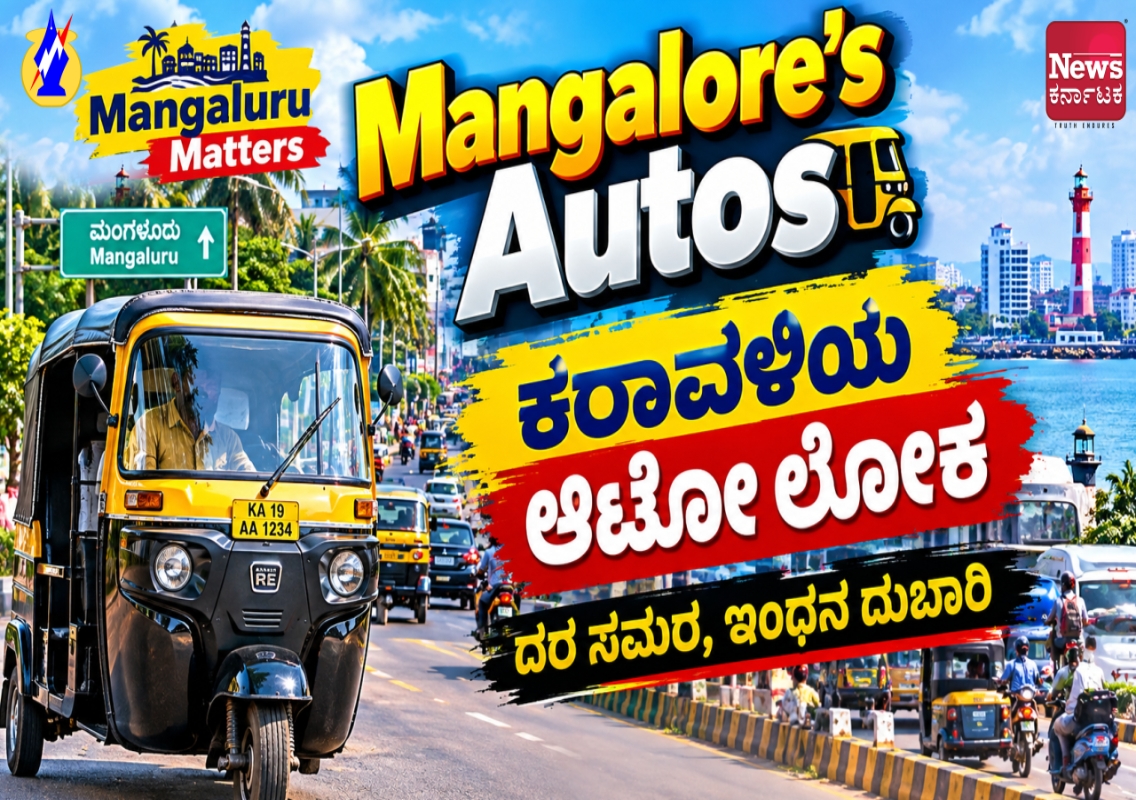


Mangaluru: Auto-rickshaw unions in Dakshina Kannada have demanded a revision of fares, seeking a minimum fare of ₹50 and a running charge of ₹30 per kilometre, while warning of a possible district-wide strike if their demands are not addressed.
The issue was discussed during a recent episode of the digital news programme News Karnataka presents Mangaluru Matters, where Dakshina Kannada District Auto Drivers and Owners Association President Bharath Kumar and General Secretary Lokesh Shetty spoke about the economic and operational challenges confronting auto-rickshaw drivers in the region.
Unions question existing fare calculation
According to the union leaders, the recent fare revision by the Regional Transport Office (RTO) was based on an old ₹17 running rate from 2020, rather than the current ₹20 rate they say should form the basis for calculating fares.
They said rising LPG and CNG prices, vehicle maintenance expenses and the increasing cost of essential commodities have significantly affected drivers’ earnings.
The unions argue that the existing fare structure is no longer sufficient to meet the rising cost of operating an auto-rickshaw and supporting a household.
E-rickshaw permits become a major concern
The union also raised concerns over the increasing number of e-rickshaws operating within Mangaluru.
There are approximately 5,900 registered traditional auto-rickshaws in the city, along with more than 1,400 e-rickshaws, according to the association.
The leaders clarified that they are not opposed to electric vehicles. Their primary concern, they said, is the alleged lack of enforcement of existing permit and zoning regulations.
They referred to a 2004 administrative arrangement under which the district was divided into Zone 1, covering the city, and Zone 2, covering rural areas. The union alleges that vehicles permitted to operate in rural areas are frequently entering city limits, increasing competition for traditional auto drivers.
According to the association, the resulting competition has forced some drivers to work for as long as 15 hours a day to earn a sustainable income.
Infrastructure adding to drivers’ difficulties
The union leaders also linked several complaints against auto drivers to shortcomings in the city’s transport infrastructure.
One of the major issues raised was the shortage of authorised auto stands. Important areas such as Balmatta and Jyothi, they said, lack adequate dedicated parking facilities for autos. This can leave drivers with little choice but to park along roadsides, potentially resulting in penalties.
Traffic congestion was another concern. The association pointed to the shortage of flyovers and inadequate enforcement of designated pedestrian crossing zones as factors contributing to congestion in the city.
Why some drivers refuse night trips
The union representatives also responded to complaints from passengers regarding drivers refusing fares at night.
They said such refusals are not always deliberate and may be linked to safety concerns, particularly when passengers request trips to poorly lit or isolated areas.
Places such as Jokatte, they cited, can present additional safety concerns for drivers operating late at night.
Memorandum submitted to authorities
The auto association has submitted a memorandum to the district administration seeking an immediate revision of fares and stricter enforcement of zonal permit regulations.
The union maintains that addressing these concerns would help create a more equitable working environment for traditional auto-rickshaw drivers while also improving the overall functioning of the city’s public transport system.
With the possibility of a district-wide strike being raised, the fare dispute and permit-related concerns are now likely to require the attention of the district administration and transport authorities.