







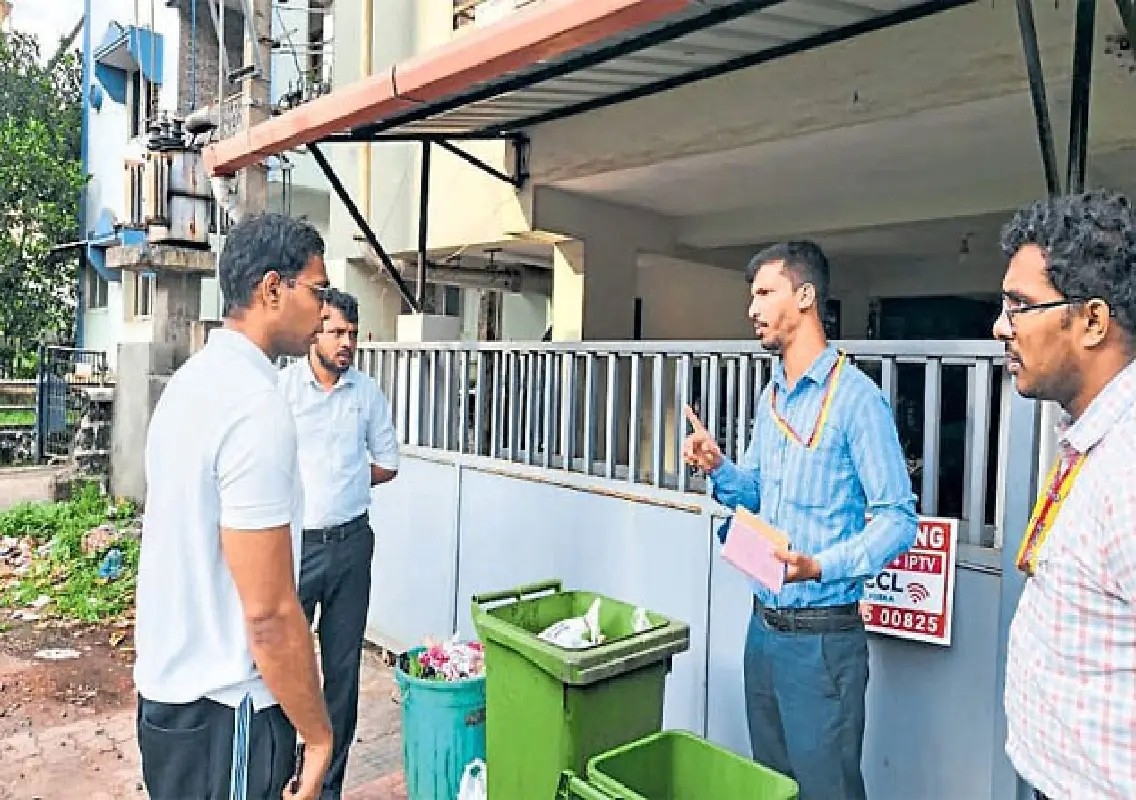


Mangaluru: The Mangaluru City Corporation (MCC) has intensified enforcement against improper waste disposal across the city, with Karnataka cadre IAS probationary officer Archit Parag Dongre leading inspections and directing officials to take action against violations.
Dongre has been appointed as the nodal officer for solid waste management within the corporation limits to strengthen the implementation and monitoring of solid waste management rules. Soon after taking charge, he began visiting different parts of the city to assess waste collection, segregation and disposal practices and issued instructions to the concerned officials.
The enforcement drive is aimed at improving compliance with waste segregation rules and reducing the number of locations where garbage is illegally dumped.
Inspections conducted across Mangaluru
Accompanied by environmental engineers and health officers, Dongre inspected several areas, including Bendoor, Court, Central Market, Harbour and Port Ward.
The team checked whether waste was being segregated before collection and whether establishments and members of the public were following prescribed disposal practices.
MCC officials have also begun imposing fines on shops, commercial establishments and individuals found violating solid waste management rules.
The civic body has said the enforcement measures are intended to improve compliance and contribute towards maintaining a cleaner Mangaluru.
The inspections also highlighted the continuing challenge of source segregation within the corporation limits.
Around 30% households still hand over mixed waste
Residents are required to segregate wet and dry waste before handing it over to the waste collection system. However, the rule is reportedly not being followed by a significant number of households.
According to the information available to the MCC, around 30% of households continue to hand over mixed waste instead of segregating it at source.
The issue creates difficulties for waste collection and processing. If mixed waste is not collected from households that fail to segregate it, there is a possibility that some residents could resort to dumping garbage in public places, potentially increasing the number of black spots across the city.
This has also led to calls for the enforcement drive to cover residential areas more extensively.
Some members of the public have demanded that fines be imposed on households that fail to separate wet and dry waste before handing it over to collection personnel.
Such enforcement, along with awareness and regular monitoring, could help improve compliance with source segregation requirements.
MCC imposes fines for violations
As part of the enforcement action, MCC officials conducted raids and inspections at various shops and other locations on September 29.
Several establishments and individuals were fined for improper disposal and failure to segregate waste.
A supermarket in Surathkal was fined Rs 500 for failing to segregate wet and dry waste. A resident of Pumpwell was also fined Rs 500 for disposing of waste at a public place in Bendoorwell.
A hotel in Surathkal was fined Rs 500 for failing to comply with wet and dry waste segregation requirements.
In Falnir, a person was fined Rs 2,000 for dumping boxes and other materials associated with the transportation of goods on a public footpath, thereby obstructing pedestrian movement.
An individual was fined Rs 1,000 for dumping waste on GHS Road.
Action taken against black-spot dumping
MCC officials also took action against people found dumping unsegregated waste at identified black spots.
Three residents of Kodikal 5th Cross were fined Rs 500 each, amounting to Rs 1,500, for illegally dumping unsegregated wet and dry waste at a black spot.
Another person was fined Rs 2,000 for illegally dumping garbage and construction waste on a public footpath near Ford Mansion.
The enforcement action indicates that the MCC is targeting not only commercial establishments but also individuals who dispose of waste in public areas.
Commercial establishments face penalties
Further action was taken against commercial establishments in Surathkal and Bejai.
A commercial establishment in Surathkal was fined Rs 1,000 for failing to segregate wet and dry waste. Another shop in the area was fined Rs 500 for handing over wet and dry waste without segregation.
In Bejai, an apartment complex was fined Rs 5,000 for failing to follow waste segregation rules. A hotel in the area was fined Rs 1,000 for handing over wet and dry waste without segregation.
A person was also fined Rs 1,000 for illegally disposing of fish waste at a black spot in Sultan Battery.
The fines are part of the MCC’s efforts to ensure that waste is segregated at source and disposed of through the prescribed system rather than being dumped in public places.
Four categories of waste
The MCC has emphasised that waste generated by households and establishments should be segregated into four broad categories.
Wet waste includes kitchen waste, vegetable and fruit peels, leaves, leftover food, meat waste, flowers and garden waste, among other biodegradable materials.
Dry waste includes plastic bottles, paper, cardboard boxes, glass bottles, metal cans, rubber and old clothes. These materials are generally handled separately for recovery, recycling or appropriate disposal.
Domestic hazardous waste includes used batteries, CFL bulbs, tube lights, expired medicines, mosquito-repellent spray cans, paint cans, old mobile phones and other electronic devices.
Sanitary waste includes used sanitary pads, baby diapers, wound dressings, blood-stained cotton and used face masks.
Proper segregation at the point of generation is important because mixing different categories of waste makes subsequent processing and safe disposal more difficult.
Enforcement to continue
The appointment of a dedicated nodal officer and the inspections across different parts of Mangaluru indicate a renewed focus on enforcing solid waste management rules within MCC limits.
While fines are being imposed for violations, the continuing issue of mixed waste from households remains an important challenge. The corporation will need to ensure that enforcement extends across residential areas while maintaining regular collection and creating awareness about segregation requirements.
The latest drive also covers several types of violations, ranging from failure to segregate household and commercial waste to dumping garbage, construction material and fish waste at public locations.
With inspections being carried out by senior officials and penalties imposed on violators, the MCC’s enforcement drive is aimed at improving compliance and reducing illegal dumping across Mangaluru.
For residents and commercial establishments, following source segregation rules and handing over different categories of waste through the designated collection system will remain essential to support the city’s waste management efforts.