







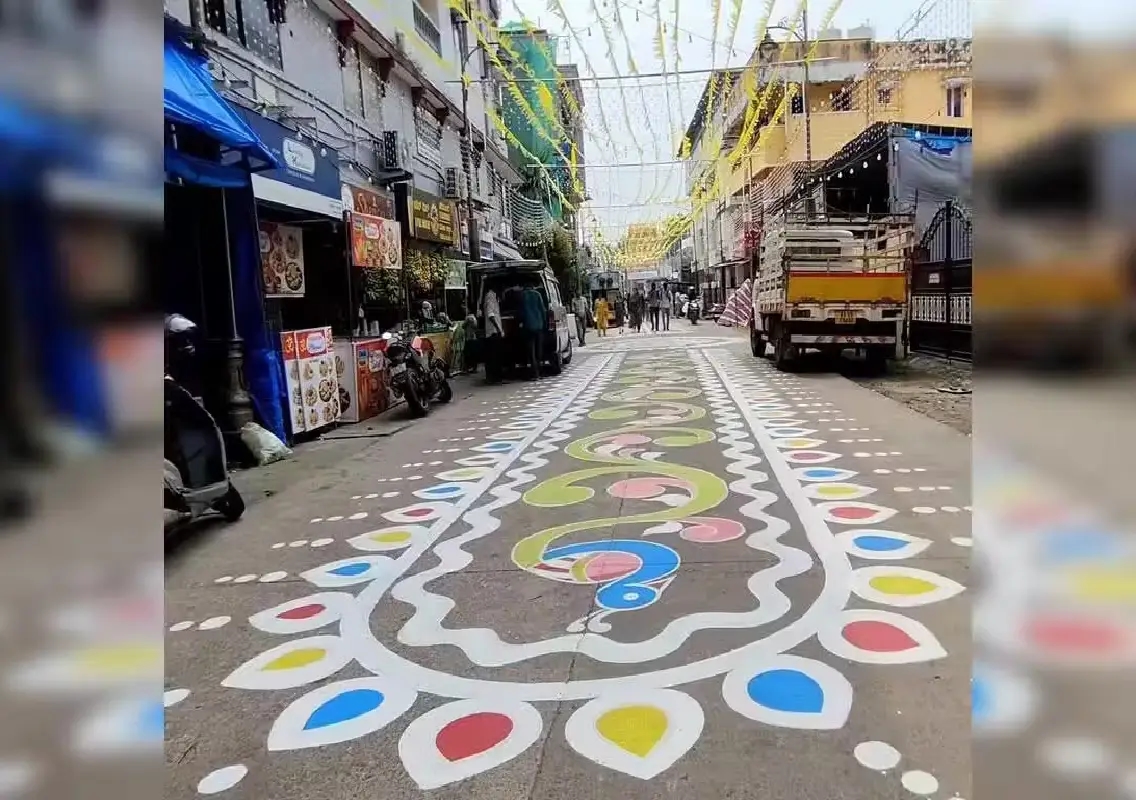


Mangaluru: The approach to Kudroli Gokarnanatheshwara Temple turned into a vibrant canvas of traditional Bengali folk art as around 15 artists and more than 150 volunteers came together to create ‘Alpana’ during Mangaluru Dasara. The initiative, organised by Pixncil Studio, brought an art form traditionally associated with auspicious occasions and religious rituals in Bengal into a public space in coastal Karnataka.
The artwork stretched from the entrance of the temple to its doors, offering visitors a colourful and distinctive visual experience. Artists and volunteers worked together to fill intricate designs with colour, transforming the temple approach into a temporary open-air art installation.
Alpana brings traditional folk art to a public space
Alpana is a traditional Bengali form of decorative floor art, generally created on the ground during religious ceremonies, festivals and other auspicious occasions. The designs are often associated with rituals and may be drawn before religious ceremonies, including the installation of an idol.
Inspired by this tradition, the artists recreated Alpana along the approach to the Kudroli temple, retaining its traditional design elements while incorporating motifs inspired by the coastal region.
Pixncil Studio founder Prithviraj said the initiative aimed to introduce Mangaluru residents to artistic traditions beyond familiar mediums such as paper and canvas.
“We wanted people to see that art need not be confined to paper and canvas. There is so much scope for art beyond these mediums, and we want to introduce people in Mangaluru to different forms of artistic expression,” he said.
The project also provided an opportunity for the public to participate directly in creating an artwork, rather than experiencing art only as spectators at galleries or exhibitions.
More than 150 volunteers join the initiative
The response to the initiative exceeded the organisers’ expectations. Around 15 artists led the project, while an estimated 130 to 150 volunteers, including people from different age groups, joined them in bringing the designs to life.
According to Prithviraj, the studio had not anticipated such a large turnout. The participation of volunteers turned the project into a collective creative effort, with people working alongside the artists to add colour to the elaborate patterns.
The team prepared the sketches on Friday morning, laying the foundation for the artwork along the temple approach. Volunteers began joining the artists at around 6 pm, and the painting continued through the night.
The work was completed between 4 am and 5 am on Saturday, creating a large-scale artwork for devotees and visitors arriving at the temple during the Dasara celebrations.
The project demonstrated how public participation can help bring traditional art forms into everyday spaces and make them accessible to a wider audience.
Coastal motifs add a local touch
While the artwork drew inspiration from Bengali Alpana, the artists introduced a regional element by incorporating fish motifs into the traditional designs.
The addition gave the artwork a coastal character, connecting the folk-art tradition with the cultural identity of Mangaluru and the surrounding region.
The idea took shape after Prithviraj discovered Alpana and explored the possibility of adapting the art form for a public installation. Padmaraj Poojary, treasurer of the Kudroli Temple governing committee, encouraged Pixncil Studio to organise the initiative and extended support during the Dasara celebrations.
The temple setting provided an opportunity to present the art form in a space associated with religious and cultural activities. Instead of being displayed within a gallery, the designs became part of the approach to one of Mangaluru’s prominent temples during its festive season.
The combination of traditional patterns, local motifs and community participation gave the project a distinctive character.
Pixncil Studio’s street-art journey since 2020
Although the Alpana project was the studio’s first initiative of this kind, Pixncil Studio has been involved in street-art projects since 2020.
Prithviraj said the team had undertaken projects at various locations in and around Mangaluru, with each initiative guided by a different concept.
The studio aims to encourage people to engage with art in public spaces while giving artists opportunities to experiment with new settings and forms of expression. Such projects can also introduce residents to artistic practices that they may not otherwise encounter in their daily lives.
According to Prithviraj, Mangaluru has considerable scope to expand its art scene, and public installations can help create greater awareness of different art forms.
“Art has advanced considerably, and people need to see the possibilities beyond pencils, paper and canvas. There is considerable scope for the art scene in Mangaluru to grow, and projects like these can help introduce people to different forms of art,” he said.
Public spaces emerge as creative platforms
The Alpana initiative at Kudroli demonstrated how a familiar public space can be transformed into a platform for artistic expression. By bringing artists and volunteers together, Pixncil Studio created an opportunity for people to experience the process of making art collectively.
The project also highlighted the possibilities of adapting artistic traditions from different parts of India while incorporating elements that reflect local culture.
As Mangaluru Dasara draws visitors to the city, initiatives of this kind add another dimension to the celebrations by combining cultural exchange, community participation and visual creativity.
For Pixncil Studio, the project represents another step in its effort to take art beyond conventional mediums and encourage a broader appreciation of creative expression across Mangaluru.