







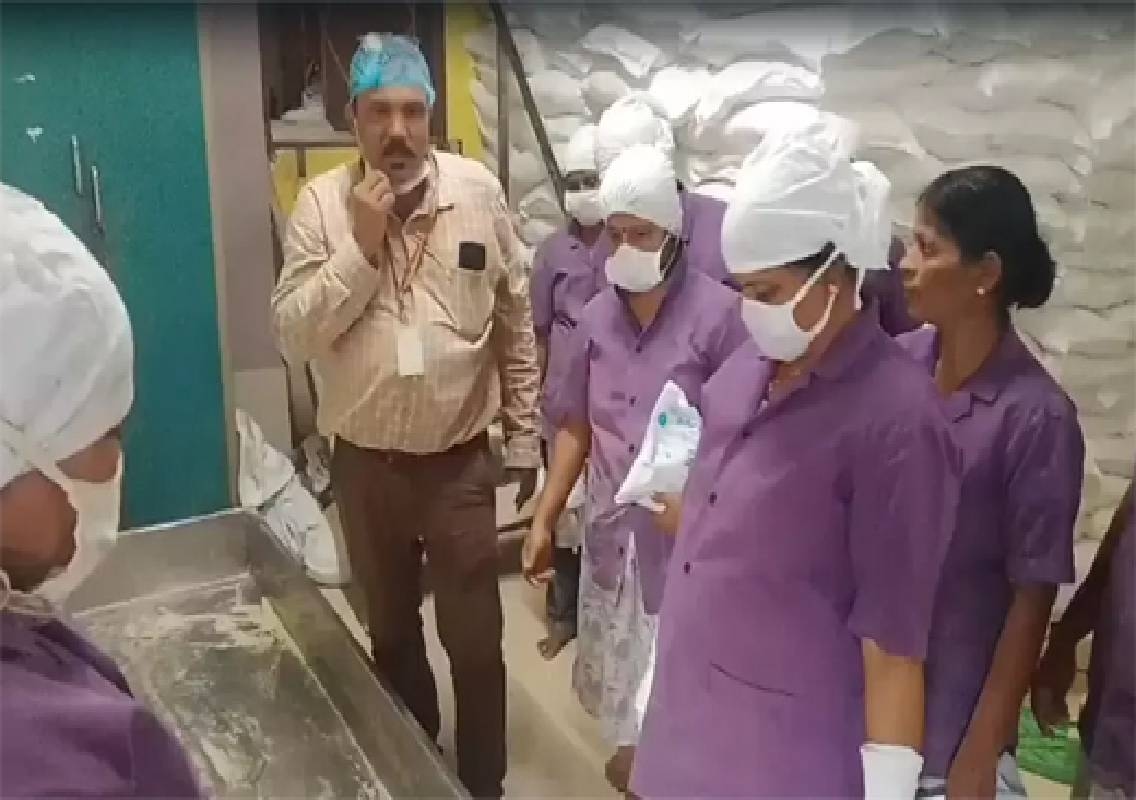


Mangaluru: Dakshina Kannada food safety officials inspected the Mangaluru Taluk and Urban Mahila Supplementary Production and Training Centre (MSPC) at Moodushedde and collected samples of supplementary nutritional food products supplied to children at Anganwadi centres.
The inspection was carried out by Dakshina Kannada District Food Safety Designated Officer Dr Praveen Kumar CH following directions issued during the second quarterly Karnataka Development Programme (KDP) meeting chaired by Health Minister U.T. Khader.
Officials examined the preparation and handling of products including Pushti and millet laddu mix, which are supplied as supplementary nutrition to children through Anganwadi centres. Samples were collected and sent to a food laboratory for testing.
Pushti, millet laddu and sambar powder samples collected
During the inspection, food safety officials collected samples of Pushti, millet laddu powder and sambar powder produced at the centre.
The samples have been sent to a food laboratory for analysis. Officials said further legal action, if required, would be taken based on the laboratory report.
The collection of samples is part of the food safety inspection process and does not by itself establish that the products are contaminated or unsafe. The final findings will depend on the laboratory analysis.
The inspection assumes importance as the products are intended for consumption by children attending Anganwadi centres, making hygiene, quality control and proper handling essential during production and packaging.
Officials check food preparation standards
The inspection focused on the way supplementary nutritional food products are prepared at the MSPC.
Dr Praveen Kumar briefed the centre’s authorities about the requirements under the Food Safety and Standards Act, 2006, and advised them to follow prescribed food safety practices.
Officials examined whether the preparation process and handling of the nutritional products met the required hygiene and quality standards.
The centre prepares supplementary food products that are distributed to children through Anganwadi centres. Maintaining proper standards during production is therefore important to ensure that the food reaches beneficiaries safely.
The inspection also provided an opportunity for officials to point out areas where the centre needs to strengthen its production and packaging practices.
Packaging machinery to be introduced
Food safety officials directed the centre to take steps towards introducing machinery for packing the food products.
The move is intended to improve the packaging process and ensure that required information can be printed clearly and consistently on the packets.
A letter will also be sent to the Deputy Director of the Women and Child Development Department regarding further action.
The coordination between the food safety and Women and Child Development departments is expected to help address the requirements identified during the inspection.
Centre told to use food-grade plastic
The officials instructed the MSPC to use good-quality, food-grade plastic for packaging the nutritional products.
They also directed the centre to ensure that mandatory information is clearly printed on the packages.
This includes the manufacturing date, expiry date and batch number. Appropriate equipment should be used to print the details in accordance with food safety regulations.
Proper labelling is important for products distributed through public nutrition programmes as it allows authorities to identify individual batches and track products if any quality-related issue is subsequently reported.
Inspection follows KDP meeting directions
The inspection follows directions issued at the second quarterly KDP meeting in Dakshina Kannada.
The meeting was chaired by Health Minister U.T. Khader, after which the food safety department inspected the MSPC located within the Moodushedde Gram Panchayat limits.
The action reflects the role of district-level food safety officials in monitoring food preparation facilities and checking products intended for public nutrition programmes.
The inspection also brings attention to the need for regular monitoring of supplementary food prepared for children, particularly with regard to hygiene, packaging and traceability.
Laboratory report to determine further action
The samples collected from the MSPC have now been sent to a food laboratory.
The laboratory report will determine whether the samples meet the prescribed food safety and quality standards. Officials have indicated that further legal action will be considered based on the findings.
Until the test results are available, there is no basis to conclude that the sampled Pushti, millet laddu powder or sambar powder failed food safety standards.
Meanwhile, the centre has been instructed to strengthen its packaging arrangements and comply with labelling requirements.
The inspection has placed emphasis on preventive food safety measures at the production centre, particularly because the products are distributed to children through Anganwadi centres.
With the laboratory analysis pending, authorities are expected to review the findings and take any necessary action based on the results.